Author: Robbie McAllister

  • Tykes in Flight: Social Mobility and Falconry in Kes (1969)

    Tykes in Flight: Social Mobility and Falconry in Kes (1969)

    The recent release of H is for Hawk (2025) has encouraged me to revisit Ken Loach’s Kes (1969), an extraordinarily empathetic production that needs little introduction. As well as helping to cement British social realism as one of the country’s most significant cultural movements, Loach’s body of work provides UK cinema with a degree of conscience, articulated through the exploration of debates such as immigration, colonialism, poverty, workers’ rights, and social justice. As the director’s second feature film, Kes arguably remains one of his finest calls to compassion, an unflinching, yet tender and poetic exploration of a young Yorkshire lad who finds fleeting fulfilment in the art of falconry.

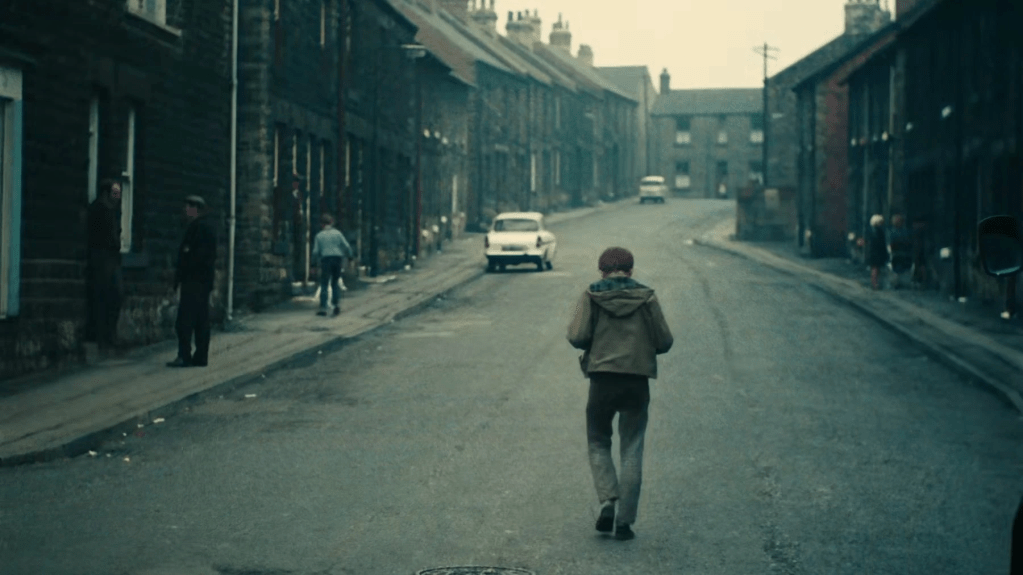
    The boy himself is Billy Casper, convincingly played by 14-year-old David Bradley. Billy suffers physical and mental abuse at both school and home, and, despite his distress at the prospect of working down the pits, there seems to be little opportunity for him to break free of the exploitative grind that determines his present and will surely govern his future. Frustrated, alone and with no emotional support, he resorts to petty criminal acts to escape the tedium of life in the amalgam of mining communities surrounding Barnsley, South Yorkshire, that the film is set and shot within.

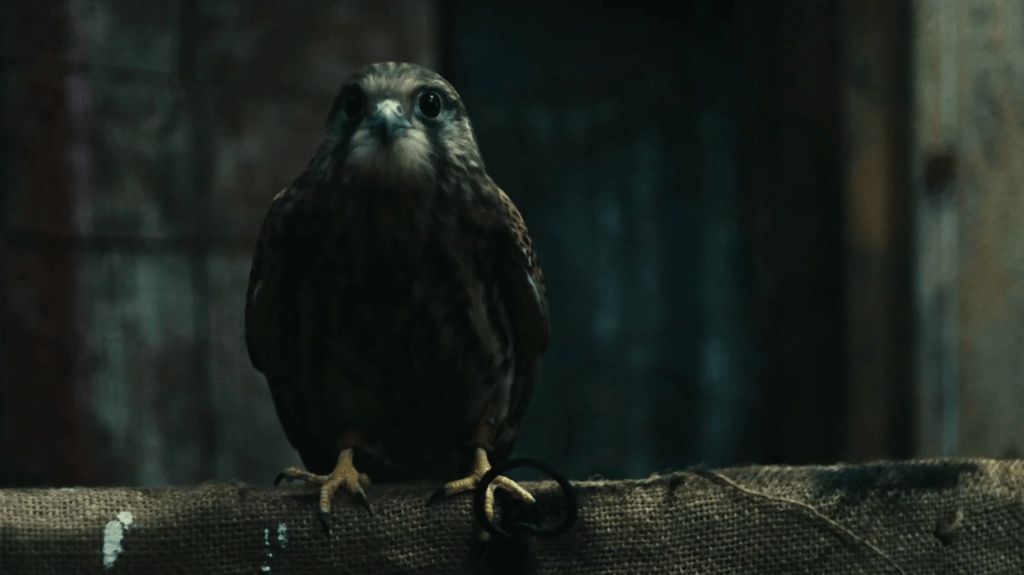
    Image: Kes, United Artists, 1969.

    Kes’ social significance has been well-documented and covered by an endless array of critics, authors, and film historians. As Jacob Leigh highlights in the loftily-titled The Cinema of Ken Loach: Art in the Service of the People, ‘Kes protests against an educational system which fails to recognise individual talent, and it suggests that this is a consequence of a capitalist society which demands a steady supply of unskilled manual labour’ (Leigh 2002: 64). In this article, I’ll be engaging with discussions that explore how these themes are expressed through a key icon of the film’s cultural authority and relevance: the eponymous avine himself.

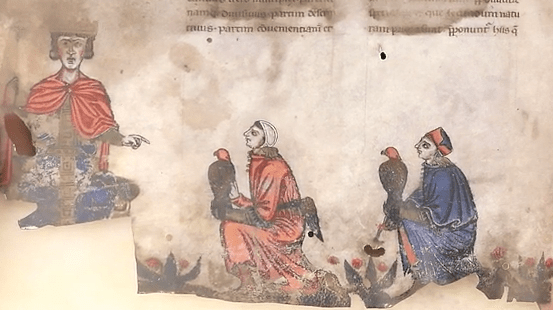
    Kes’ use of falconry subverts and develops perceptions of class and social status that can be traced through centuries of avicultures that have spread around the world. When UNESCO recognised the practice as an Intangible Cultural Heritage of Humanity in 2010, it did so in recognition of the indelible ties that link birds of prey to various cultures’ antiquities, spanning thousands of years across several continents. For the Bedouin peoples of the Middle East and North Africa, raptors were integrated into all strata of their nomadic life, signposting discipline, heritage, and identity, as well as providing a practical means of subsistence hunting (Wakefield 2012: 280). In Medieval Europe, their purpose was more recreational, but nevertheless still signalled social position.

    Image: De Arte Venandi Cum Avibus (The Art of Hunting with Birds), 1240s.

    Much of this history is foreshadowed in the name of the book that Kes adapts, A Kestrel for a Knave (1968), by Barry Hines. Hines’ novel will be familiar to generations of Brits who read his work on their GCSE English syllabus, and was based on the escapades of his own brother, Richard, who, after being inspired by T. H. White’s The Goshawk (1951), had trained a kestrel himself while growing up in Hoyland Common, South Yorkshire.

    Hines’ title was borrowed from The Book of Saint Albans (1486), otherwise known as The Book of Hawking, Hunting, and Blasing of Arms, which provides a hierarchy of raptors based on social positioning, assigning those on the lowest rung, the knave or servant, the small Eurasian kestrel (Berners 1486 [1881]). The art of falconry, then, reflects recognition of the social restrictions that limit Billy’s horizons, but also provides him with the tools that, for a time, allows him to defy them.

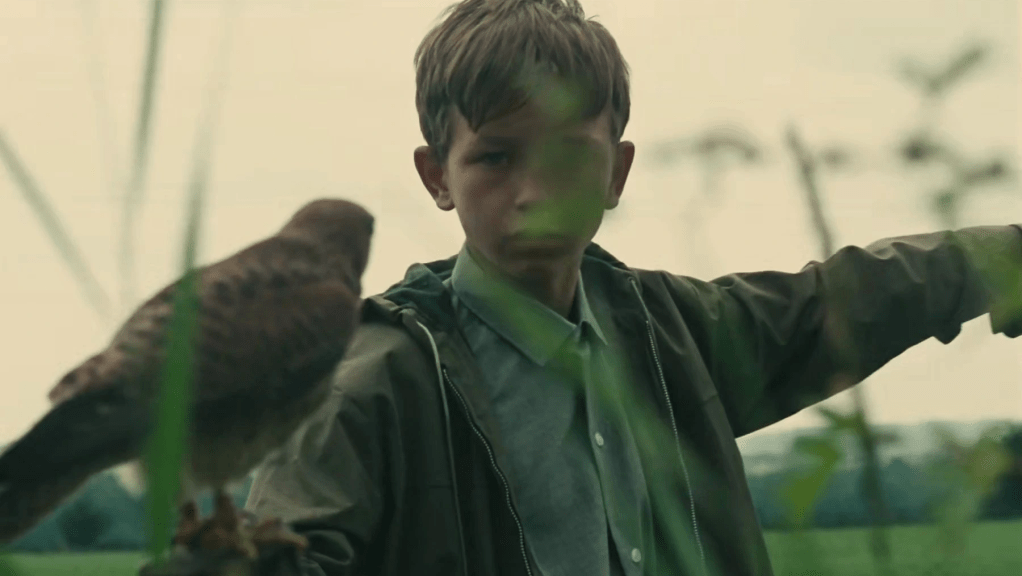
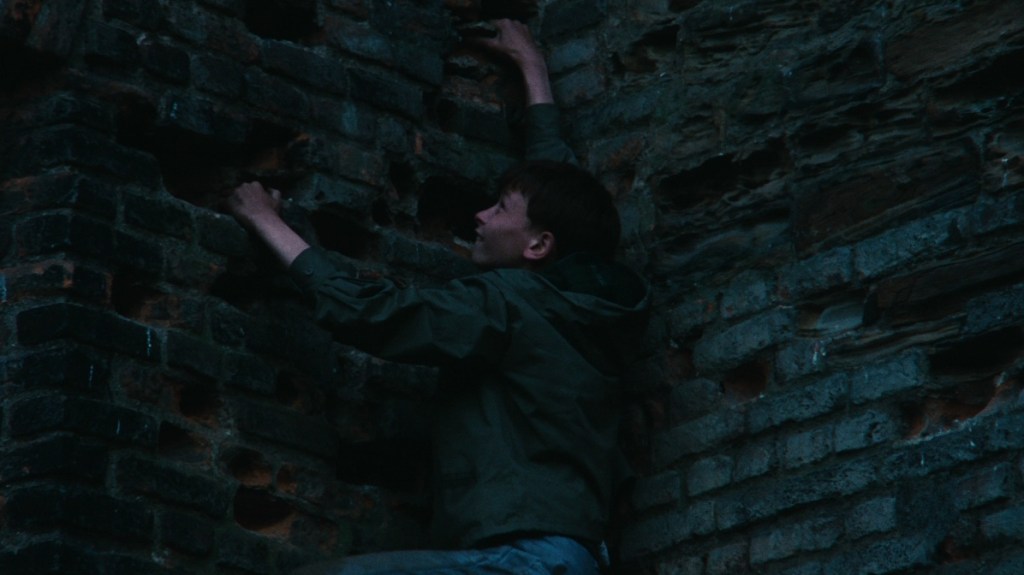
    For Billy, training Kes affords him a freedom and autonomy that he drastically lacks both at home and school. The cunning that he demonstrates as a troublemaker, filching milk and eggs from carts, is granted a productive outlet and he is finally able to engage with a practical and intellectual challenge that stimulates him. It is his own curiosity that draws Billy to the kestrel’s nest in the ruins of Tankersley Old Hall, and he mimics the actions of his real-world counterpart, Richard Hines, by furtively trespassing under the cover of darkness and stealing a nestling from its shelter in the stonework (Hines 2016: 165).

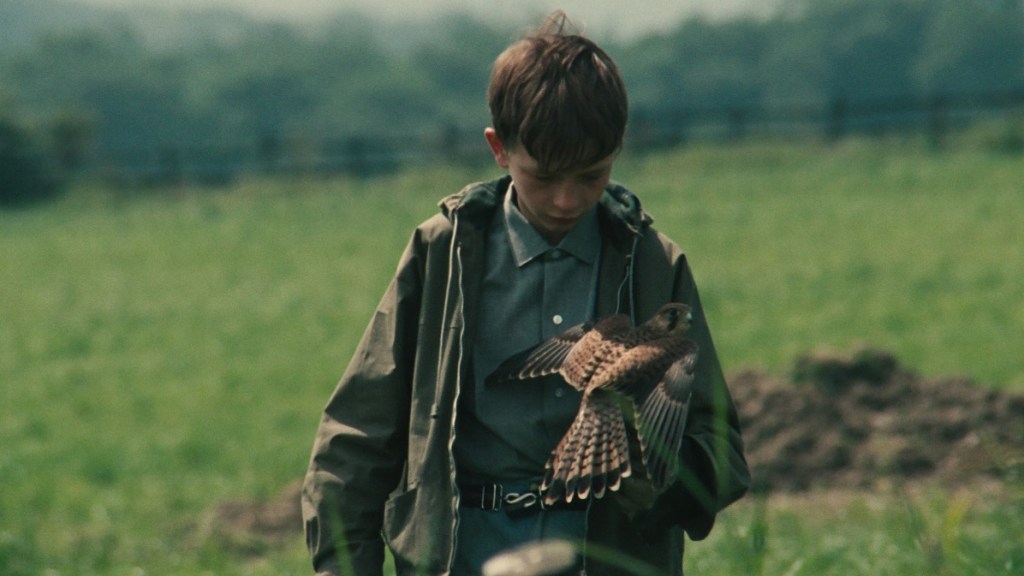
    Image: Kes, United Artists, 1969.

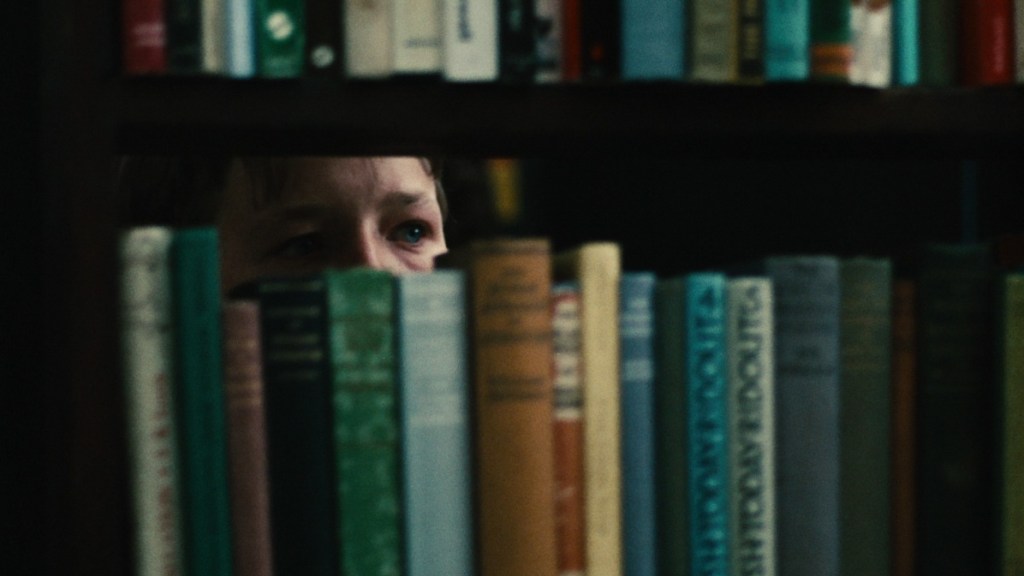
    Blocked at almost every turn by authority, Billy’s attempt to acquire both knowledge and resources are systemically restricted. With no assistance, he has to get by on his own initiative and intuition to begin training the bird. He is denied membership to his library due to his dirty hands and the lack of authorisation from a parent, and, with no money, Billy resorts to stealing a book on falcons from a second-hand shop. His elder brother, Jud, Freddie Fletcher, mocks him and treats it with disdain: ‘you must be crackers,’ he says, ‘I could understand if it were money, but chuff me, not a book!’

    Billy’s ability to engage in the art of falconry is not only a sign of his maturity and growth; it is the product of a Promethean act of rebellion against an educational system that is failing him on every conceivable level. Theft remains the boy’s only recourse. Whether it be the removal of Kes from his nest or the pilfering of a book, everything that Billy holds dear must be self-gained.

    Simon Golding associates this misfortune with the tripartite system that, throughout mid-twentieth-century Britain, ensured that pupils were segregated based on their performance in their examinations at the ages of eleven to twelve. ‘Billy Casper,’ he writes, ‘was a victim of the 11-plus. A government directive that turned out, who passed the exam, prospective white-collar workers, fresh from grammar schools, into jobs that were safe and well paid. The failures, housed in secondary modern schools, could only look forward to unskilled manual labour or the dangers of the coal face’ (2014: ii).

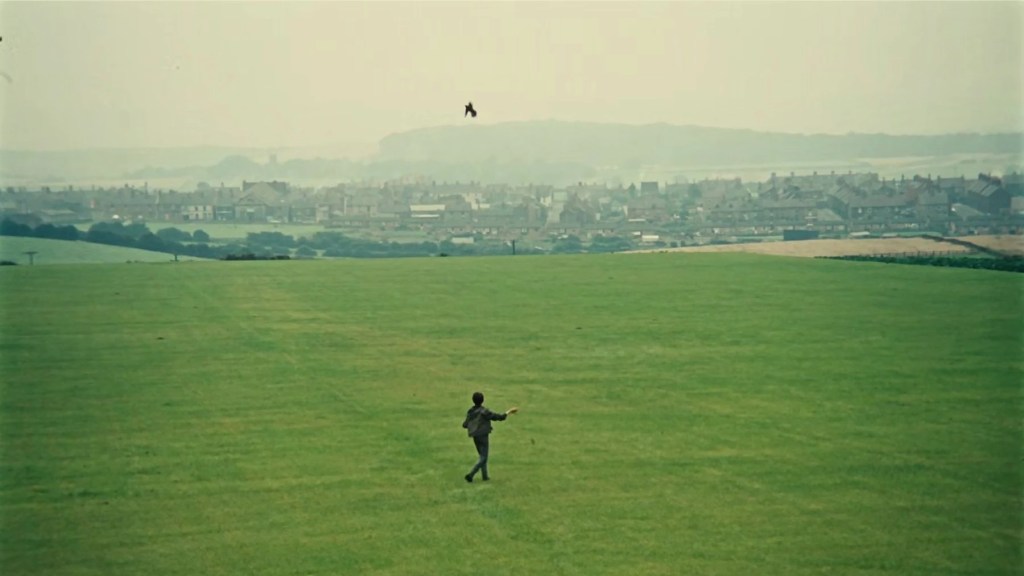
    Image: Kes, United Artists, 1969.

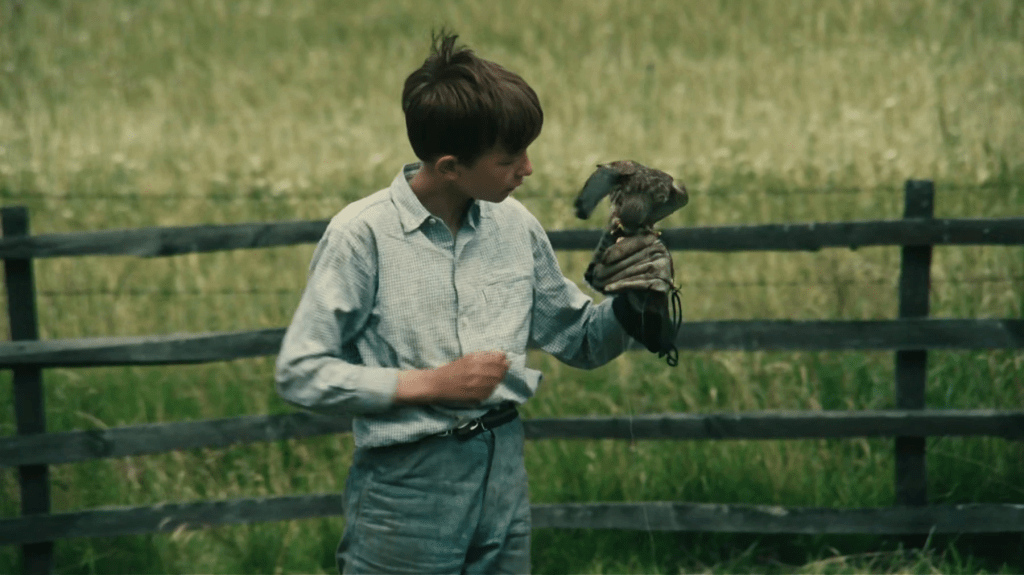
    If Billy’s acquisition of Kes and his book on falconry are the product of his own tenacity and resourcefulness, then his eventual skills reflect his patience and competencies. Training a wild bird is no small feat, and little by little, we watch as Billy learns to leash his bird and guide it through the air using his lure. Karl-Heinz Gersmann and Oliver Grimm argue that, while our fascination with hawks and falcons may have been born from an envious fascination with their ability to glide and kite through the air, stooping down suddenly in pursuit of their prey, it is ultimately the patience required to handle and train them that underlines their significance as cultural symbols. ‘In the history of domestication, birds of prey hold a special position,’ they write, ‘strictly regarded, they are not domesticated; they can only be trained to grow accustomed to the presence of humans, which is time-consuming and calls for patience’ (2018: 19).

    This patience, for many cultures, becomes emblematic of both wisdom and effective leadership, meaning that to properly train a falcon walks hand in hand with the qualities required to be an adept ruler. Kes, therefore, helps to elevate Billy’s sense of self-worth and gives him an opportunity to prove his mettle. Writing for Sight & Sound, Isabel Stevens marvels that Loach had never considered the symbolic meaning of the kestrel itself, but argues that it is impossible not to, with hindsight, interpret the bird as representative of stymied potential. In opposition to the fact that ‘the fate of many working-class boys like Billy lies underground in one of Barnsley’s collieries,’  she argues that Kes demonstrates ‘mastery of the sky, soaring and swooping high above’ (2021).

    Image: Kes, United Artists, 1969.

    Significantly, Billy’s skill in falconry not only affords him self-earned agency, but also, to his great surprise, gains him a degree of dignity and respect that he has never received before. One of his teachers, Mr. Farthing, Colin Welland, is impressed enough to watch him train Kes after school, remarking ‘Well done, Casper. The most exciting thing I’ve ever seen in my life. Great!’ The boy is even encouraged to develop the confidence to talk with authority about a subject of which he now has specialist knowledge, standing in front of his class, answering questions from his curious schoolmates, and explaining equipment such as jesses and a creance.

    As well as affording Billy his own autonomy and pride, the young boy’s respect for his kestrel is undeniable. He is particularly affronted by the suggestion that it might be considered a domesticated pet. ‘Is it heck tame! Hawks can’t be tamed,’ he explains enthusiastically, ‘they’re manned. It’s wild and it’s fierce and it’s not bothered about anybody. Not bothered about me, right. That’s what makes it great.’

    In Kes, Billy has discovered a creature worthy of the adoration that is denied to him at home. In counterpoint to Jud’s domineering bullying and his mother’s exhausted indifference, the kestrel’s wild nature acts as preferable source of emotional support and companionship. Sean Nixon notes in Passions for Birds: Science, Sentiment and Sport (2022), that Billy thrills ‘at being connected to its more-than-human world’ and contends that while the boy ‘identifies with the independence and wildness and violence of the kestrel’s life, he does not want to dominate it and own it in any proprietorial sense’ (185).

    Image: Kes, United Artists, 1969.

    Kes’ majestic characteristics transfer to the textual qualities of Loach’s film as well. His flights provide both Billy and his audience respite from the kitchen-sink aesthetic so often associated with British social realism. There can be no denying the natural beauty surrounding the villages of South Yorkshire, not yet excavated by the coal fields that Billy’s brother toils within. The sight of boy and kestrel training in the neighbouring countryside, captured by cinematographer Chris Menges, provides the film a serenity and grace that is far removed from the hubbub of Billy’s domestic and school life.

    Mr. Farthing immediately notices a sense of awe and sanctity when watching the bird in flight. ‘It’s as if they’re flying in a pocket of silence,’ he says while Billy houses Kes in his mews, ‘have you noticed how quietly we’re speaking? As if we’re frightened to raise our voices, a bit like shouting in church.’ Spatially and audibly, the world seems to slow down when Billy flies his kestrel, accompanied by the lilting tones of a sole flute, composed for the film by John Cameron.

    These are sublime moments captured in a movement of realist filmmaking most familiarly represented through that of gritty miserabilism. Of his own research into the film, David Forrest states that Kes ‘shows us that places like Barnsley – often overlooked and maligned in mainstream culture – are sites of humour, creativity, beauty, and potential. Far from being pessimistic, Kes points to a hopeful way of imagining Britain as formed from the unique cultural contributions of its regions, towns, and cities’ (Barton 2024).

    Image: Kes, United Artists, 1969.

    The virtues to be found in the tale of Billy and Kes had not gone unnoticed. The Walt Disney Company had expressed interest in adapting Hines’ novel, with the condition that Kes survive and Billy be provided a happy ending (Stevens 2021). Loach’s Kes might possess idyllic moments but, like the young boy’s attitude towards his bird, is certainly not sentimental and ultimately concludes, like the book, in tragedy. Jud, angry that his brother didn’t place a bet as he was instructed, kills Kes in callous retribution. For Jud, the kestrel’s death is rightful recompense for the loss of winnings that equated to a week’s work he could have avoided down the pits. For Billy, the loss is catastrophic and he responds in impotent fury. The film’s final moments see the boy tenderly stroking Kes’ feathers, before digging a makeshift grave and burying him.

    As for the fate of the real animals used during filming, Richard Hines, acting as technical adviser, had caught and trained three kestrels to be used during filming, taking them from their nests at Tankersley Old Hall Farm (Hines 2016: 164). David Bradley would remember spending numerous days at the Hineses’ house in Hoyland, steadily learning to work with the birds that had been named Freeman, Hardy and Willis, after the shoe-store chain. ‘Freeman is the kestrel that flies fairly low to ground, whereas Hardy flies from a fairly high vantage point and he would swoop down at me,’ Bradley would explain decades later, ‘Willis, unfortunately, was completely neurotic and psychotic and we couldn’t use him’ (Loach et al. 1999).

    Barry Hines would describe the process as being complex and painstaking: ‘It’s not like working with a trained dog. A kestrel has to be the right weight,’ he would explain, ‘they only fly if they’re hungry so we would weigh them before a scene and if they were too heavy they had to wait to shoot the scene’ (ibid.). In a bid to heighten Bradley’s emotions before shooting the film’s conclusion, Loach and his team informed the boy that they had needed to kill one of the kestrels to use on screen. ‘I was really miffed when it came to do that sequence,’ the actor recalled, ‘it was quite upsetting’ (ibid.). The filmmakers would assure Bradley after filming that the body used had been sourced from a bird that had died from natural causes, with Freeman, Hardy and Willis being hacked back to the wild when they were no longer needed (Stevens 2021).

    Image: Kes, United Artists, 1969.

    Kes’ arrival on screen coincided with a renewed public interest in aviculture, with Rachel Carson’s Silent Spring (1962) and J. A. Baker’s The Peregrine (1967) both gaining success as natural science books in the years before its release. This public interest was timely and vital due to the fact that kestrel numbers, alongside many species of wild birds, were experiencing a steep decline. Use of organochlorine pesticides had devastated their population after the Second World War, while ever-intensifying methods of farming made a similarly destructive impact on their habitats throughout the 1970s (UK Gov 2025).

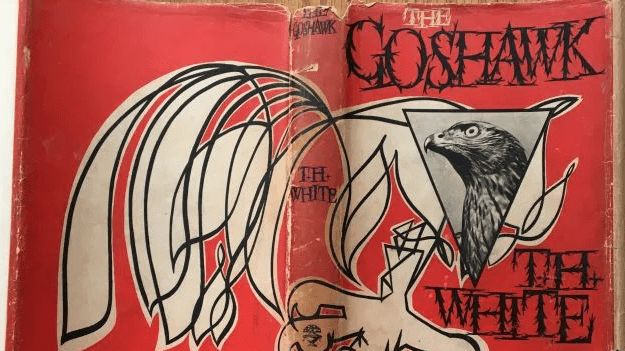
    The profound influence of T. H. White’s evocative writing on Richard Hines, passed in turn onto Billy Casper, has proved similarly long lived. It has, however, been significantly reframed since its publication. Helen Macdonald, author of H is for Hawk (2014) is plain in her admiration for White’s prose, but distances herself from his falconry techniques which, she argues, expressed far more of his relationship to himself and his repressed sexuality that it did the needs of his goshawk: ‘He couldn’t be himself,’ she states, ‘so he wanted to associate with the hawk because it was all the things he wanted to be – powerful, sadistic’ (Barkham 2014). Indeed, White would describe depriving the creature of rest, ensuring it was exposed to extreme stress, and, in moments of anger, wishing to inflict upon it the ‘extreme torture it deserved’ (White 1951: 115). The depictions of animal care in Kes, and for that matter, H is for Hawk, are, thankfully, more ethically robust than White’s. Both are tender without overly anthropomorphising their subjects. The greatest unease to those outside of falconry circles is undoubtedly the visceral manner with which the training of these captive animals requires the hunting of those that remain in the wild.

    Image: The Goshawk, Jonathan Cape, 1951.

    The practice of wild take, that undertaken by both Richard Hines and Billy to acquire their kestrels, has also significantly changed over the last half century. A 2025 report by Natural England observed that the state receives almost no requests for licences to retrieve birds of prey from their nests in the United Kingdom, and that, instead, falconers now entirely rely on captive breeding to obtain the creatures (Natural England 2025). One interviewee stated that when they were a child ‘everybody went out and collected eggs and robbed nests. Kids don’t do that anymore. They identify nests or they jump on their webcam and watch a peregrine breeding its young and it’s enough, and that’s great’ (ibid).

    The Wild Animal Welfare Committee welcomed the news that the review recommended the cessation of such licenses, stating firmly that ‘wild caught individuals are likely to experience an increased likelihood of motivational frustration, a high likelihood of negative affective states (such as fear) and behaviours consistent with experiencing stress in captivity’ (Wild Animal Welfare Committee 2025).

    Image: ITV News, 2020.

    Even with the end of licensed wild take, current conservation laws are consistently flouted in ways that the British government is struggling to police. A 2025 report by The Guardian observed that UK-based breeding facilities of falcons had grown from approximately 27 in the 1980s to a current tally of 160, all of which have ties to Middle Eastern markets that are driving an underground industry of illegal capture and smuggling of wild birds (Weston 2026).

    Half of these facilities are considered non-compliant with contemporary UK legislation, driving an international trade within which a well-bred falcon can cost upwards of tens of thousands of pounds. ‘This Bedouin tradition has evolved into a spectacle of wealth and prestige to meet the tastes of the modern Gulf elite,’ Phoebe Weston reports, ‘the cold climate of northern Europe is considered the ideal for creating tough, fast birds, and British-bred birds from established lines carry additional prestige’ (ibid).

    Image: The Guardian (photo credit: ARIJ).

    The mistreatment of birds of prey is not isolated to illegal acts of capture, trade, and smuggling. The RSPB recently highlighted the widespread killing of threatened species such as golden eagles, goshawks and hen harriers that has gone almost completely unprosecuted throughout the United Kingdom (RSPB 2024). ‘In the past 15 years, only one person has been jailed,’ their report claims, ‘and of all individuals convicted of bird of prey persecution-related offences between 2009 and 2023, 75% were connected to the gamebird shooting industry’ (ibid). Conservationist Ruth Tingway’s blog, Raptor Persecution UK, acts as a harrowing, but vital, attempt to track such acts of violence, and is an essential resource for understanding the scale of human-inflicted damage upon these remarkable creatures.

    Acts of hunting, trading, and smuggling continue to have devastating consequences for species of birds that, for centuries, have been utilised by humanity as icons of nobility and dignity. Their training and use for sport encourage the same discussions that are necessitated whenever our species chooses to capture or domesticate other animals for our own interests. Our love of raptors has ensured that they are ferried around the country for handling experiences, kept captive in bird display centres, and tethered for the entertainment of the public. It is significant that Kes’ socialist power, as an exploration of hierarchies that restrict and curtail, should be articulated through the bond between a boy and his bird. Billy’s respect for Kes’ autonomy reflects the cultural contradiction that lies at the heart of our fascination with falcons and hawks. His admiration, like ours, also brings with it the discomfort found when wildness is expressed through fettered wings.

    Head Image: Kes, United Artists, 1969.

    Baker, J. A. 1967. The Peregrine, London: Collins.

    Barkham, Patrick. 2014. ‘Helen Macdonald: ‘I Ran to the Hawk Because I Was Broken and Grieving,’ The Guardian, August 1: https://www.theguardian.com/books/2014/aug/01/helen-macdonald-interview-hawk-grief.

    Barton, Sean. 2024. ‘Kes Recognised as British Classic and Landmark in World Cinema,’ University of Sheffield, May 7: https://sheffield.ac.uk/news/kes-recognised-british-classic-and-landmark-world-cinema.

    Berners, Juliana. 1486 [1881]. The Book of Saint Albans: https://archive.org/details/cu31924031031184/mode/2up.

    Carson, Rachel. 1962. Silent Spring, Boston: Houghton Mifflin.

    Forrest, David. 2024. Kes, London: Bloomsbury.

    Gersmann, Karl-Heinz & Grimm, Oliver. 2018. Raptor and Human: Falconry and Bird Symbolism Throughout the Millennia on a Global Scale, Hamburg: Wachholtz Verlag.

    Golding, Simon. 2014. Life after Kes, Clacton on Sea: Apex Publishing.

    H is for Hawk. 2025. D. Philippa Lowthorpe, UK & USA: Lionsgate.

    Hines, Barry. 1968. A Kestrel for a Knave. London: Michael Joseph.

    Hines, Richard. 2016. No Way But Gentlenesse: A Memoir of How Kes, My Kestrel, Changed My Life, London: Bloomsbury.

    Kes. 1969. D. Ken Loach, United Kingdom: United Artists.

    Leigh, Jacob. 2002. The Cinema of Ken Loach: Art in the Service of the People, London: Wallflower Press.

    Loach, Ken, Garnett, Tony, Hines, Barry, Bradley, David & Welland, Colin. 1999. ‘A Typical Reaction Was A Snigger… I Was Making A Film About the Wrong Kind of Bird,’ The Guardian, August 29: https://www.theguardian.com/film/100filmmoments/story/0,4135,77579,00.html.

    Macdonald, Helen. 2014. H is for Hawk, London: Jonathan Cape.

    Natural England. 2025. ‘Summary of Natural England’s Position on Wild Take Licensing for Falconry and Aviculture,’ gov.uk, March 6: https://www.gov.uk/government/publications/taking-birds-of-prey-from-the-wild-for-falconry-and-aviculture-outcome-of-review/summary-of-natural-englands-position-on-wild-take-licensing-for-falconry-and-aviculture.

    Nixon, Sean. 2022. Passions for Birds: Science, Sentiment and Sport, London: McGill-Queen’s University Press.

    RSPB. 2024. ‘Illegal Bird of Prey Killing Must End, Urges RSPB Birdcrime Report,’ RSPB, October 22: https://www.rspb.org.uk/media-centre/illegal-bird-of-prey-killing-must-end.

    Stevens, Isabel. 2021. ‘Kes: Big Screen Classics,’ Sight & Sound, September: https://bfidatadigipres.github.io/big%20screen%20classics/2022/08/09/kes/.

    UK Government; Department for Environment, Food & Rural Affairs. 2025. ‘Wild Bird Populations in the UK and England, 1970 to 2024,’ gov.uk, September 23: https://www.gov.uk/government/statistics/wild-bird-populations-in-the-uk/wild-bird-populations-in-the-uk-and-england-1970-to-2024.

    Wakefield, Susan. 2012. ‘Falconry as heritage in the United Arab Emirates,’ World Archaeology 44. 2: 280-290.

    Weston, Phoebe. 2026. ‘How Demand for Elite Falcons in the Middle East is Driving Illegal Trade of British Birds,’ The Guardian, January 5: https://www.theguardian.com/environment/2026/jan/05/elite-falcons-middle-east-illegal-trafficking-trade-british-birds.

    White, T. H. 1951 [2023]. The Goshawk, Alien ebooks.

    Wild Animal Welfare Committee. 2025. ‘Wild Take Licences Come to an End,’ Wild Animal Welfare Committee, March 6: https://www.wawcommittee.org/news/wild-take-licences-come-to-an-end.

  • Comic Cryptids and Eco-Sustainability in Sasquatch Sunset (2024)

    Comic Cryptids and Eco-Sustainability in Sasquatch Sunset (2024)

    I’ve always had a soft spot for cryptozoology, the pseudoscientific field of fascination with unsubstantiated creatures. Who can resist the romantic allure of the Loch Ness Monster that supposedly dwells in the Scottish Highlands, the chupacabra of Hispanic America, or Point Pleasant’s own Mothman? Cryptozoology’s marriage of ‘kryptós’ and ‘logos,’ translated directly to ‘hidden knowledge,’ reminds us that the world undoubtedly possesses secrets that have not yet been revealed. Beyond the astonishing fervour that a surprising number of conspiracy theorists continue to demonstrate, cryptozoology’s broader appeal reflects an understanding that nature still possesses the ability to surprise and delight us.  

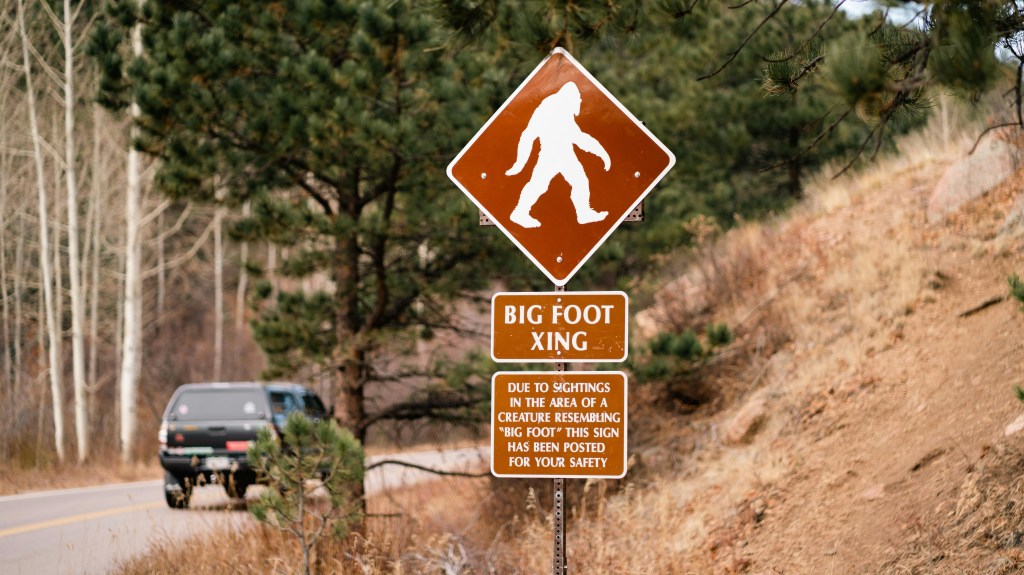
    If there is any cryptid who rivals Disney’s Mickey Mouse or Nintendo’s Mario as an immediately recognisable mascot, it is almost certainly Bigfoot, alternatively known as Sasquatch, the hairy, hulking, bipedal beast that patrols both American and Canadian folklore. As with the Himalya’s own Yeti, or Abominable Snowman, on the other side of the globe, North America’s Bigfoot demonstrates a continued fascination with ape-like and Neanderthalic humanoids that can be traced throughout all our species’ history.

    The Sasquatch has become an important emblem of North American cultural identity, with its origins rooted in the legends and folklore of the Sts’ailes, a community indigenous to Chehalis, in British Columbia, who ‘passed down songs and stories about sasq’ets, a supernatural slollicum, or shapeshifter, that protects the land and people’ (Kadane 2022). As so often occurs with indigenous mythologies, the fascination surrounding these wildmen was soon Anglicised and eventually, after several well-publicised hoaxes by North Western loggers and foresters, translated into a veritable commercial empire.

    Image: Rocky LaRock, Salish, Photo by Bill Jorgens.

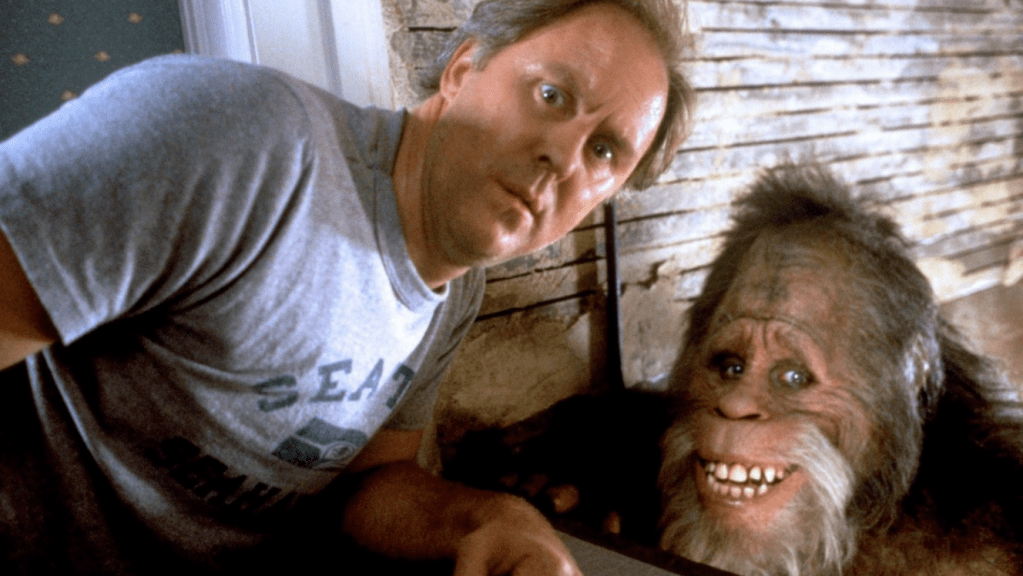
    Following a tidal-wave of media interest that reached fever pitch in the late 60s and 70s, Bigfoot has certainly found itself well-represented in film. From horror movies such as Bigfoot (1970), Night of the Demon (1980) and Abominable (2006), which depict its sightings ending in violence and carnage, to saccharine family-friendly adventures such as Cry Wilderness (1987), Bigfoot: The Unforgettable Encounter (1995) and Little Bigfoot (1997), America’s love of the hairy cryptid appears relatively boundless. It goes without saying that the Academy-Award-winning masterpiece Harry and The Hendersons (1987) deserves an article of its own for featuring John Lithgow begrudgingly learning to befriend one of the creatures after hitting it with his station wagon.

    All in all, for contemporary audiences, bigfoots and sasquatches – let’s settle on our plurals now – have come to signal a sense of instability and incompatibility in our own relationship to nature. Whether they depict the cryptid as a rampaging monster or benevolent beast, these are films that collectively draw upon the shared fears and anxieties that are produced when we feel a sense of removal from the natural order we associate with the wilderness.

    Image: Harry and the Hendersons, Universal Pictures, 1987.

    Sasquatch Sunset (2024), one of the more recent attempts to engage in this shared mythology, wears its cult credentials proudly on its furry sleeves. Directors and brothers Nathan and David Zellner had previously dabbled in bigfoot filmmaking with Sasquatch Birth Journal 2 (2010), an absurdist short that is almost entirely constructed around a single take of one of the creatures giving birth while bracing itself among the branches of a tree.

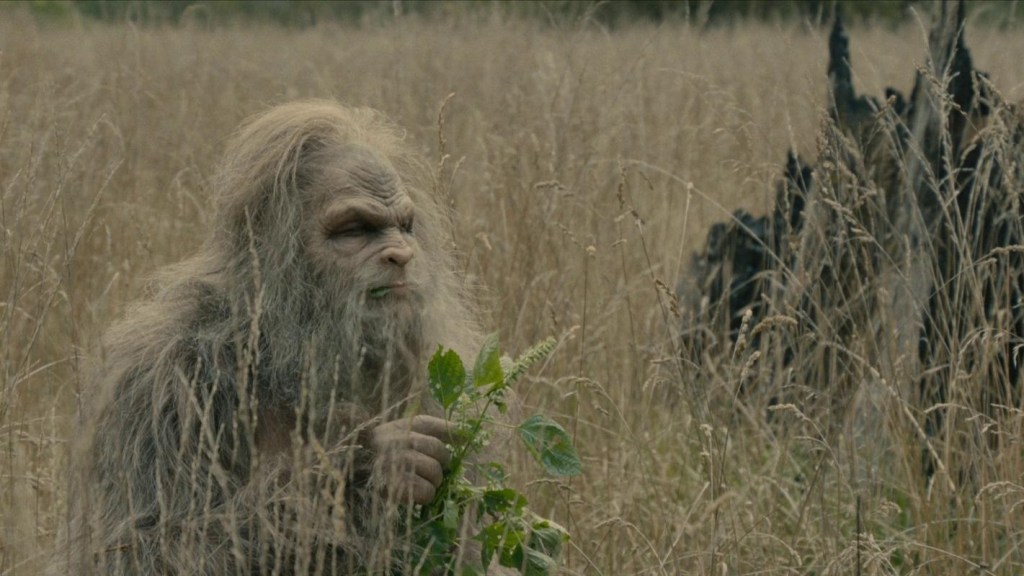
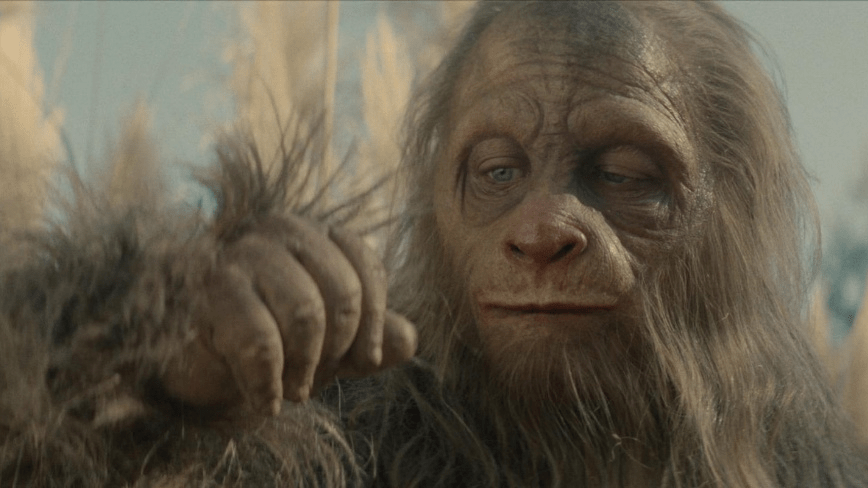
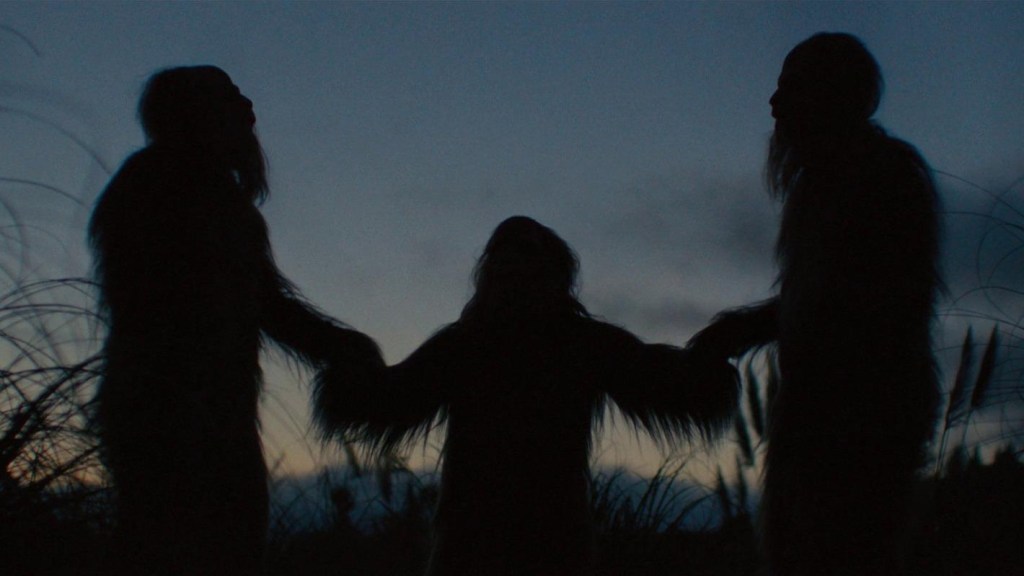
    Sasquatch Sunset maintains this singular focus by featuring no human characters or discernible dialogue. Throughout its entire theatrical running time, audiences are treated to performances of Riley Keough, Jesse Eisenberg, Christophe Zajac-Denek, and Nathan Zellner himself, elaborately costumed as a family of nomadic bigfoots who go about grunting, whooping, and huffing through the wilderness.

    Image: Sasquatch Sunset, Bleeker Street, 2024.

    The Zellners’ film relies on a strange concoction of crude scatological humour, sexual encounters, and full-frontal sasquatch nudity with an eerily beautiful depiction of the American wilderness. Life as a bigfoot is represented as comically visceral and bawdy, yet underscored by a wordless and ever-present sense of existential melancholy. If this is a film that either intrigues or repels you, you can probably already tell. Sasquatch Sunset is undeniably a passion project produced by like-minded collaborators who vibe with its tonal shifts and absurdist humour, with Eisenberg even footing some of the production budget himself when an initial financier backed out (Salisbury 2024).

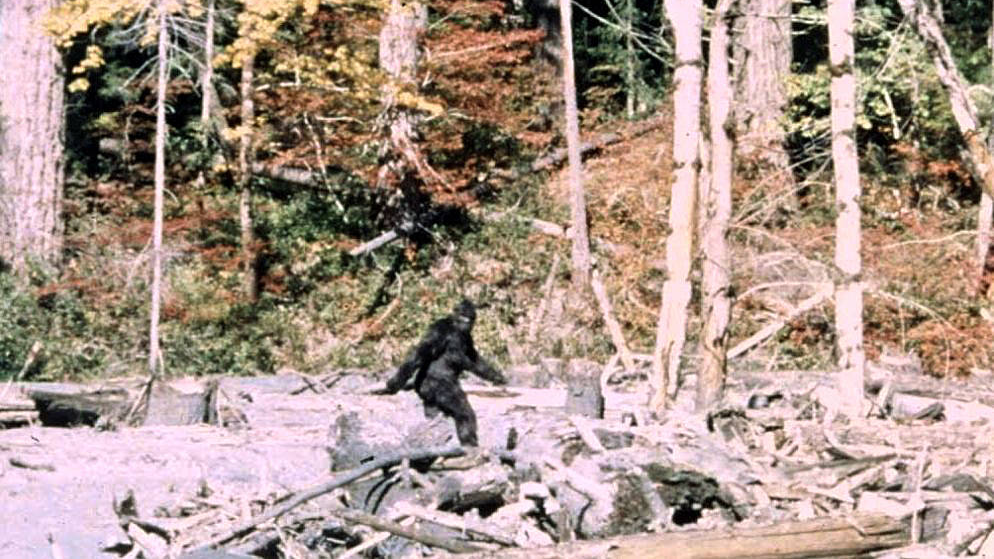
    The film’s most remarkable quality is that it is framed as a fabricated nature documentary, taking inspiration from the Patterson-Gimlin footage of 1967 that supposedly captured images of a bigfoot striding purposefully through Six Rivers National Forest. ‘It’s one of the most famous pieces of film in film history,’ David Zellner would argue, describing the fascination that he and his brother developed after watching the footage in an episode of the 1970s paranormal investigation series In Search of… hosted by Leonard Nimoy (ibid).

    Image: Roger Patterson and Robert Gimlin, 1967.

    Sasquatch Sunset might best be defined as a kind of cryptid mockumentary, playfully mashing up conventions of satire and documentary just as its subject stalks the boundaries of science and pseudoscience. While paranormal investigation series such as Finding Bigfoot (2011-2018) have helped perpetuate the creature’s myth, the Zellners’ film is presented as if it were a David-Attenborough-esque nature documentary, minus the presenter’s dulcet narration. Similarly, the film’s drama is depicted as emerging naturally from the four sasquatches as they meander around their woodlands, rather than conforming to the tightly plotted regimes of scripted filmmaking.

    Sasquatch Sunset’s ridiculous central premise, that of human performers stomping about in bigfoot costumes, satirises the seemingly unimpeachable authority that Matthew Brower argues is often falsely attributed to wildlife photography: a ‘nonintrusive, environmentally friendly activity that shows proper respect for the fragility of nature’ (2011: xiii). Our media’s representations of the natural world have, of course, always been the product of deliberate construction. Disney’sWhite Wilderness (1958), for example, grotesquely featured filmmakers carolling a group of lemmings off a cliffside to emulate mass migration, while, more recently, the BBC defended its decision to record scenes of a polar bear giving birth in a Dutch zoo for its Frozen Planet (2011) series (Burrell 2011).

    Image: White Wilderness, 1958.

    The refusal of Sasquatch Sunset’s subjects to behave in a manner that might see them appropriate for wide-spread documentation is undeniably part of their charm. Scenes in which they variously consider having sex with a hole in a log after being rebuffed by a potential mate, throw a recently birthed placenta to distract a hostile mountain lion, or embark on a hallucinatory rampage after consuming a psychoactive cocktail of berries, aren’t just silly, they are amusing precisely because they are delivered in the straight-faced and erudite delivery of the wildlife documentary. By revisiting Patterson and Gimlin by way of Attenborough, the Zellner brothers identify, as with all good mockumentaries, an appropriate target for ridicule. The sasquatches’ antics remind us that nature is, in contrast, equal parts funny, tragic, grotesque, and absurd.

    Sasquatch Sunset undermines another significant fallacy that Brower identifies, one that acts as a lynchpin of the Bigfoot myth. This is the argument that wildlife footage and photographs ‘function as a substitute for a real nature that the images themselves assert is impossible for humans to enjoy’ (2011. xiv). Brower’s claim here is that the pleasure of watching animals in the wild is often credited to the act of looking into a world that we believe we are excluded from. Just as Bigfoot’s status as a wildman emphasises our own seemingly distinct identity as modern and civilised beings, so too does the nature documentary’s erasure of signs of human observation help to reinforce the myth that our species is ultimately separated from the wildlife that surrounds us.

    This perspective is often masked under noble intentions, that of conservationism, yet belies an anthropocentric arrogance that defines much of our species’ experience. The idea that humans are different, distinct, and no longer bound to a natural order is everywhere. René Descartes famously labelled species different from our own as ‘automata,’ machine-like beings incapable of thought or reason (Brown 2018), while Aristotle and Giovanni Pico della Mirandola respectively cited humanity’s seeming rationality and self-determinism as evidence of our apparent distinctiveness (Aristotle 1925 [circa 350 BCE]: X.7, Pico della Mirandola 2016 [circa 15th c.]).

    Humanity’s innate belief in its own exceptionalism is not aided by the fact that we are the last surviving Hominina species. Our developing understanding of taxonomic threads such as Neanderthals, Denisova, Luzonesis and Floresiensis actively remind us that our direct siblings have only been extinct for a brief span of our existence. The mystique of the ‘missing link’ is a testament to the perceived gulf that can, with enough evidence, be breached. That, surely, is part of the appeal of Bigfoot; the idea that we might bump into a fellow family member were we to delve deep enough into the surrounding wilderness. We might, we imagine, not be as alone as we first assumed.

    Image: Pexels, 2021.

    Attempting to explain his movie’s ambitions beyond its gross-out humour, David Zellner would argue that he wanted to subvert the tradition of films featuring Bigfoot, as well as similar monsters and cryptids, that privilege a human perspective and point of view: ‘we really wanted to have it reversed where the humans assume that position, where they’re the mysterious alien life form basically that you’re only exposed to to a certain degree’ (qtd. in Frank 2024). As such, Sasquatch Sunset reframes its bigfoots from being the supporting and antagonistic figures most predominantly depicted in media, into full-ledged protagonists. Audiences are then invited to play at being ethologists, deciphering the nature of their relationships, reactions, and rituals entirely non-verbally.

    Watching Keough playing the sole female in the group, we gradually come to understand her resolve to keep her family together despite the hedonistic impulses of Zellner, whose territorial and aggressive personality quickly gets the better of him. The grunts and huffs of Eisenberg’s curious sasquatch teach us that he is attempting to dabble with basic arithmetic, although he struggles to make it past the number three, while Zajac-Denek’s youngster of the group carefully watches and learns from his elders’ interactions.

    Sasquatch Sunset’s positioning of its audiences amongst its hairy subjects reflects how our relationship to animals is ordered by the very acts of spectatorship and subjectivity that film-watching itself is defined by. As Murray Smith argues, character engagement is constructed through various processes of ‘recognition, alignment, and allegiance,’ or, rather, the human need to find a point of identification through which we can experience a narrative (2022: 73). The team behind the film were well-aware of the potential problems that they might encounter when dramatising a story that features a cast entirely buried beneath fur suits and thick latex prosthetics. Eisenberg enlisted the movement coach Lorin Eric Salm, whom he had worked with when playing Marcel Marceau in Resistance (2020), and the Zellners ran a ‘Sasquatch School’ to help the performers cultivate a consistency between their behaviour and mannerisms (Nemiroff 2024).

    Image: Sasquatch Sunset, Bleeker Street, 2024.

    Despite the already laborious make-up process, the decision was made to avoid using contact lenses, with David Zellner explaining that ‘we wanted the actors’ real eyes to be seen because so much information was going to be communicated through them. Especially with Riley, because she’s so expressive. She has these bright blue eyes that pop and telegraph so much info.’ (qtd. in Salisbury 2024). Zellner’s comment that it is the performer’s eyes that act as the gateway to a meaningful connection recalls popular discussions of similar opportunities to develop human-animal empathy. As Jane Goodall wrote of her first close encounter with the apes that would forever shape her life and work, ‘staring into the eyes of a chimpanzee, I saw a thinking, reasoning personality looking back’ (1999: 2).

    Whether through sight gags, such as the compulsion of Keough’s sasquatch to repeatedly sniff at her fingers after scratching her crotch, or scenes of despair, as experienced when a newborn infant suffers from asphyxiation, the film’s seemingly raw and observational nature emphasises its connection between observer and subject. The film’s chief delight is reconciling the sasquatches’ strange behaviour with relatively primal impulses that we, as humans, are all familiar with. More sinisterly, this process acts as an opportunity to question our species’ tendencies towards anthropomorphism, and the dangerous consequences that occur when our ability to empathise is primarily motivated by whether or not we can position ourselves alongside the identities of those different to us.

    Image: Sasquatch Sunset, Bleeker Street, 2024.

    As well as reflecting questions of human experience and subjectivity, the myth of Bigfoot evokes the concerns of countless species that are on the brink of extinction due to human encroachment upon their habitats. The Zellners don’t need to articulate directly that this clan may be the last of their kind as we are all too familiar with the fact that the sasquatches’ elusive aura is sustained by their scarcity. Folklorist Joshua Blu Buhs connects the creature to various tales of similar spirits and wildmen, arguing that ‘sasquatch became a symbol of the environmental movement, a myth created to re-enchant the world and make its preservation a sacred task’ (2009: 234)  

    An existential sense of loneliness seeps throughout Sasquatch Sunset as successive misadventures see their number slowly dwindle. At various points in their journey, we watch as the family ritualistically drums upon tree trunks with branches, beating out a call that echoes through the forests. Prominent Bigfoot trackers who have heard such noises, called tree-knocking, coming from woodlands have argued that the sound likely acts as a means of communication by the species (Carrol Sain: 2020). Whatever the case, when Sunset Sasquatch’s protagonists send out their call, there is no answer but silence.

    Shot in Six Rivers National Forest, the same region that the Patterson-Gimlin footage was captured, Sasquatch Sunset is something of a pilgrimage for the Zellner brothers. The landscape photography of cinematographer Mike Gioulakis is suitably awe-inspiring, depicting acres of coniferous forests and towering redwoods that sweep across the Klamath Mountains into a seemingly endless expanse of greenery.

    Image: Sasquatch Sunset, Bleeker Street, 2024.

    The stalking image of Bigfoot has become what ethnohistorian Robert Walls describes as ‘a kind of charismatic megafauna’ (2022), indivisible from the greater ecology of the Pacific North West within which it lives. Eisenberg would consider these themes a primary motivator for his interest in the fictional cryptid, stating that sasquatches ‘represent our connection to nature and other creatures in a mythological—or perhaps not mythological—way’ (qtd. in Frank 2024).

    Throughout most of the film, the Zellners depict this wilderness as a liminal space, completely devoid of any markers that we can grasp upon to locate ourselves within a specific period of time. That is, until the film establishes its final act, and the sasquatches encounter a road. The family react in abject horror at the enormous and alien strip of tarmac that carves through their territory, urinating and defecating upon it to express their displeasure. Soon after. they quizzically attempt to decipher the strange ‘x’ marks that have been branded upon several trees, flee from a forest fire that bellows smoke in the distance, and stumble upon an abandoned campsite where they rummage through the decidedly human artefacts that have been left strewn about.

    The finest sequence in the film is undoubtedly the one in which Keough’s sasquatch lifts a boombox aloft and, fiddling with the device, plays a tape which has Erasure’s hit, ‘Love to Hate You’ (1991), recorded upon it. Keough stands as if in a trance as the synth-pop tune blares from the boombox’s speakers. When the refrain of ‘Waoh Oh Oh Oh!’ begins, she appears captivated by what are, significantly, the first human voices that we have heard in the entire film. They are almost certainly the first that she has heard in her entire life. Her response, when she finally moves, is one of primal rage and loathing, and she proceeds to destroy every constructed human object that is within her reach. 

    Image: Sasquatch Sunset, Bleeker Street, 2024.

    This is the moment where the gulf between the sasquatches and their human audience is at its largest. They are completely unaware of the nature of the strange world they have entered, while we, of course, are able to experience it with easy familiarity. Yet, although the dramatic irony experienced through our differing understanding might be distinct, the anger directed at humanity’s encroachment of the forest is certainly not.

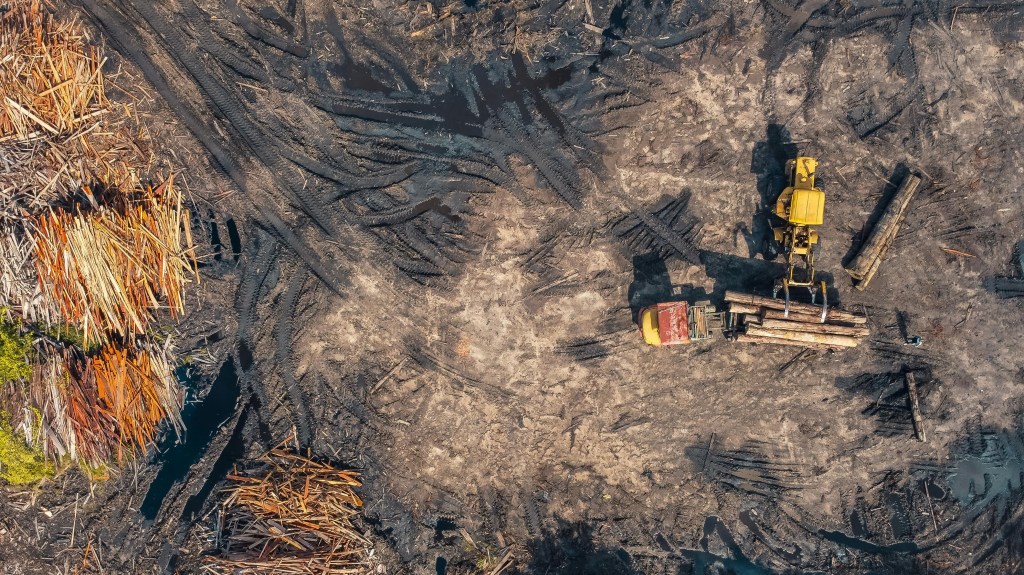
    In April of this year, soon after taking office for his second term, Donald Trump rescinded various environmental protections that applied to over half of the U.S.’s national forests. The administration cited attempts to control wildfires as the cause of their decision (Brown 2025), but fingers were quickly pointed at Trump’s desire to cut lumber imports and his statement that ‘we have massive forests. We just aren’t allowed to use them because of the environmental lunatics who stopped us’ (qtd in. Milman 2025).

    Researchers and state foresters have argued clearly and vocally that the strategy of preventing wildfires via increased logging requires careful and precise management if it is not to worsen the situation, and can only be of potential aid if done selectively (Cornwall 2025). Such recent changes in policy are only the tip of an ecological and biological collapse that decades of climate change and industrialisation have wrought. Sasquatch Sunset might dramatise the moment that its family of bigfoots stumble upon the Anthropocene, but the tipping point that announces the irreversibility of our own relationship to our forests is, sadly, already far behind us.

    Image: Pexels, 2019.

    However, just as the myth of Bigfoot encourages the human propensity to anthropomorphise the natural world into a human form, so too are there dangers to overly-sentimentalising our wildernesses. The cryptid’s commercialisation throughout popular media in the 1970s brought with it what Joshua Blu Buhs defines as a particularly middle-class fantasy of the natural world: ‘the paradise that Bigfoot guarded was a place where leisure was valued over work,’ he writes, ‘where walkers and hikers and backpackers knew the world better, survived the world better than those who worked in it’ (2013: 45).

    The particularly bourgeois tendency to imagine the wilderness as a place that should be cleansed of human influence threatens to erase the countless communities, trades and businesses that are inexorably tied to its well-being. The current administration’s rolling back of environmental laws and heavy tariffs have been announced as the remedies for the struggling logging towns scattered throughout the Pacific North West, but forestry experts contend that doing so does little to assist their long-term survival (McNichols 2025). Similarly, plans to entirely close the U.S. Forest Service’s headquarters in the region under the guise of cutting public spending will effectively dismantle the vital presence of rangers, firefighters, ecologists, and researchers who help maintain the area (Ehrlich 2025).

    Image: Sasquatch Sunset, Bleeker Street, 2024.

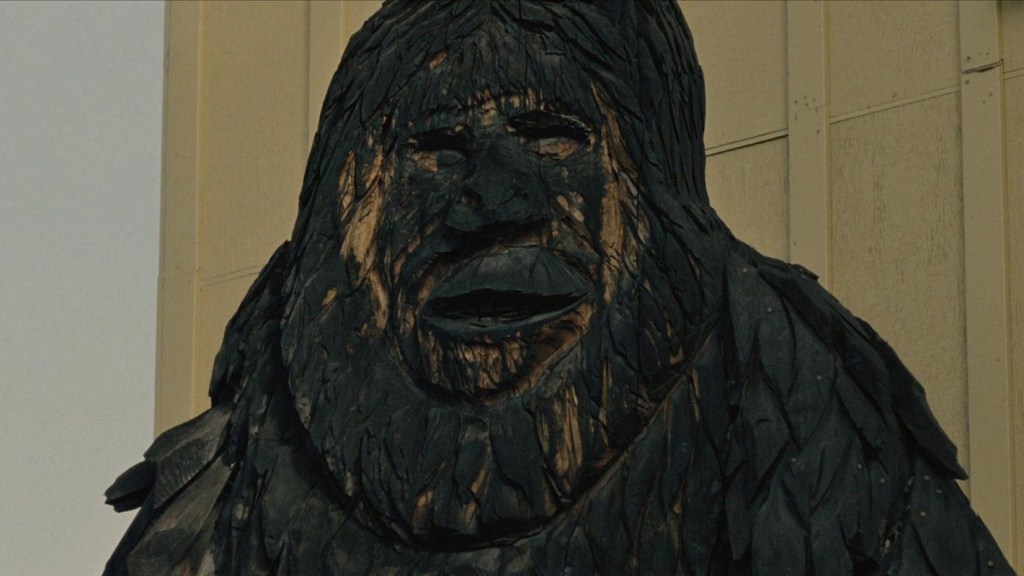
    The ecosystems that the legend of Bigfoot encourages us to engage with are, to put it mildly, extraordinarily complex. Sentimentalism and anthropomorphism are not the answers to the region’s survival, but empathy for the realities of the beings that live there is essential. It is notable, therefore, that Sasquatch Sunset concludes on imagery that complicates the mythologies that it helps to advance. The surviving bigfoots never encounter a living human throughout the duration of their long journey, but they do conclude it by staring up at a strange effigy that our species has created in their own image.

    This endpoint is a 25-foot statue called ‘Oh Mah Bigfoot’ that stands at the entrance of Willow Creek-China Flat Museum, self-proclaimed ‘Gateway to Bigfoot Country’ (‘Willow Creek’ 2025). This encounter, static though it may seem, enables the Zellners to flip the position of observer and subject that has sustained the production so far. The camera lingers as Keough and Zajac-Denek stare, dumbfounded into the statue’s face, seeking recognition in the warped, uncanny totem that stands alone within this utterly alien world. In our desperate attempt to give form to ideas and mythologies that we do not truly understand, humanity’s attempts to represent the sasquatches mean little to the creatures themselves. As Margaret Atwood wrote in a poem she once penned about the ever-mysterious cryptid, ‘sasquatch can never be known: he can teach you only about yourself.’ (1970: 20).

    Head Image: Sasquatch Sunset, Bleeker Street, 2024.

    Abominable. 2006. D. Ryan Schifrin, Film, USA: Freestyle Releasing.

    Aristotle (1925 [c.350 BCE). The Nicomachean Ethics: Translated with an Introduction. Translated by David Ross. Oxford: Oxford University Press.

    Atwood, Margaret. 1970. ‘Oratorio for Sasquatch, Man, and Two Androids,’ Poems for Voices, Toronto: Canadian Broadcasting Corporation.

    Frozen Planet. 2011. TV Series, October 26 – December 28, UK: BBC.

    Bigfoot. 1970. D. Robert F. Slatzer, Film, USA: Ellman Enterprises.

    ‘Bigfoot.’ 1977.  In Search of…, TV Episode, April 28, USA: Alan Landsburg Productions.
    Bigfoot: The Unforgettable Encounter. 1995. D. Corey Michael Eubanks, Film, USA: PM Entertainment.

    Brower, Matthew. 2011. Developing Animals: Wildlife and Early American Photography. Minneapolis: University of Minnesota Press.

    Brown, Deborah J. 2018. ‘Animal Souls and Beast Machines: descartes’s mechanical biology’, in Peter Adamson, and G. Fay Edwards (eds) Animals: A History, New York: Oxford Academic: 187-210.

    Brown, Matthew. 2025. ‘Trump administration rolls back forest protections in bid to ramp up logging,’ Independent, April 4: https://www.independent.co.uk/news/donald-trump-joe-biden-forests-congress-great-lakes-b2727730.html.

    Buhs, Joshua Blu. 2009. Bigfoot: The Life and Times of a Legend, Chicago: Chicago University Press.

    Buhs, Joshua Blu. 2013. ‘Camping with Bigfoot: Sasquatch and the Varieties of Middle-Class Resistance to Consumer Culture in Late Twentieth-Century America,’ The Journal of Popular Culture 45:1: 38-58.

    Burrell, Ian. ‘BBC denies fake polar bear scene was misleading,’ Independent, December 13: https://www.independent.co.uk/hei-fi/news/bbc-denies-fake-polar-bear-scene-was-misleading-6276283.html.

    Carrol Sain, Johnny. 2020. ‘Finding bigfoot: in the woods in search of North America’s great, wild ape,’ Hatch, September 25: https://www.hatchmag.com/articles/finding-bigfoot/7715127

    Cornwall, Warren. 2025. ‘Trump wants to log more forests. Will it really help prevent wildfires?’ Science, April 17: https://www.science.org/content/article/trump-wants-log-more-forests-will-it-really-help-prevent-wildfires.

    Cry Wilderness. 1987. D. Jay Schlossberg-Cohen, Film, USA: Visto International Inc.

    Ehrlich, April. 2025. ‘Time is running out to weigh in on Forest Service overhaul that would close Pacific Northwest headquarters,’ Oregon Public Broadcasting, September 27: https://www.opb.org/article/2025/09/27/forest-service-northwest-headquarters-closure/.

    Smith, Murray. 2022. Engaging Characters: Fiction, Emotion, and the Cinema, Oxford: Oxford University Press.

    Finding Bigfoot. 2011-2018. TV Series, May 29 – May 27, USA: Animal Planet.

    Frank, Allegra. 2024. ‘There’s Much More to Sasquatch Sunset Than Piss and Poop,’ Daily Beast, April 20: https://www.thedailybeast.com/obsessed/sasquatch-sunset-is-about-so-much-more-than-piss-and-poop/.

    Goodall, Jane and Berman, Phillip. 1999. Reason for Hope: A Spiritual Journey. New York: Warner Books.

    Harry and The Hendersons. 1987. D. William Dear, Film, USA: Universal Pictures.  
    Kadane, Lisa. 2022. ‘The true origin of Sasquatch,’ BBC, July 21: https://www.bbc.co.uk/travel/article/20220720-the-true-origin-of-sasquatch.

    Little Bigfoot. 1997. D. Art Camacho, Film, USA: Republic Pictures.

    ‘Love to Hate You.’ 1991. Erasure, Song, Chorus, UK: Mute Records.

    McNichols, Joshua. 2025. ‘Could Trump’s tariffs bring back the Pacific Northwest lumberjack?’ Oregon Public Broadcasting, July 20: https://www.opb.org/article/2025/07/20/washington-lumberjack-trump-tariffs/.

    Milman, Oliver. 2025. ‘Outcry as Trump plots more roads and logging in US forests: “You can almost hear the chainsaws,”’ The Guardian, October 6: https://www.theguardian.com/us-news/2025/oct/06/trump-logging-forests.

    Nemiroff, Perri. 2024. ‘Riley Keough Opens Up About Having a Sasquatch for a Director,’ Collider, January 27: https://collider.com/sasquatch-sunset-riley-keough/.

    Night of the Demon. 1980. D. James C. Wasson, Film, USA: VCII, Inc.

    Pico Della Mirandola, Giovanni. 2016 [circa 15th c.]. ‘Oration on the Dignity of Man’, translated by Richard Hooker, Brians: https://brians.wsu.edu/2016/11/14/pico-della-mirandola-oration-on-the-dignity-of-man-15th-c-ce/

    Resistance. 2020. D. Jonathan Jakubowicz, Film, USA, UK & Germany: IFC Films.

    Salisbury, Mark. 2024. ‘How Jesse Eisenberg “saved the day” by helping to fund Sasquatch Sunset,’ Screen Daily, February 15: https://www.screendaily.com/features/how-jesse-eisenberg-saved-the-day-by-helping-to-fund-sasquatch-sunset/5190541.article.

    Sasquatch Sunset. 2024. D. Nathan and David Zellner, Film, USA: Bleecker Street.

    Walls, Robert. 2022. ‘Bigfoot (Sasquatch) legend,’ Oregon Encyclopedia, September 7: https://www.oregonencyclopedia.org/articles/bigfoot_sasquatch_legend/.

    ‘Willow Creek.’ 2025. The Humboldt County Visitors Bureau: https://www.visitredwoods.com/listing/willow-creek/118/.

  • Capturing Animals in Motion

    Capturing Animals in Motion

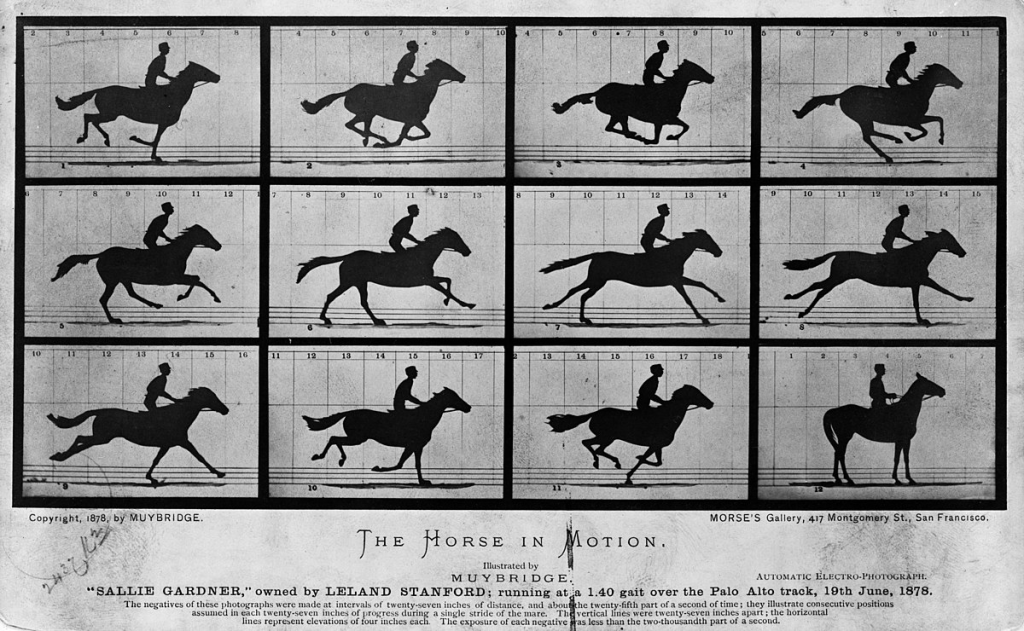
    Have you seen this image before? If you have, it’s almost certainly because someone has attempted to illustrate an example of early photographic motion to you. These distinct silhouettes of a galloping horse are what we first call to mind when we think of cinema’s birth. Before we imagine Louis Le Prince’s family at a garden in Roundhay, Leeds (1888), before Fred Ott sneezes for William Dickson at Thomas Edison’s movie studio (1894), before the Lumière brothers’ train pulls up to its station (1896) and before Georges Méliès memorably embeds a rocket ship in the eye of the man in the moon (1902), all our visual media seems to trace us back to this horse, seemingly hanging in mid-air, as its legs gallop beneath it.

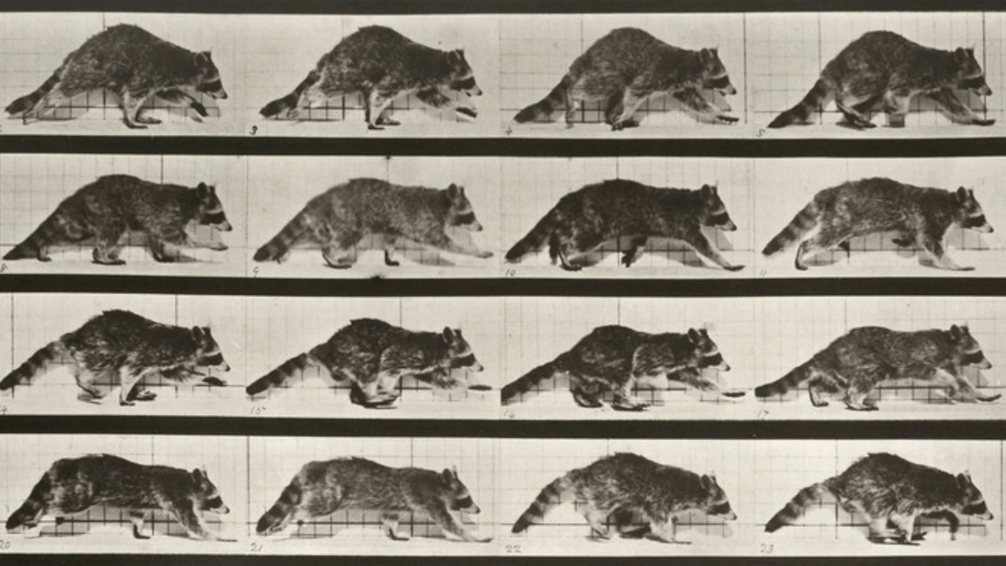
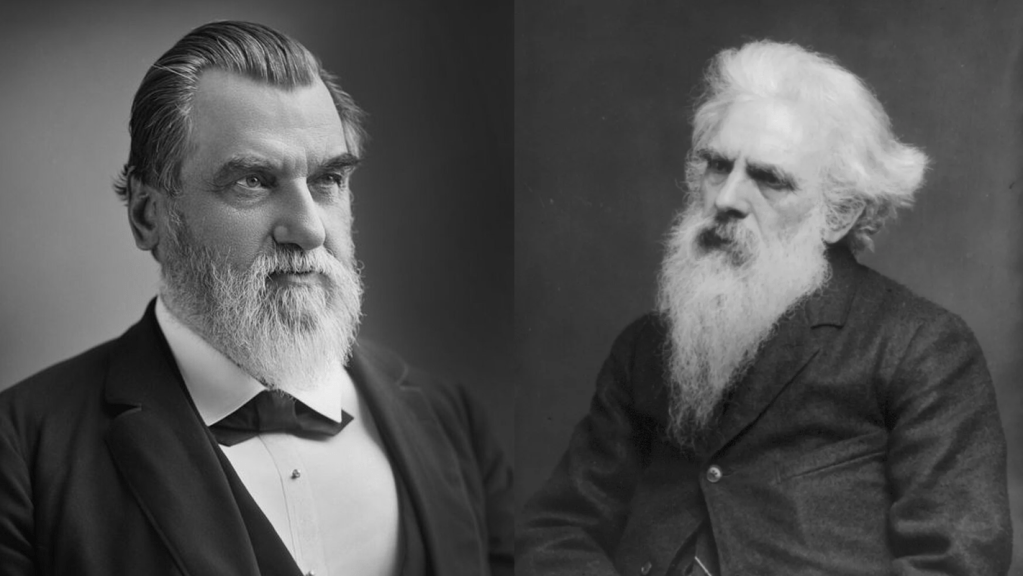
    Most of us are aware that these images were captured by Eadweard Muybridge, the photographic pioneer who would publish them throughout the 1880s. Muybridge had been commissioned by the industrialist and politician Leland Stanford to help him determine the exact gait of a horse and settle the issue as scientifically as possible. It’s a reminder to us that the film industry first arose out of nineteenth-century technological experimentation and was often driven by attempts to study the natural world and document it for posterity. The image of the horse wasn’t only the product of this curiosity; it was its inspiration.

    Image: Stanford University Archives (left); Library of Congress (right)

    The power of film’s historical gaze forces us to consider the extent that its foundational images play a hugely significant role framing, focusing upon, and erasing the lives of those that it ostensibly attempts to capture. We would, after all, do well to remember that, in his time as Governor of California, Stanford perpetuated the suppression and elimination of the state’s Native American communities (Madley 2016), and referred to Chinese immigrants that had sought labour during the gold rush as ‘an inferior race’ (qtd. In Sandmeyer 1973: 43). Before the publication of his historical plates, Muybridge had already proved himself to be a similarly controversial figure, having shot and killed the man he believed was having an affair with his wife, a woman half his age at the time of their marriage. The all-too-familiar moral whiplash of encountering the attitudes of the past through those of the present is one that is experienced by anyone who expresses any degree of historical curiosity. If history teaches us anything, it is that, rather than avert our gaze, we possess a responsibility to consider how these uncomfortable truths are embedded in both our most treasured myths and, therefore, our contemporary surroundings.

    Jordan Peele calls this history into question in his sci-fi horror movie Nope (2022), offering a powerful indictment of the erasure of Black bodies from cinema’s history by utilising Muybridge’s images. Plate 626 (1887), of mare Annie G. being ridden by an unnamed Black rider, is used in the film to illustrate the voices, perspectives and experiences forever condemned to silence. Engaging with similar debates, art history professor John Ott used Muybridge’s photographs to consider the barriers and restrictions facing a Black American workforce: ‘boxing and horse racing were two fields where they could make a name for themselves and could mingle with white Americans,’ he states, arguing that such roles also had the effect of positioning Black sportsmen within racist associations of animalistic performance’ (qtd. in Han 2022).

    Image: Universal Pictures, 2022.

    As for the horses, their value was great enough that their names were indeed recorded.  Sallie Gardner, Abe Edgington, Mahomet, Annie G., and Occident, as well as others, were all owned by Stanford and had their names listed alongside their respective plates. As standard and thoroughbreds, their names were worthy of record and signalled their status as creatures with immense commercial value. Lyman Horace Weeks’ historical account, The American Turf, tracks well-trained racehorses being sold for multiple thousands of dollars in this era, while those whose costs of upkeep outpaced their ability to perform were, instead, ‘shot as useless’ (1898, p. 92).

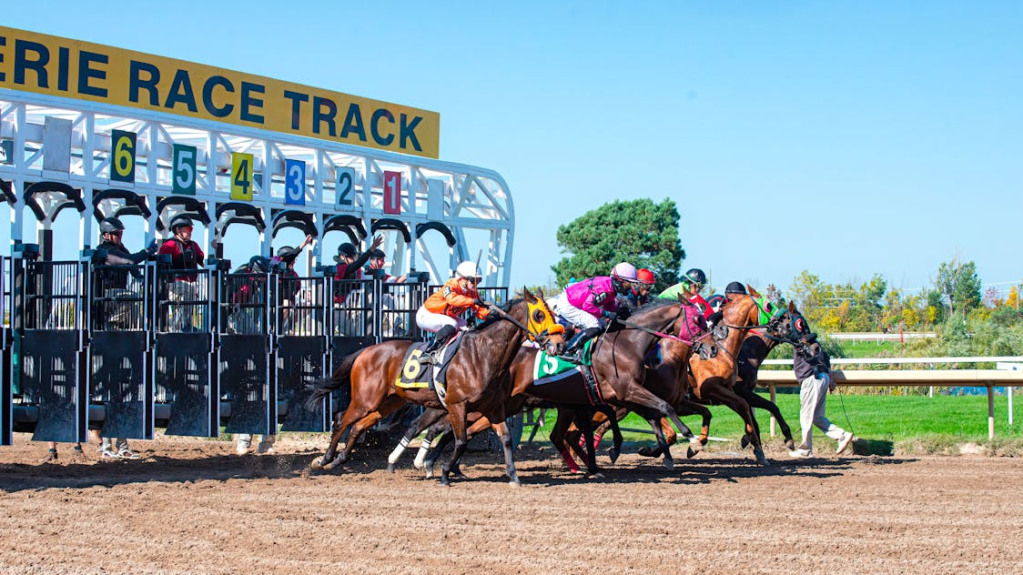
    The exploitation of racehorses is as well-documented as it is harrowing. While it was in the best interests of owners such as Stanford to keep their top-achieving animals fit, well-fed and cared for, their status as investments to be capitalised upon was without question. Bone and tendon injuries are endured from over racing, pain-based techniques using whips, spurs and harsh-bits are implemented to advance speeds, heritable weaknesses are driven by genetic exploitation, while the animals can find themselves wracked by musculoskeletal damage, respiratory conditions, bleeding lungs, gastric ulcers, and chronic lameness.

    Such conditions are inflicted through breeding and training, well before the sheer danger involved in racing itself is encountered. The Horseracing Integrity and Safety Authority (HISA) reported that, in 2024, the fatality rate of breaking the gate in America could be measured at 0.90 of 1,000 (Carroll 2025). Although an improvement over previous years, this statistic confirms that almost one in a thousand horses will not survive the races that they endure, let alone the harrowing experience of cruelty, drug-use and slaughter experienced off the track.

    Image: Pexels, 2022

    Beyond their commodification within the sporting world, Muybridge’s images remind us of the vivisectional status of animals within our society. In both the twenty-first and nineteenth-centuries the autonomies of non-human animals are treated as inconsequential if their lives may be put to the service of our scientific enquiries. As Annie Dwyer argues of Muybridge’s photography, ‘the camera not only captures but actively constructs animal life as a mechanical phenomenon, stripped of animacy or agency’ (2022: 34). Dwyer positions Muybridge’s photographs of horses alongside those of humans: men, who he depicts in the act of ‘carpentry, masonry, and blacksmithing,’ and women, who he comparatively captures performing domestic tasks such as ‘sweeping, washing, and scrubbing floors’ (ibid.: 44). Human and horse alike find their bodies reduced to anatomical projections of expectations regarding identity and labour.

    Similarly, Stanford’s racehorses are swept up in Muybridge’s catalogue of railroads, dockyards and plantations, transformed into icons of industrialised capitalism that careens forwards with forceful momentum. In An Introduction to Animals and Visual Culture (2012), Randy Malamud contends that ‘the horses lose something in this transaction’ (66). ‘Muybridge’s photographs starkly alienate animals from their natural context,’ he writes, ‘exuberantly reframing them in his own amazing new technological discourse of visual culture. The animals appear against a backdrop of numbered scales and grids, the more convenient to chart and graph them’ (ibid.: 66).

    Image, Muybridge, 1887.

    Capturing them within his lens, Muybridge turned Stanford’s galloping horses into icons of the birth of an entire industry. Their emergence into the world of the moving image carried with it the sense of dignity, endurance, gender, nation, Empire, chivalry, and industry that our species has projected upon equines for numerous centuries. In the very-same decades that Muybridge’s work capitalised upon these attitudes, women such as Caroline Earle White and Anna Sewell were actively transforming conceptions of equine welfare through, respectively, the foundation of the American Anti-Vivisection Society and the publication of Black Beauty (1877). Our relationships to horses had become a means through which our entire civilisation and engagement with the natural world could be understood.

    Much of the history of film scholarship has taught us that to photograph, to gaze and to look is not a passive activity. Instead, to distil an identity into a moving image is to engage in dynamics of power and dominance. To represent the lives around us in our visual media is to define and control them through our own understandings and prejudices. Muybridge’s images act as a branch of natural photography that treated animals as subordinated tools to further humanity’s industrial and scientific enterprises.

    In his book, Developing Animals: Wildlife and Early American Photography (2011), Matthew Brower argues that these photographs ‘have been seen as offering us access to an otherwise inaccessible “truth” of animals. But this access has come at the cost of devaluing the unmediated experience of animals,’ asserting that such imagery ‘does not provide unmediated access to the animals depicted, but rather it structures its audience’s understanding of animals in particular ways’ (xix).

    Humanity’s desire to watch and look at other creatures is an innate part of our species’ nature, especially as we find ourselves living in an ever-modernising world that seems to pull us further and further away from the realm of seemingly natural experience. Just as our ancestors daubed great beasts on the stone walls that surrounded their hearths, the photographic technologies we now utilise are products of our animalistic ingenuity, and allow us to leave an indelible imprint upon our cultures. While those cave paintings were rendered in flickering firelight, our own cinematic images of animals offer powerful opportunities to reflect upon our relationship with nature. Significantly, they also allow us to leave a lasting impression of how this bond might be remembered.

    Head Image: Muybridge, 1878.

    Brower, Matthew. 2011. Developing Animals: Wildlife and Early American Photography. Minneapolis: University of Minnesota Press.

    Carroll, Rory. 2025. ‘Horse racing-US horse racing deaths fell in 2024, regulator says,’ Reuters, February 20: https://www.reuters.com/sports/horse-racing-us-horse-racing-deaths-fell-2024-regulator-says-2025-02-20/.

    Dwyer, Annie. 2022. The Incorporation of the Animal: Eadweard Muybridge’s Animal-Machine. Transpositiones 1:2, 33-54.

    Fred Ott’s Sneeze. 1894. D. William Dickson. USA, Film: Edison Manufacturing Company.

    Han, Yoonji. 2022. ‘From a murderous affair to an anonymous Black jockey, the true story behind the moving pictures in Jordan Peele’s Nope,’ Business Insider, August 2: https://www.businessinsider.com/nope-black-jockey-pictures-muybridge-horse-in-motion-history-2022-8.

    L’Arrivée d’un train en gare de La Ciotat. 1896. D. August and Louis Lumière. France, Film: Société Lumière.

    Le Voyage dans la Lune. 1902. D. Georges Méliès. France, Film: Star Film Company.

    Madley, Benjamin. 2016. An American Genocide: The United States and the California Indian Catastrophe, 1846-1873. New Haven: Yale University Press.

    Malamud, Randy. 2012. An Introduction to Animals and Visual Culture. New York: Palgrave Macmillan.

    Nope. 2022. D. Jordan Peele. USA, Film: Universal Pictures.

    Roundhay Garden Scene. 1888. D. Louis Le Prince. UK, Film: Louis Le Prince.

    Sandmeyer, Elmer Clarence. 1973. The Anti-Chinese Movement in California. Urbana: University of Illinois Press.

    Sewell, Anna. 1877. Black Beauty: His Grooms and Companions, the Autobiography of a Horse. London: Jarrold and Sons.
    Weeks, Lyman Horace. 1898. The American Turf: An Historical Account of Racing in the United States. New York: The Historical Company.
  • Frankenstein (2025) and Vegetarian Monstrosity

    Frankenstein (2025) and Vegetarian Monstrosity

    Guillermo del Toro loves monsters. If there is any connective thread that runs through the director’s work, it is the very-same that the zealous Frankenstein uses to stitch together the patchwork flesh of his own creation. Whereas the latter would become horrified by the monstrous appearance of his life’s work, del Toro hopes to enthral us with his representations of outcasts who are demonised for their rejection of social norms.

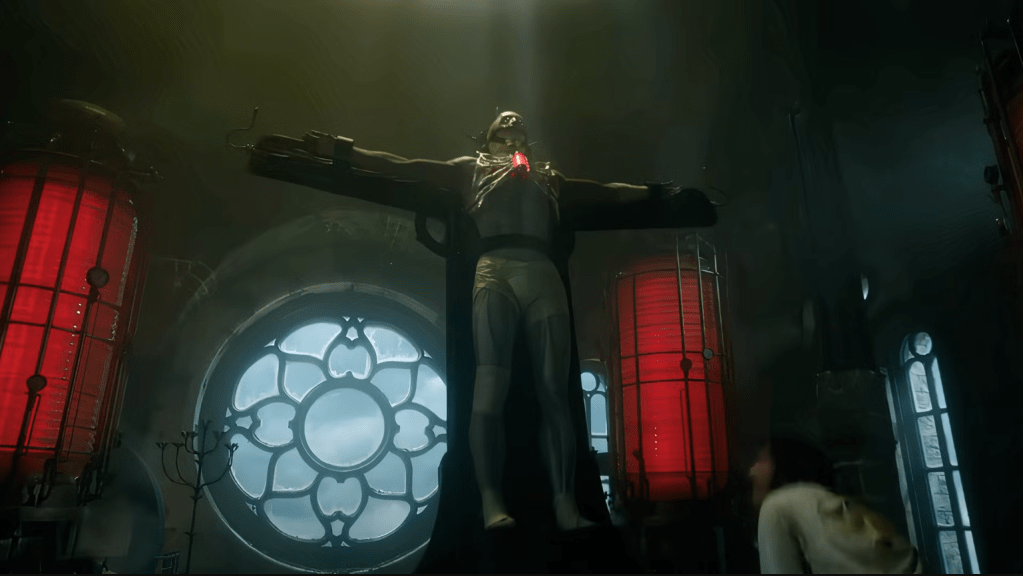
    The anticipation surrounding his adaptation of Mary Shelley’s Frankenstein; or, The Modern Prometheus (1818) has been fuelled by its seeming inevitability. ‘The creature of Frankenstein,’ del Toro would argue, speaking of Boris Karloff’s portrayal, “was a more beautiful martyr figure than Jesus with the exposed fracture. And I started adoring him’ (qtd. in Sweet 2025). This veneration is on full display in his adaptation, not only through his casting of the impossibly chiselled Jacob Elordi, but through the dialogue of Elizabeth, Mia Goth, who questions the incredulous Frankenstein, Oscar Isaac, ‘What if, unrestrained by sin, our creator’s breath came into its wounded flesh directly?’ (Frankenstein, 2025).

    Image: Netflix, 2025

    Del Toro’s messianic depiction of his Creature reflects his ongoing attempts to relate the special-effects driven spectacle of genre cinema through stories that feature marginalised individuals that are villainised for their social difference. So too has Mary Shelley’s own work continually been opined as a significant opportunity to explore nineteenth-century attitudes towards issues such as sexuality, gender, and social strata from an almost endless array of perspectives.

    As George Haggerty argues in ‘What is Queer about Frankenstein?’ ‘there is nothing normative about the relationship between Frankenstein and his creature: the almost by-definition dysfunctional family relations are transgressive from the start’ (Haggerty 2016: 116). The scientist’s own fervour, after all, is defined by his willingness to deviate from expected roles regarding reproduction in the pursuit of the ‘perfect’ male form, while the resultant Creature is defined by its inability to find social acceptance.

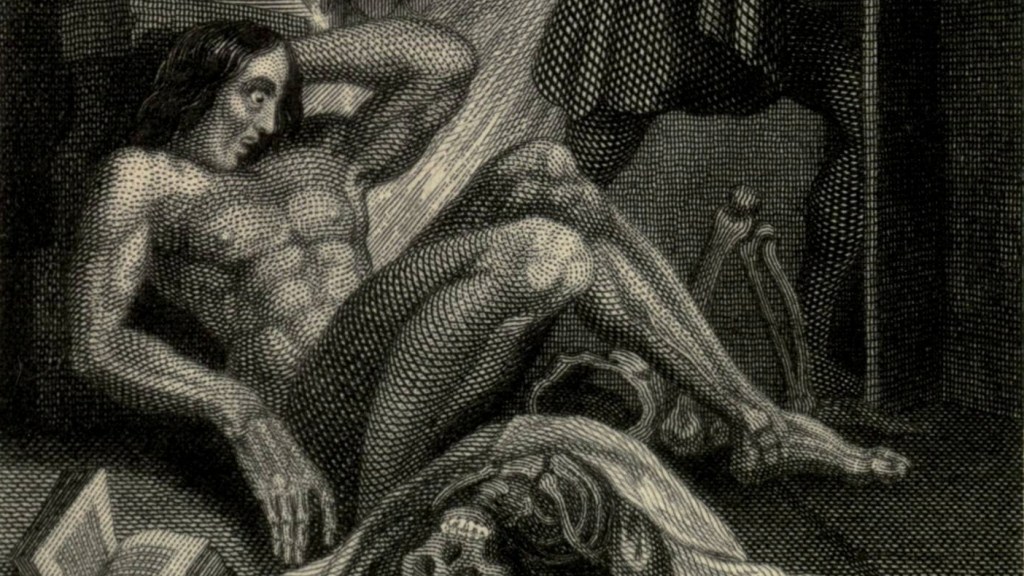
    One act of defiance that the Creature claims for itself is its choice to refrain from eating meat, stating to his creator that “My food is not that of man; I do not destroy the lamb and the kid to glut my appetite; acorns and berries afford me sufficient nourishment.  (Shelley 1818: 149). Notably, Carol J. Adams linked the Creature’s diet to feminist scholarship by dedicating an entire chapter of her book, The Sexual Politics of Meat: A Feminist-Vegetarian Critical Theory (1990), to its exploration. ‘Vegetarianism, like feminism,’ she writes, ‘is excluded from the patriarchal circle, just as Mary Shelley experienced herself as being excluded from the male circle of artists of which she saw herself a part’ (Adams 1990, 119).

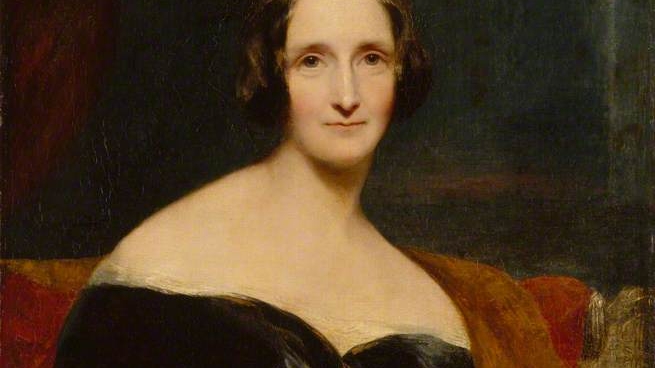
    Image: Theodor von Holst and William Chevalier, 1831

    The Creature’s revelation of his plant-based diet has several different functions in Shelley’s novel. Being a veggie, for him, is a means of persuading Frankenstein to create a female mate. His reasoning is that, if he were to have some companionship, he would have no incentive to harm anyone and could live out the remainder of his life beyond civilisation’s reach. A rejection of carnism, therefore, is an attempt to evidence both his moral dignity and his desire for social withdrawal.

    The idea that vegetarianism is a sign of monstrous deviance is everywhere in our contemporary culture. Think for a moment, of the many vegan and vegetarian characters who are depicted as fanatics or oddballs, smug moralists, or even dangerous psychotics. Tom Clancy, for example, seems to find the prospect of such lifestyles utterly baffling, depicting them in Rainbow Six (1998) as a sure-fire means of identifying extremist eco-terrorists hell-bent on humanity destruction. Worse still, refusing to eat meat is frequently depicted as a rejection of presumed maleness. ‘The vegan monster offers a monstrous embodiment of human desires,’ writes Emelia Quinn, ‘threatening, as a result, existing discourses of meat-eating that work to shore up and insatiate a particular ideal of white, Western masculinity’ (Quinn 2021: 17).

    So, how did these culinary contexts make their way into Frankenstein? As the child of pioneering women’s rights campaigner Mary Wollstonecraft and political author William Goldwin, Mary Shelley was profoundly influenced by the social circles that she encountered throughout her life. She would rub shoulders with several Romantic-era advocates for vegetarianism, including Joseph Ritson, John Frank Newton and, notably, Percy Bysshe Shelley, the writer with whom she would elope and begin a tumultuous relationship.

    Image: Richard Rothwell, c. 1831-1840

    Percy Shelley himself would produce a pro-veggie pamphlet in which he argued that, were it not for the Promethean theft of fire, we might not be so willing to tuck into the flesh of other animals: ‘It is only by softening and disguising dead flesh by culinary preparation that it is rendered susceptible of mastication or digestion, and that the sight of its bloody juices and raw horror does not excite intolerable loathing and disgust’ (Shelley 1813: 13). Food, as it were, for thought.

    By imagining another Promethean creation similarly falling from grace, Shelley’s writing acts a cornerstone of the Regency and Victorian-era Romantics who helped to develop criticisms of industrialisation, the potential hazards of over-agriculturalisation and inequality driven by starvation and malnutrition, developing many of the country’s first animal welfare laws. When Michael Owen Jones collated several articles that explore the relationship between food and culture, for example, he chose to title it Frankenstein Was a Vegetarian: Essays on Food Choice, Identity, and Symbolism (2022).

    With this history in mind, where does this leave Guillermo del Toro’s recent production, and his own obsession with the vegetarian monster that haunted Shelley’s imagination over two-hundred years ago? The director had stated in 2015 that watching The Texas Chainsaw Massacre (1974) had ‘made me a vegetarian for four years’ (qtd. In Alexander 2015), and he has similarly delivered a graduation commencement speech for the entirely vegan MUSE School in Los Angeles, where he argued that “we’re living in a world that is really on the brink in so many ways, ecologically, socially, full of injustice that seems to change, then comes back’ (MUSE School CA 2019).

    Image: MUSE School CA, 2019

    It’s in del Toro’s own body of work, however, that it becomes clear that his monstrous protagonists are all, in some way or another, shaped by issues surrounding speciesism and humanity’s fascistic approach to animal welfare. It is no coincidence that when the Creature of this film first encounters human civilisation, it is through an encounter of hunters stalking prey. Alone for the first time and wandering disorientated through the woods, Frankenstein’s creation encounters a deer peacefully grazing upon a bush. Approaching tentatively, he retrieves some berries and eats one himself, before extending his palm out to the animal in an invitation to feed. Bang! Suddenly this moment of serenity is shattered when hunters kill the deer with a single shot of a rifle.

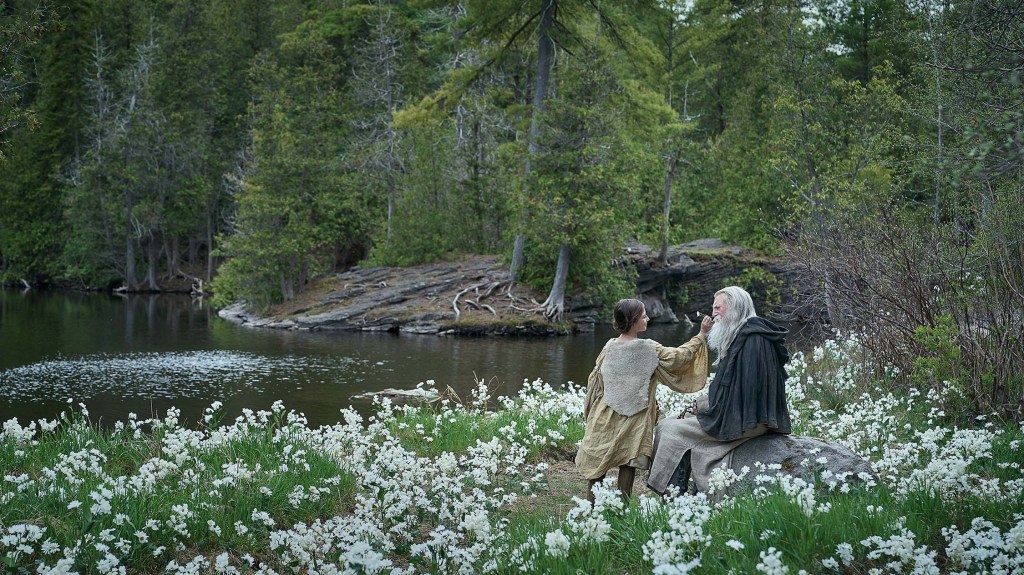
    Despite being a product of man-made intervention, del Toro frequently positions his Creature as a force of nature, having a group of cottagers refer to him as ‘The Spirit of the Forest’ when he offers them unseen benevolence. Even when held captive within the bowels of the great stone tower that Frankenstein uses as his laboratory, the Creature is fascinated with the few elements of the natural world that he can interact with from his confinement, marvelling at leaves as he sets them upon water, watching them float down a small gulley that passes through his otherwise barren basement.

    Image: Netflix, 2025

    If the Creature’s identity is defined by his relationship to nature and vegetarianism, then Frankenstein’s is as carnivorous as one can imagine. It is an act of meat eating that establishes the toxic nature of his parents’ relationship and the scientist’s subsequent desire to penetrate the natural order of life and death. Charles Dance, coldly demands that his pregnant wife, Mia Goth in her second role, eat a piece of bread that has been dipped in the red juices of a particularly rare cut of meat, explaining to her that ‘the salts will enrich your blood.’

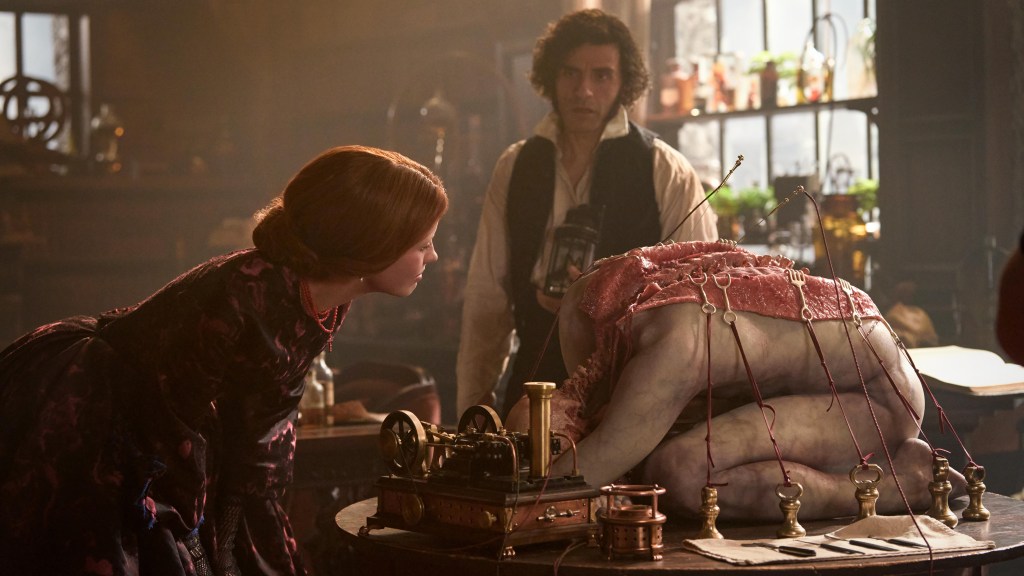
    Describing the shocking amount of flesh that covers many of the film’s sets, Oscar Isaac would describe his laboratory as a ‘meat banquet’ (qtd. in Hall 2025). Indeed, Frankenstein’s workshop opens into a butchers’ market that is decorated with a row of pigs’ heads hanging on a rail, carts of meat, and even a bucket of bones and offal. When the scientist invites his soon-to-be benefactor, Henrich Harlander, Christoph Waltz, inside, the audience is treated to a close-up of the latter hopping over a puddle of blood that has spilled down the street. It should be remembered that Shelley herself utilised similar imagery in her own novel, with her scientist stating that ‘The dissecting room and the slaughter-house furnished many of my materials; and often did my human nature turn with loathing from my occupation’ (Shelley 1818: 55).

    Image: Netflix, 2025

    Although they seem dissimilar, both Frankenstein and his creation are bound by their shared desire to understand the circumstances of their life, birth, and eventual death. What distinguishes the Creature’s gentle observations from his creator’s unempathetic zeal is their treatment of other living beings. It’s impossible to watch the film without comparing the scientist’s cruel conduct towards his creation, pulling him up in chains, barking instructions and beating him with a metal rod to real-world acts of animal mistreatment and captivity. Notably, when the scientist begins preparing for his final confrontation with his creation, he is asked by a merchant what he is hunting; his reply is, simply, ‘big game’.

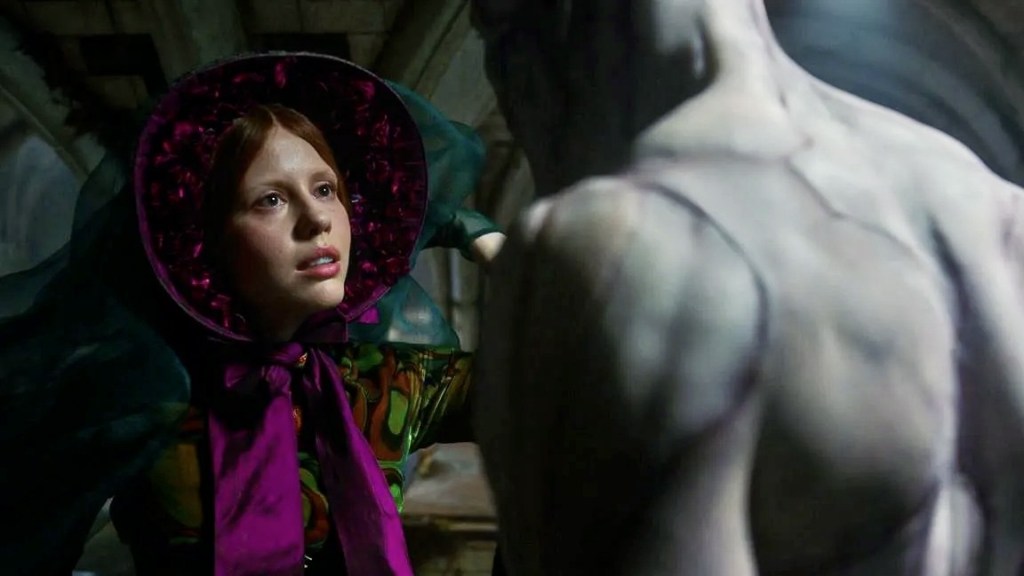
    Frankenstein then, is not a character that del Toro depicts as one who would have any interest in animal lib. Instead, it is Elizabeth that allows the director to offer comparative acts of compassion. The dual casting of Mia Goth as Frankenstein’s deceased mother and unrequited paramour allows her to represent the life and love that the scientist is impotently unable to dominate. It is Elizabeth who challenges Frankenstein’s assumptions that humanity’s infliction of pain on other animals can be justified due to their seeming lack of sentience. ‘What is pain,’ Elizabeth proposes, ‘if not a mark of intelligence?’

    Image: Netflix, 2025

    Mary Shelley’s most enduring legacy is, perhaps, the rage expressed by Frankenstein’s ‘monster’ once it realises that its existence will not be tolerated by humanity. Some have chosen to explore this anger as an expression of the many traumas that the author endured throughout her life, especially the patriarchal injustices that she was subjected to as an intellectual (Tillotson 1983: 175). Others have continued to find courage in her Creature’s indignant wrath. ‘My Words to Victor Frankenstein above the Village of Chamounix: Performing Transgender Rage,’ for example, acts as a powerful example of Shelley’s novel being transformed into a performance piece designed to ‘harness the intense emotions emanating from transexual experience – especially rage – and mobilize them into effective political actions’ (Stryker 1994: 237).

    As for del Toro, his speech at the plant-based and sustainably-driven campus reflected similar concerns. ‘One of the energies you have as young people is rage. Most people tell you not to use it, to put it away, to be nice,’ he would claim, “I say make peace with it and use it. Be enraged at what you are inheriting. Be enraged at what you cannot do and what’s possible before and change it […] What makes you “stubborn” and “impossible” makes you tenacious’ (MUSE School CA 2019).

    The power of Mary Shelley’s creation has resonated across two centuries, in far greater effect than those of her male contemporaries. Del Toro’s newest incarnation of her Creature reminds us that rage is a natural response to injustice and that if we want to continue defining humanity through our seemingly humane natures, then we drastically need to rethink our relationship to the natural world that we exploit for the sake of our own pride, ambition, and gluttony.

    Head Image: Netflix, 2025

    Adams, Carol J.  1990. The Sexual Politics of Meat: A Feminist-Vegetarian Critical Theory. New York: Continuum.

    Alexander, Thomas. 2015. ‘[Interview] Guillermo del Toro on Serenading Crews, Silent Hills and Crimson Peak,’ October 7, Bloody Disgusting: https://bloody-disgusting.com/news/3364524/interview-guillermo-del-toro-on-serenading-crews-silent-hills-and-crimson-peak/.

    Clancy, Tom. 1998. Rainbow Six. New York: G.P. Putnam’s Sons.

    Frankenstein. 2025. D. Guillermo del Toro. USA, Film: Netflix.

    Haggerty, George. 2016 ‘What is Queer about Frankenstein?’ Andrew Smith ed. The Cambridge Companion to Frankenstein. Cambridge: Cambridge University Press, 116-127.

    Hall, Gerrad. 2025. ‘Oscar Isaac on creating Frankenstein’s doctor — and giving him a ‘rock star’ quality,’ September 4, Entertainment Weekly: https://ew.com/oscar-isaac-frankenstein-doctor-victor-rock-star-exclusive-11801021.

    Jones, Michael Owen. 2022. Frankenstein Was a Vegetarian: Essays on Food Choice, Identity, and Symbolism. Jackson: University Press of Mississippi.

    MUSE School CA. 2019. ‘2019 MUSE School Graduation Commencement Speech,’ June 26, YouTube: https://www.youtube.com/watch?v=NokdAkdjzFw&t=95s.

    Shelley, Percy Bysshe. 1913. A Vindication of Natural Diet. London: Smith & Davy.

    Shelley, Mary. 1818 [2013]. Frankenstein; or, The Modern Prometheus. London: Penguin Books.

    Sweet, Matthew. 2025. ‘How Netflix turned Frankenstein Catholic,’ November 11, The Telegraph: https://www.telegraph.co.uk/films/0/how-netflix-turned-frankenstein-catholic/.

    The Texas Chain Saw Massacre. 1974. d. Tobe Hooper. USA, Film: Bryanston Distributing Company.

    Tillotson, Marcia. 1983. ‘“A Forced Solitude”: Mary Shelley and they Creation of Frankenstein’s Monster,’ Julian E. Fleenor ed., The Female Gothic. Montreal: Eden, 176-175.

    Stryker, Susan. 1994. ‘My Words to Victor Frankenstein Above the Village of Chamounix: Performing Transgender Rage,’ A Journal of Lesbian and Gay Studies 1:3, 237-254.

    Quinn, Emelia. Reading Veganism: The Monstrous Vegan, 1818 to Present. Oxford: Oxford University Press.

  • Welcome to Creature Features

    This is a blog dedicated to exploring representations of animal welfare on screen.

    Thank you so much for finding it and taking a look!

    Rather than holding off until I have a range of articles and posts to start off with, I’ve decided to stick up the piece of writing that inspired me to set it up in the first place.

    There’ll be more to come in the months ahead but thanks for dropping by as it gets started!