
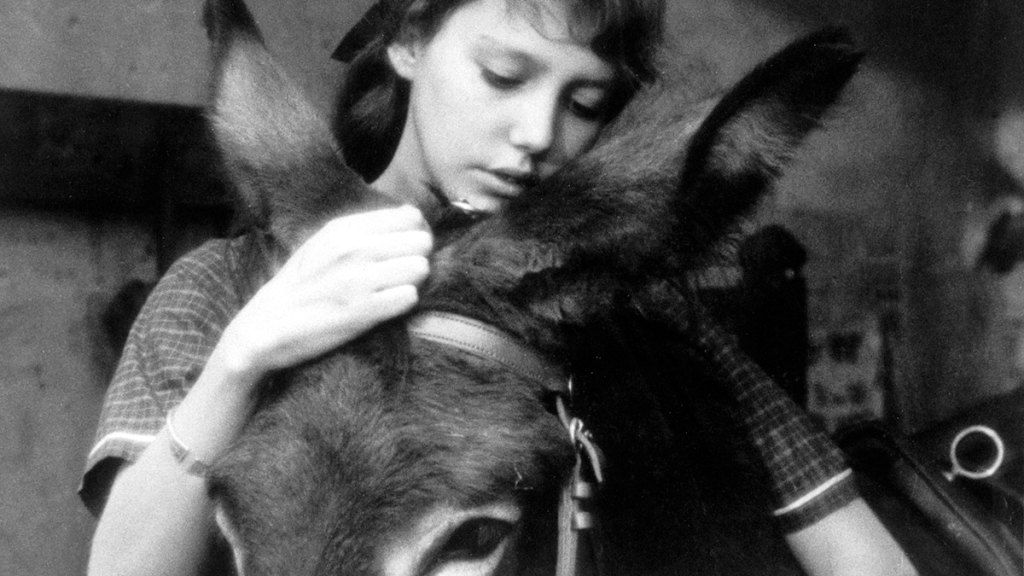
Chimps get to be cheeky, owls wise, and foxes crafty. Yet, if there is any emotional state that we most commonly impose upon the donkey, it’s sadness. Across both past and contemporary culture, our species frequently encumbers the animals with a melancholy attitude, burdened with the brunt of a cruel and unfair world. Whether immortalised through Benjamin, the most cynical member of the anthropomorphic cast of George Orwell’s Animal Farm (1945), or Eeyore, the perpetually morose inhabitant of A. A. Milne’s Hundred Acre Wood (Winnie-the-Pooh, 1926), centuries of forced servitude have relegated the woebegone donkey with little hope of contentedness in humanity’s regard.
What on earth did the animals do to deserve being lumbered with our collective impression of existential despair? Such sorrow hardly seems commensurate to the enormous debt of gratitude we owe them. Zooarchaeologists point to donkeys playing a key role in the development of many of our most ancient herding societies when they were first domesticated around 6,000 years ago. “Donkeys are tough desert-adapted animals,” write Stine Rossel et al., “their ability to carry heavy loads through arid lands enabled pastoralists to move farther and more frequently and to transport their households” (2008: 3715).
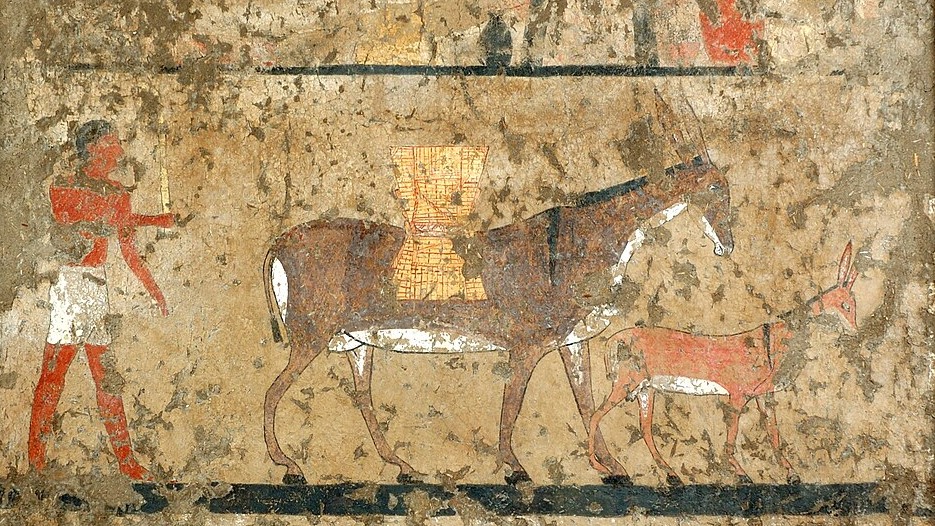
Nevertheless, the reward for donkeys’ labours is usually either commiseration or complete intellectual disregard. When not defined by their toil and exertion, the donkey’s identity is used as a figurative stand-in for idiocy and foolishness. Few of us want to be called a jackass, after all. Whether through the English donkey, the French âne, Italian asino or Spanish burro, to be compared to the animal means being accused of obstinate mindlessness and slow-wittedness. What worse fate could there be for Pinocchio but to be turned into one? “It is written in the decrees of wisdom that all boys who are lazy, and who take a dislike to books, to schools, and to masters, and who pass their time in amusement, games, and diversions, must end sooner or later by becoming transformed into so many little donkeys,” says a passing marmot, when diagnosing the puppet with “donkey fever” (Collodi, 1883 [1917]: 162).
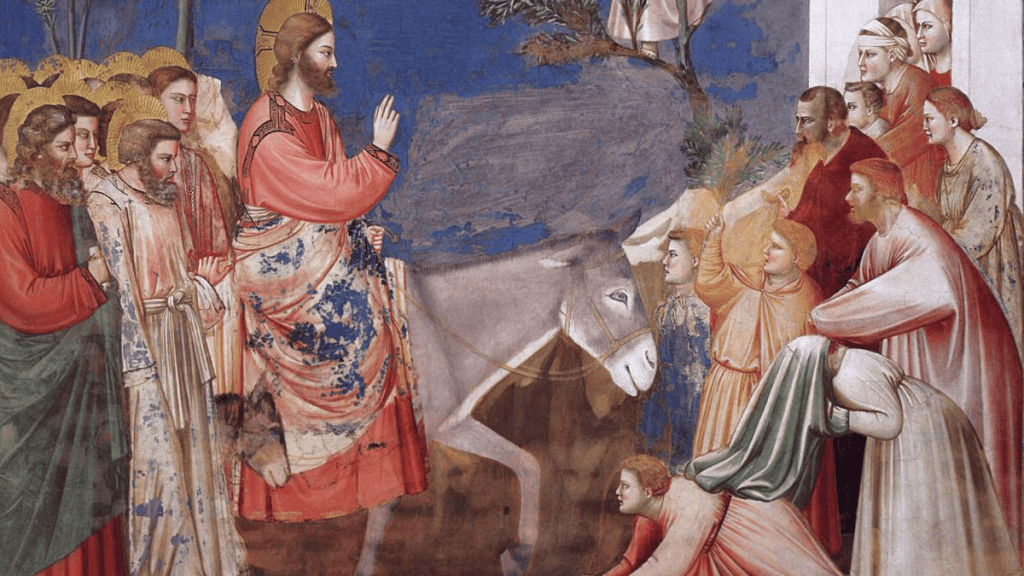
These cognate meanings have all filtered and splintered through centuries of donkeys’ representations as pitiable beasts of burden. Unlike numerous other species, our myths and religions rarely imagine the animals as zoomorphic deities. Instead, they are most often entrusted with the duties of carrying or accompanying those of a higher exulted or sacred status. It is donkeys we turn to when we need a creature to act as the companions to our Gods, kings, and saints, bearing the likes of Jesus to Jerusalem or accompanying Dionysus’ revelrous processions.
Most interestingly, this subordination often allows donkeys to play the archetype of the ‘wise fool,’ understanding and delivering wisdom that is imperceptible to their apparent masters. Fans of Eddie Murphy’s portrayal of Donkey in Shrek (2001) might be surprised to discover that a talking ass also appears in the Hebrew Bible’s Book of Numbers. When the diviner Balaam beats his donkey for halting unexpectedly, he is shocked to discover that it is because it has seen an angel that remains invisible to him, and all the more startled when it is granted the power of speech and turns back to him, asking “what have I done to you, that you have struck me?” (22:28).
Whether represented as doltish beasts or oppressed chattel, donkeys’ cultural meanings are all positioned respectively of their masters’ authority and/or cruelty. I was delighted, recently, to discover that the University of Exeter recently launched a course in collaboration with Devon’s The Donkey Sanctuary titled ‘Scrublands, Sanctuary, Screens: Co-Creating Knowledges alongside Donkeys.’ Deputy CEO of the Sanctuary and anthrozoologist Faith Burden would explain that “by observing and spending time with the donkeys here in Sidmouth, these students will have the chance to develop a lifelong appreciation of what sensitive and intelligent animals they really are, and the impact their work can have on them” (qtd. in Merrington 2025).
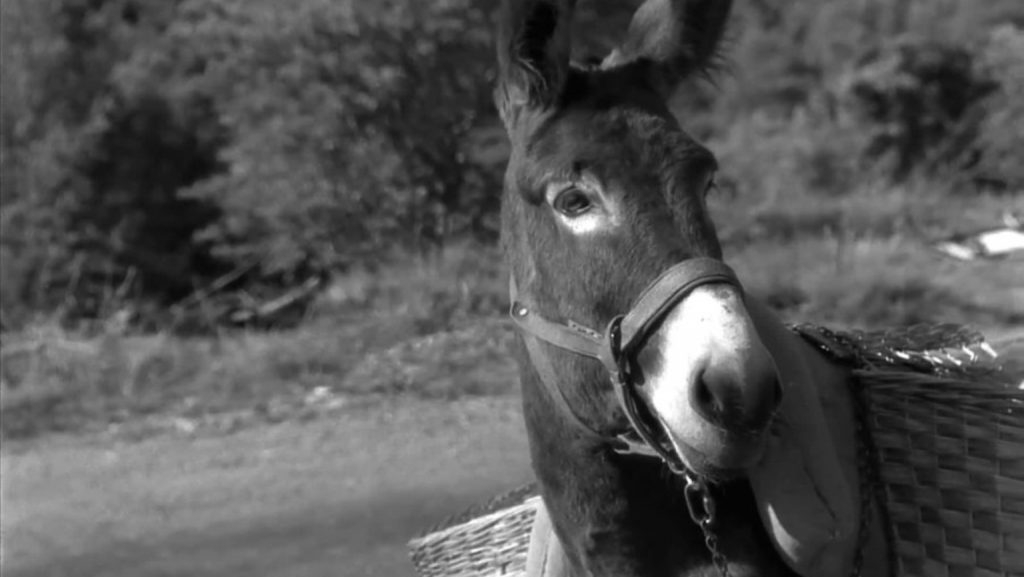
For any student of film attempting to understand the weight of cultural representations borne by donkeys, Robert Bresson’s 1966 feature Au hasard Balthazar (1966) is surely a landmark production. Not only is its identity entirely constructed around the animals’ mythic significance, but it explores these issues while cementing itself as one of the most celebrated films ever made. Bresson was already an established filmmaker by the time that fellow countrymen François Truffaut, Jean-Luc Godard, Claude Chabrol, and Éric Rohmer began tearing up the movie-making rule book as part of the French New Wave in the late 1950s. As such, Au hasard Balthazar acts as an exemplar of the director’s idiosyncratic aesthetic, tragically rendering the life of a put-upon donkey as its ownership is passed between members of a small Pyrenean community,
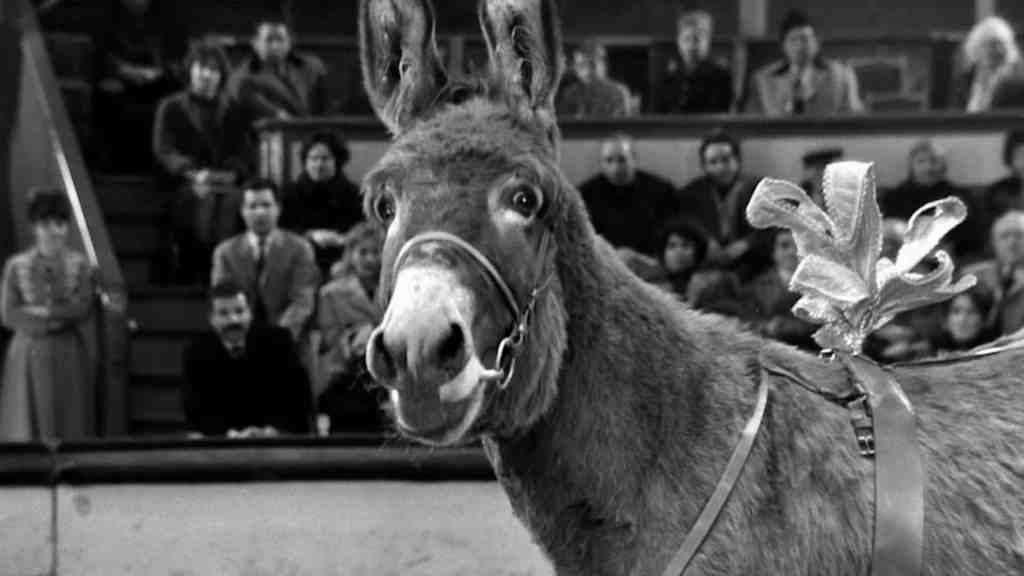
From relentless draught work and circus performances, to his final labours spent carrying smuggled goods, none of the tasks endured by the donkey are spent in his own self-interest. Balthazar’s experiences position him as an observer to a world ordered by human mercilessness. Almost everyone that the donkey encounters is either keen to exploit him or powerless to protect him. From agricultural exertion, to entertainment, and criminal utility, Balthazar’s identity is valued solely as a commodity to be mistreated and degraded by those who attempt to profit from him.
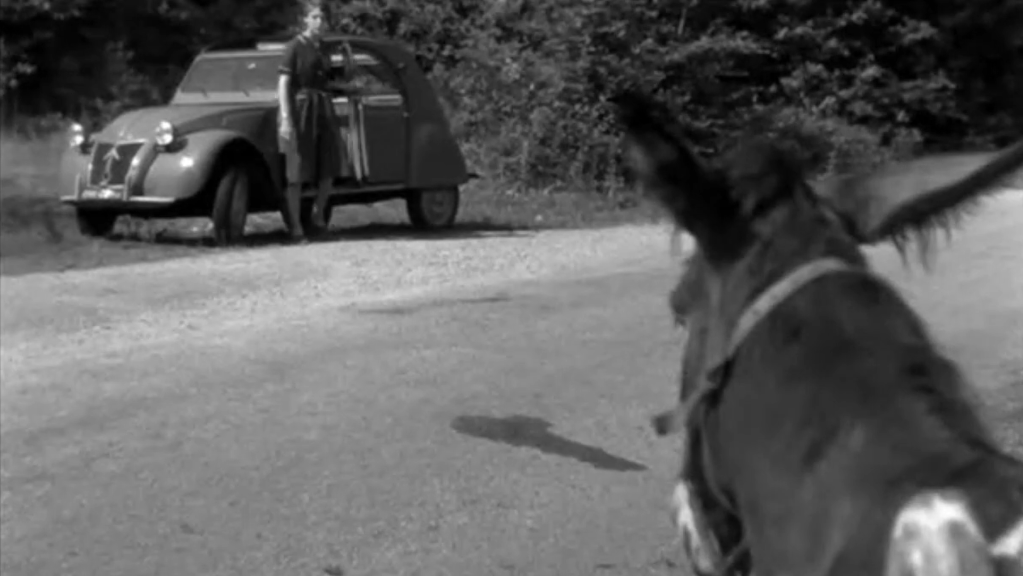
In an oft-cited endorsement of the film, Jean-Luc Godard would claim that Bresson’s ability to microcosmically compact all of existence into the contemplative look of his non-human protagonist meant that “in an hour and a half[…] we see the entire world from childhood to death” (qtd. in ‘Un metteur en ordre: Robert Bresson,’ 2005). Bresson himself would state that one of his key aims was to depict “the passage of this donkey, who passes through different human groups representing the vices of humanity” (qtd. Godard & Delahaye, 1967: 11).
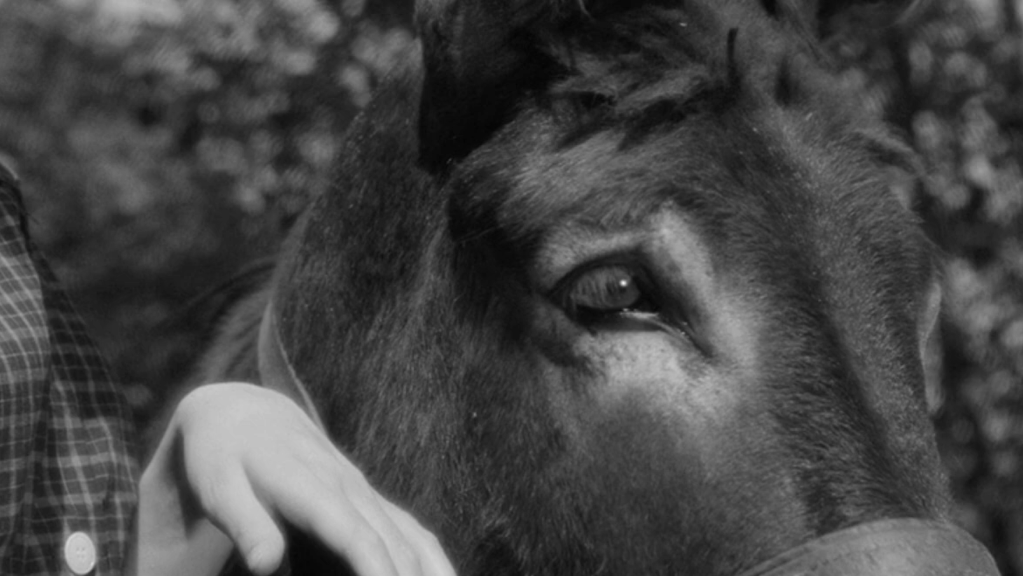
Part of this style ensures that Au hasard Balthazar’s narrative privileges ellipses over procedural cause and effect. Rather than track the precise mechanics of the donkey’s comings and goings, audiences are invited to explore the cumulative acts of human cruelty and apathy that make up his experiences. Many of the film’s most powerful scenes rely on the juxtaposition of close ups of Balthazar’s expressive features with those of the human-managed world that surrounds him. Sharon Cameron describes the donkey as an “experiencing presence,” writing that his eye “is passive, beautiful, seemingly omnipresent in its witnessing of events, an eye that could be profound, but is in fact unfathomable” (2011: 6-7). In one particularly notable scene, Balthazar is restrained and forced to work in the afore-mentioned circus, his eyes meeting those of various animals that are similarly restrained in cages. Bresson doesn’t need human narration, Balthazar’s silent observations speak volumes.
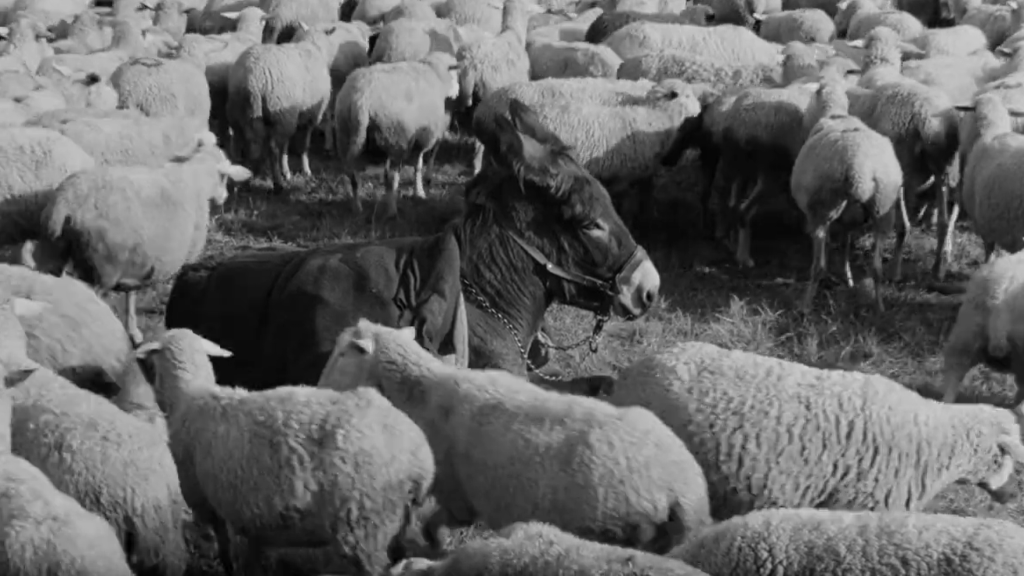
Other cinematic tools serve similar purpose. The film’s final scene features one of the most emotionally devastating cuts I have observed in some time. When Balthazar, overcome by a gunshot wound, collapses, the moment of his demise is hauntingly concealed by Bresson’s edit. A shot of the donkey lying in the grass, bleeding and lolling, cuts to the flock of sheep that have gathered around him, before slowly panning over to his now prostate form, the last reserves of his stamina depleted. The continuity between the images is maintained by the lamentory sound of Schubert’s Piano Sonata no. 20 and the gentle chiming of the sheep’s bells as they bustle around his lifeless body.
Filmmakers are often warned against working with either animals or children, but in his zoological cast, Bresson seems to have found the perfect subjects to match his own distinctive attitudes to performance. To achieve his films’ startlingly direct sense of emotional realism the director famously preferred to work with non-professionals. “No actors. (No directing of actors),” he would write, “No parts. (No learning of parts)” (1977: 1). Instead, he would relate to his cast as “BEING (models) instead of SEEMING (actors)” (ibid.). Bresson’s aim was to illicit intuitive and spontaneous responses from his performers, and, while the animals themselves are manoeuvred in completely fabricated situations, his emphasis on their gaze acts as a window into their completely unfiltered perspectives of the world.
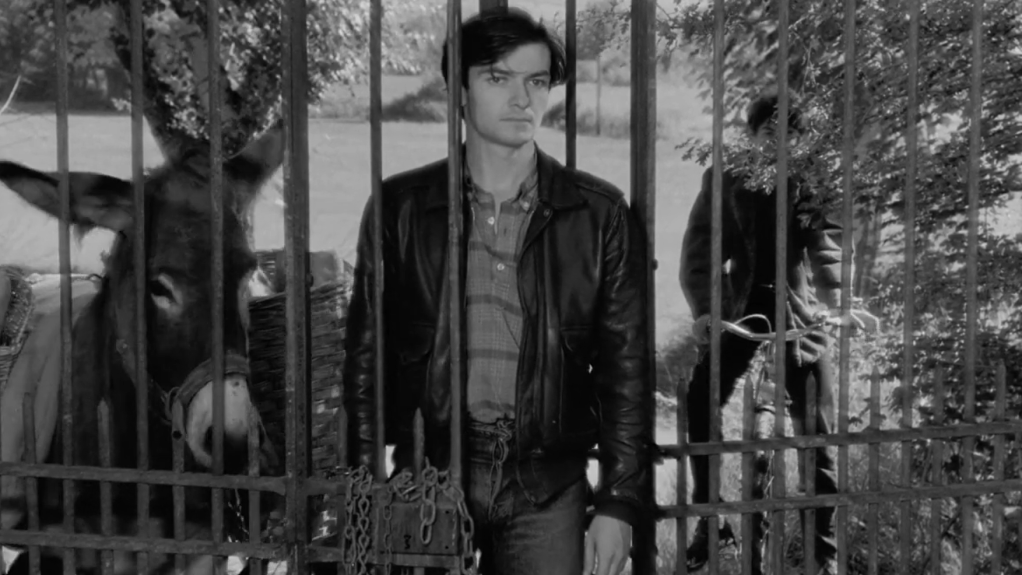
As a witness to human sin who is mocked, beaten, and eventually slain, Balthazar’s life takes the form of an animalian passion play. Balthazar’s biblical name and martyred death, situated on his own pastoral Golgotha, consecrated by the flock’s bells, reminds us why Bresson is often referred to as the ‘patron saint of cinema.’ Such sacramental themes can be traced through many of the director’s productions, developed from his Catholic upbringing and later interest in Jansenist predestination. As André Bazin would memorably opine, Bresson’s work “offers us a new dramatic form, that is specifically religious – or better still, specifically theological; a phenomenology of salvation and grace” (1967: 136).
However, Bresson’s work defies simple allergisation. Beyond its theological leanings, Balthazar’s guileless innocence can similarly be traced through the modern influences of Prince Myshkin’s tragic arc in Fyodor Dostoevsjky’s The Idiot (1869) and latter characterisation such as Peter Sellers’ extraordinary performance in Hal Ashby’s Being There (1979). Dostoevsky’s work seems to have proved a particularly profound impact upon Bresson. When Myshkin is overcome by intense melancholy, for example, it is the uninhibited braying of a donkey that rouses him, initiating something of an obsession with the animal. “I saw the donkey and was extremely pleased with it,” he would narrate, “and from that moment my head seemed to clear” (Dostoevsjky, 1869 [2025]: 36).
In The Idiot, the donkey’s vocalisation acts as a clarion call of animalistic existence, an eruption of non-human perspective in a decidedly human world. Similarly, in Bresson’s film, Balthazar’s cry carries through several key moments in his life, inarticulate and indecipherable for his human audience, but consequential nevertheless. Writing on the subject, Rochelle Rives argues that the unintelligibility of Balthazar’s bray compliments Bresson’s emphasis on his similarly bewildering gaze and, in doing so, “explores the question of human lack and anxiety, but from a perspective of in which the physicality of the animal challenges anthropomorphic values of ‘expression’ or ‘voice’” (2016: 346).
It is something of a tradition of humanity to dismiss forms of communication that do not meet us on our own terms. Defining such an issue as the “language myth,” Sinéad Kwok argues that humans have a nasty habit of refusing to acknowledge animal sentience if the creatures are unable to match our own form of verbal communication (2020: 62). “These conceptions provide sources for the stable, categorical definitions manifested through speech,” she writes, “including definitions of the human and nonhuman kind (thus the world human would stand for a stable category, so would the word animal)” (ibid.). Somewhat counterintuitively, therefore, we categorise our own form of intelligence as superior based upon our ignorance of vocalisations that we can not make sense of.
Like Balthazar, Dostoevsky’s Myshkin has his own intellectual dignity undermined by his inability to conform to social codes that privilege words over gesture. Although Bresson would maintain that Au hasard Balthazar was not a direct reworking of The Idiot’s own donkey, he would claim that the comparisons between human and animal in Dostoevsjky’s text were “magnificent”: “that idea of having the idiot say, when he sees the donkey and hears him bray: There! I understood!… that is extraordinary: that is genius” (qtd. Godard & Delahaye, 1967: 25).
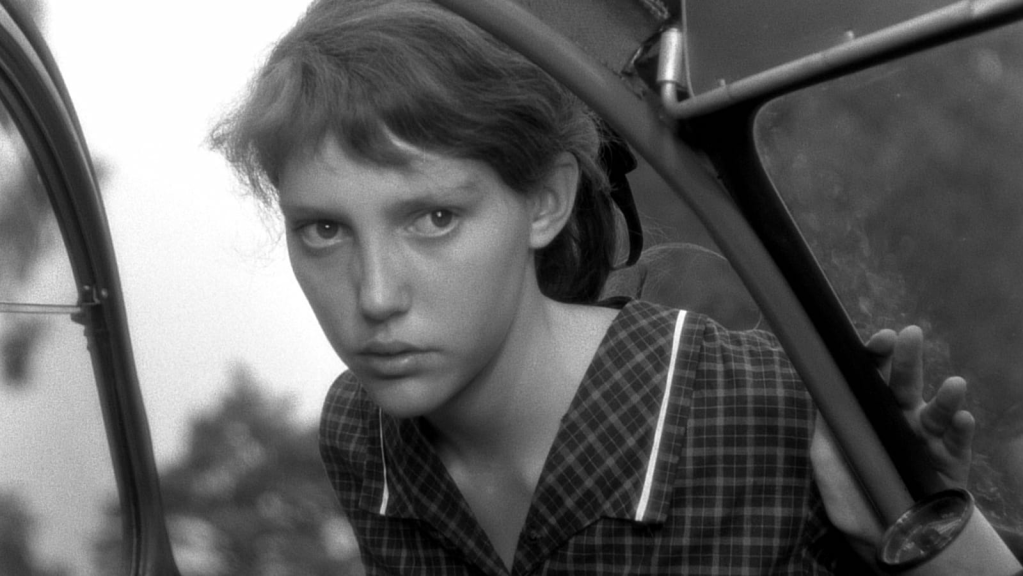
Significantly, Bresson and Dostoevsky’s work also shares a character named Marie, both of whom are exploited by predatory suitors and left emotionally, materially, and socially ruined. In Au hasard Balthazar, Anne Wiazemsky’s Marie is one of the donkey’s sole sources of tenderness. Their time together offers brief respites in dramatic trajectories that descend in parallelling spirals towards tragedy. Close ups of Marie’s hands caressing Balthazar’s fur allow Bresson to foreground the intimacy of their relationship, while those where the girl coronates him by weaving a crown of flowers into his bridle honours him with a degree of dignity and adoration that he will not receive elsewhere.
Predictably, Gérard, the young delinquent whose malice and selfishness leads to both their misfortunes, cannot comprehend the closeness of their relationship. Played by François Lafarge with youthful spite and swagger, the miscreant implies to his friend that the relationship between girl and donkey must be sexual in nature if they truly “love” one another. Gérard and his friend’s conception of love is utterly incompatible with that of Marie’s. For them, intimacy is acquired purely through intimidation and sexual coercion. Marie’s affection for Balthazar is, in counterpoint, as alien and unknowable as the donkey’s own brays.
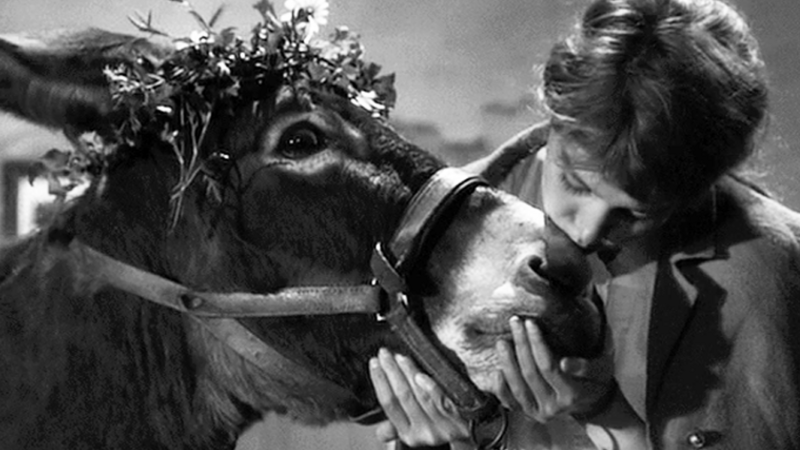
Writing for Bright Lights Film Journal, Alexandra Kulik argues that Balthazar and Marie’s bond reflects the indelible connection of both feminist and animal rights discourse, arguing that Gérard’s incredulity dramatizes, “the sadly abiding notion that certain beings hold dominion over supposed weaker beings, and that feminine values such as compassion and pacifism should be subjugated” (2016). Indeed, both Marie and Balthazar’s suffering can be traced to the androcentrism of their world. Their respective dignities are repeatedly disregarded through various processes of chauvinistic exploitation.
Not for the faint of heart, the film offers a powerfully cynical representation of a society driven by mercenary greed and commodification, where the girl and donkey’s autonomies are objectified through acts of bartering and outright theft. When Marie seeks refuge at the home of the elderly miller, Pierre Klossowski, he immediately seeks the opportunity to buy a night with the young girl. “Life’s nothing but a fairground, a marketplace where even your word is unnecessary. A banknote will do,” he argues. As with Balthazar, Marie’s bodily identity is valued as a commodity that can be purchased, or, as is the case with Gérard in an earlier sequence, stolen entirely.
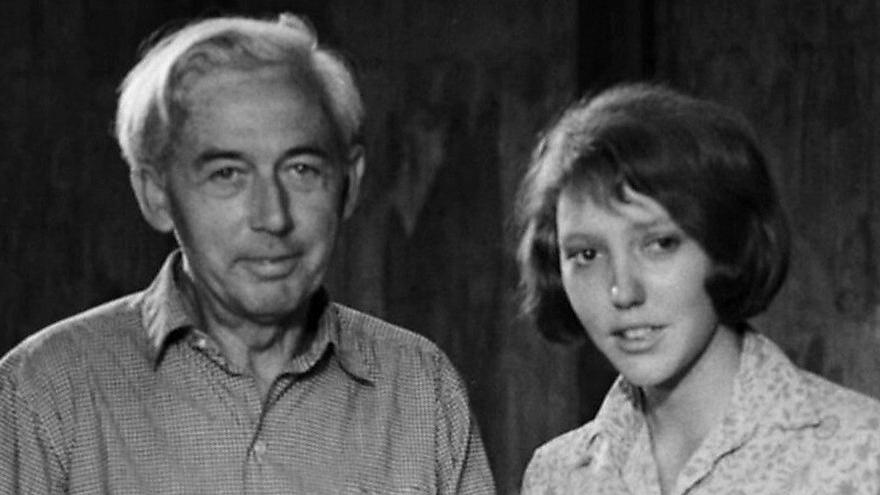
Balthazar and Marie’s parallelisms offer numerous opportunities to revisit Godard’s famous suggestion that the girl is herself “I dare say, another donkey” (qtd. Godard & Delahaye, 1967: 11). It’s a statement that clumsily attempts to describe their shared suffering, but more clearly indicates the male-dominated lens of the film industry itself (qtd. Godard & Delahaye, 1967: 11). In the years afterwards, Anne Wiazemsky would, for example, outline her need to continually rebuke Bresson’s advances while filming the feature. In her 2007 autobiography, Jeune fille (‘Girl’), she would remember the director, nearly fifty years her elder, repeatedly holding her arm and attempting to initiate increasingly uncomfortable behaviour: “his mouth sought mine. I found it unbearable and pushed him away,” she would write, “he let go of me and gazed at me with a look of distress, as if I were causing him immense pain.” (2007: 87-88).
While undoubtedly a production deserved of its lofty cultural status, Au hasard Balthazar is a pointed reminder of the astonishingly skewed systems of power that shape the film industry itself. Bresson wasn’t the only director to develop an infatuation with Wiazemsky. The year after Au hasard Balthazar’s release the actress would marry Jean-Luc Godard, having met him during the film’s production. In a later autobiography, Une année studieuse (2012), Wiazemsky would claim that Godard’s interview with Bresson for Cahiers du Cinéma (the very same exchange cited within this article) acted as a pretence to meet her, after he had become besotted with a photograph he had seen of her (2012: 11).
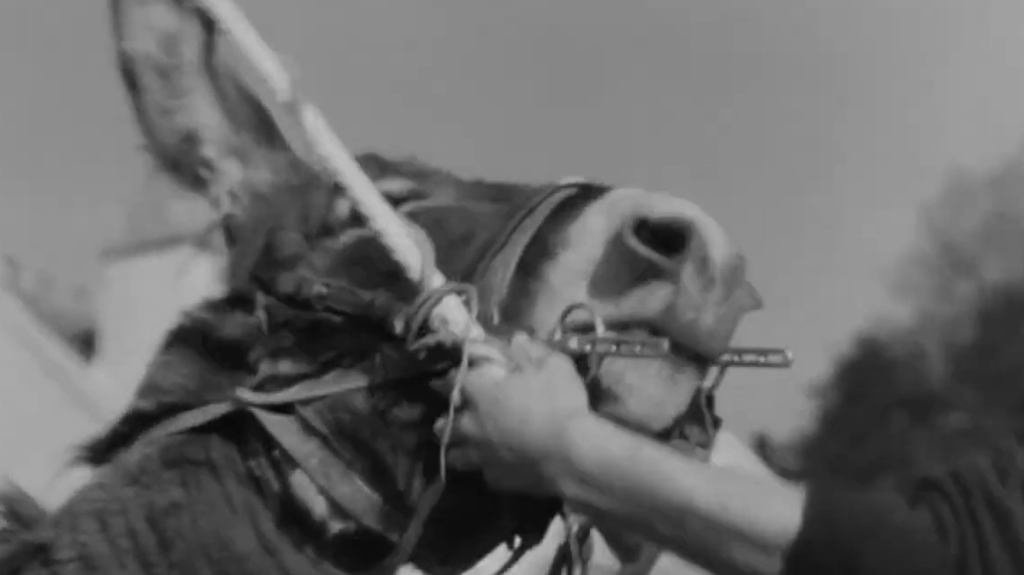
Just as the power imbalances concerning Marie and Wiazemsky’s experiences echo on-and off-screen, Au hasard Balthazar also forces us to reconcile with the uncomfortable realities that surround the use of animals on film. The identities and experiences of the donkeys that depict Balthazar on set are poorly documented, though it has been reported that “none were trained” and they were, therefore, difficult to work with (Bough, 2011: 68). Even if scenes where the donkeys are lashed and beaten were simulated, clear displays of distress and unease recall the film’s own explorations of non-human voicelessness and disempowerment. There are, thankfully, few scenes that ring particularly concerning alarm bells, but a sequence in which Gérard ties a wad of newspaper to Balthazar’s tail and sets it alight to force him to move appears troublingly unsimulated.
I am overdue writing a dedicated article that attempts to consider the muted successes of the various regulatory bodies that have historically attempted to ensure acceptable standards of animal welfare within the film industry, but a litany of scandals and accusations reveal the systematic failure to treat such creatures with any measure of dignity. For those interested, ‘Towards enhancing animal welfare standards in UK media,’ published over the last couple of years as Part 1 (2024) and Part 2 (2025), attempt to cover the debate regarding the British film industry, and are worthy of attention. Predictably, they observe several ongoing concerns and argue for “a clear need for change” that “must apply to all stakeholders, from those who train and supply the animals to the production companies booking their services” (Lambert et al., 2025: 19).
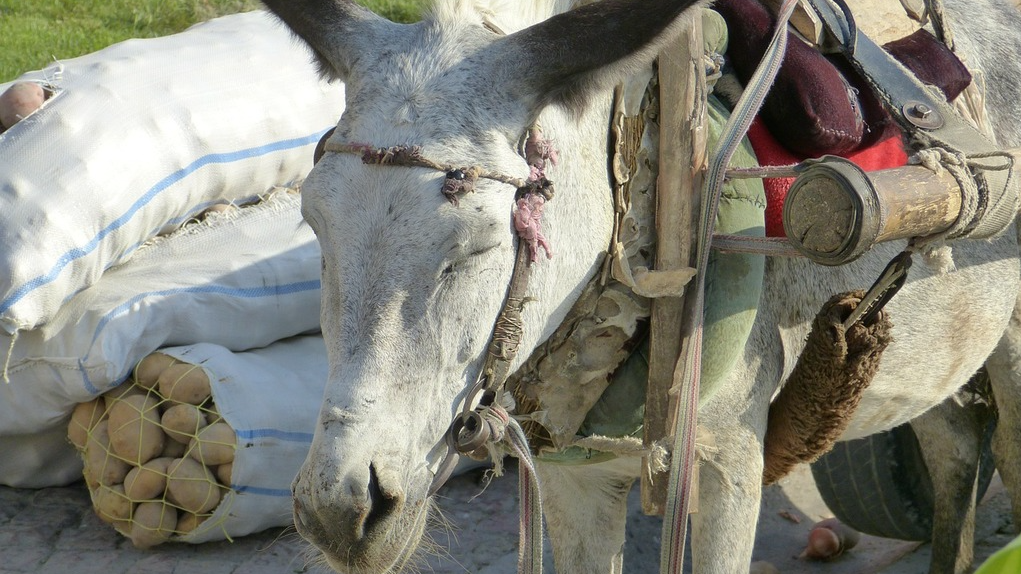
Outside of cinema, the widespread use of donkeys in labour-intensive and low-capital industries makes tracking the extent of the species’ mistreatment an impossible endeavour. Used for agriculture, haulage, construction, mining, and tourism, the animals remain one of the most commonly exploited due to their resilient and adaptable natures. In their recent article, ‘Scoping Review of the Socioeconomic Value of Working Equids’ (2026), Amelia Cameron et al. attempt to consider the complex questions that surround the creatures’ welfare and the dependencies that ensure numerous low- and middle-income communities remain incredibly reliant on their use. They note that “long work hours, limited rest opportunities, overloading, unsuitable tack and equipment, and a lack of access to suitable food, water, and shelter,” are compounded by a lack of access to veterinary services to compromise the welfare of such animals (Cameron et al. 2026: 2).
These issues impact not only the creatures themselves, but the numerous communities who rely on working donkeys for their survival. The common issues of “lameness, poor body condition, wounds, colic, infectious disease, and parasites” threaten not only to kill thousands of donkeys annually, but also leave their owners without access to the water, transport, or earnings upon which they depend (ibid.). Cameron et al.’s report highlights the importance of supporting researchers and policymakers to enact meaningful change in various aid programmes, arguing that governments should be lobbied to ensure that working equids and their owners are included in “resource and funding allocations and the development of health and welfare programmes” (ibid.: 41).
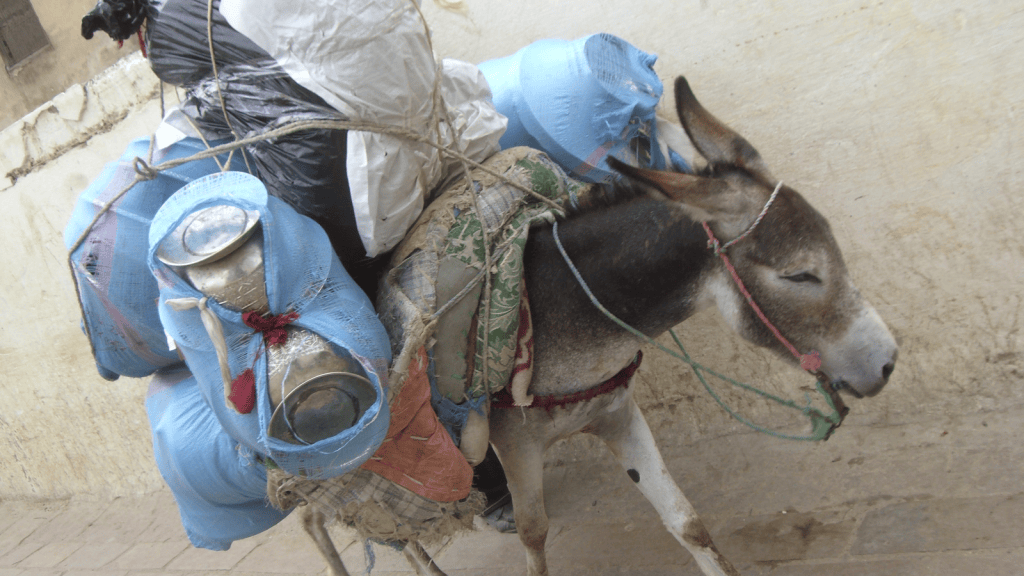
In the UK, especially, there is a frustratingly common discourse surrounding our nation’s seemingly disproportionate degree of sentimentality for the plight of donkeys. Last year alone, The Telegraph, The Times, and The Sun all published articles that helped enflame the public level of scorn directed to the number of legacy donations left to British sanctuaries (Mosbacher, 2025, Arbuthnot, 2025, & Hamilton, 2025). The Telegraph’s Michael Mosbacher deserves special mention for his callous disregard when shoehorning his views of Brexit into the discussion, defining the British “mawkishness when it comes to lesser creatures” in seeming opposition to our European neighbours (2025).
Such attitudes are prevalent across the political spectrum. An investigation by The Guardian noted the animosities that resulted from the Devon Donkey Sanctuary receiving “more in one year than several well-known charities working to combat violence against women did between them” (Glendinning, 2008). Later, they would publish another article that considered the growing number of court cases instigated by disinherited relatives contesting inheritances left to such causes (Barkham, 2015). Donkeys have, therefore, taken on new symbolism in Britain. They have become emblematic of a sentimental victimhood that seeks to misdirect the limited resources required for causes that are considered to be worthier or of more direct self-interest.
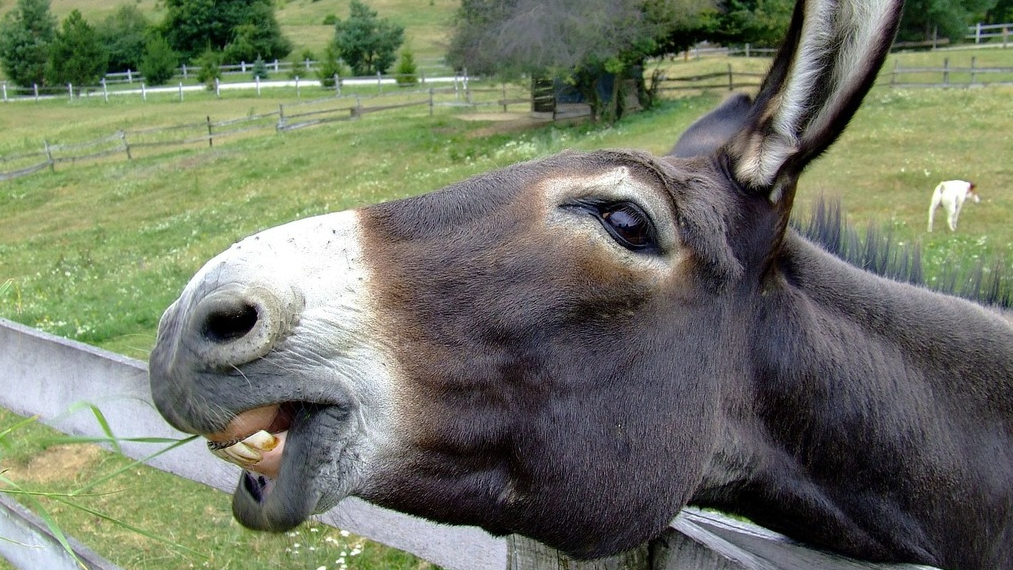
Current research highlights the uneasy “paradox of collaboration and competition” that sees charities forced to vie for a limited resource of donations, while acknowledging the operational benefits of collaboration towards a shared common good (Garner, 2026: 8). For the sanctuaries, such donations remain both necessary and meaningful. The Guardian’s former article highlighted that the Devon Donkey Sanctuary’s residents’ average lifespan of 27 years could be extended past 50 if given the proper care (Glendinning, 2008). Similarly, the charity’s funds have been instrumental in partnering with several environmental organisations to expose the illegal trafficking of donkey skins for use in the production of ejiao, a Chinese product used for medicinal purposes. Their most recent report estimates that at least 5.9 million donkeys are slaughtered to maintain the current ejiao market (The Donkey Sanctuary, 2025: 9).
As with the animals’ general welfare, trade of donkey skins has had an irreparable impact upon the living standards of those who own the animals, with widespread theft devastating the lives of the communities and families who own them (ibid.). The Donkey Sanctuary draws on research that evidences that “donkey-owning households in Ghana, for example, derive up to 60% of their income from donkeys. In other cases, working equines support 100% of the annual income of households reliant on crop and cow milk sales” (ibid.: 17). The use of such labour frees up menial tasks that “would otherwise fall to women and children,” allowing for opportunities for childcare, employment, and education that would otherwise prove impossible” (ibid.:18).
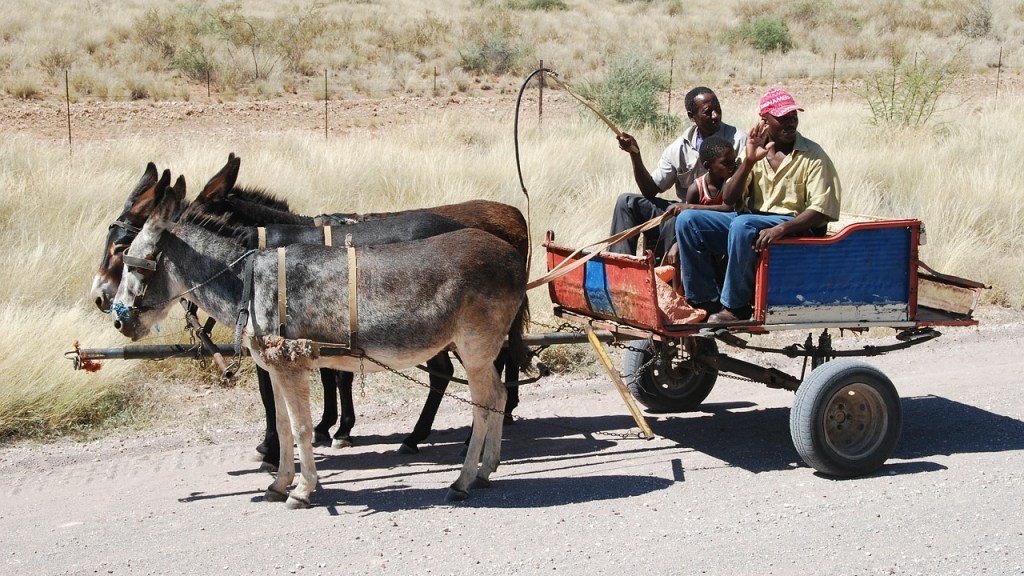
Here in the UK, rising costs of living have resulted in organisations such as the RSPCA reporting “worrying levels of animal abandonment and neglect” (qtd. ‘Sanctuary Sees spike in Dumped Abused Donkeys,’ 2026). In March of this year, Linda Gilbert of Barnhill Donkeys Retreat, Penrith, stated that her sanctuary “ran out of barn space” in this period, and observed that “the state of abuse, neglect and illness these donkeys are in is unprecedented” (ibid.) “We are in the process of extending the stable yard,” she continues, “but our feed costs have quadrupled and all other bills have rocketed” (ibid.).
The financial sustainability of such charities should not be taken for granted. Earlier this year, there was shock when horse and donkey sanctuary Redwings closed its sites in both Oxhill and Forfar, citing escalating costs in operation (Blackman, 2026). The closures resulted in the loss of 40 local jobs, two visitor centres that drove local trade and tourism, as well as the rehoming of up to 100 animals to their charity’s Norfolk base (ibid). Neither has Devon’s The Donkey Sanctuary, the largest charity of its type in the UK, been immune to such closures (Adewale, 2024). As CEO Mike Baker would state when acknowledging growing public scrutiny into expenditures, “people say The Donkey Sanctuary is really rich, they come here to see 200 donkeys looking very pampered, imagining them sipping tequila in hammocks but what they don’t see is all the welfare work we do here and overseas in 40 countries. That costs a lot of money and is a significant part of our work” (qtd. Finch, 2018).
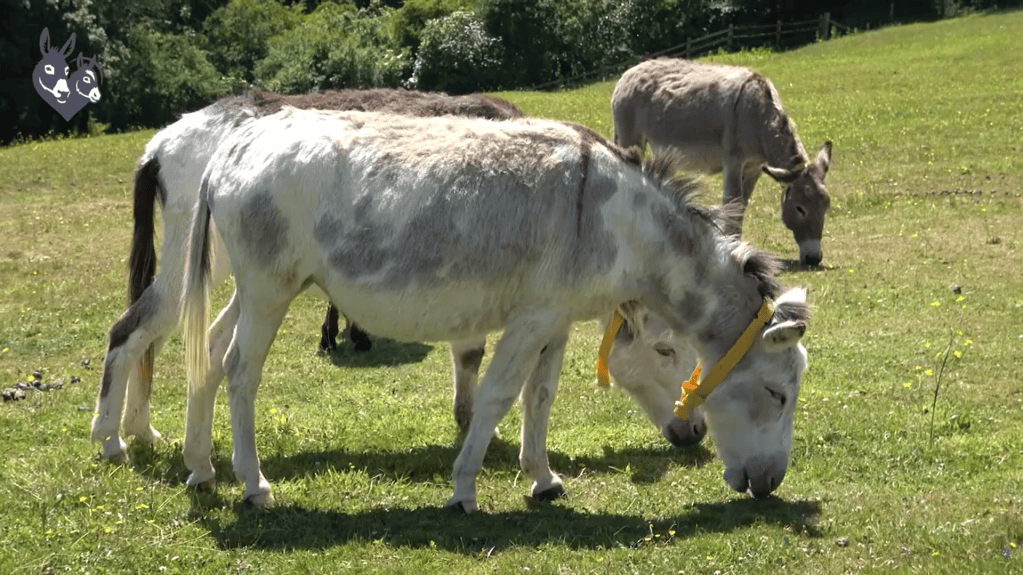
Rather than being siloed, the support of animal welfare causes is highly intersectional. It is essential that we recognise the significant interconnections that can be traced throughout the needs of countless marginalised and threatened groups, species, and peoples around the world. An exceptional exemplar of such collaborative causes can be found in the efforts of Ann Odari Onditi, of Kakdhimu, Kenya, who formed an organisation called Amani-K Women Group to help her community better understand how their health and well-being is indelibly tied to that of their donkeys. Describing the effects of ejiao-related trafficking, she would state that “my village has lost seven donkeys in total and my self-help group lost four […] these donkeys were essential to our livelihoods, and their assistance cannot be replaced by any other animal we rear” (td. Lucy 2024).
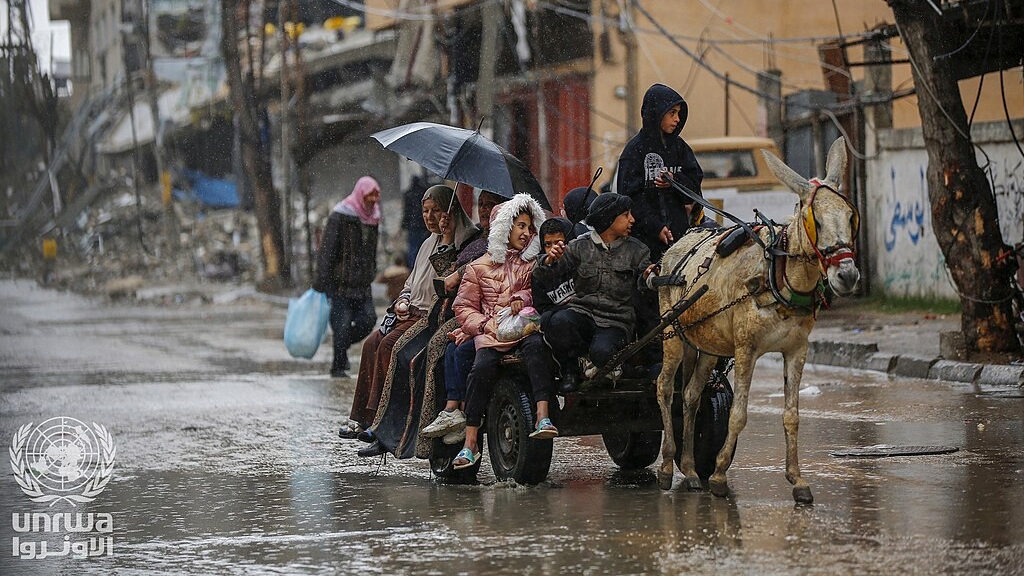
Nor should it be surprising that the species has become a symbol of Palestinian endurance amidst the violence ravaging the West Bank and Gaza. Acts of direct attack, seizure, deprivation, and forced separation have led to the abandonment of countless donkeys and other farm animals necessary for the survival of Palestinian communities (Braverman, 2026). In the summer of last year, Palestinian political analyst Ahmed Najar reflected on the animals’ significance when his family was faced with repeated displacement following Israel’s ceaseless bombardment of Gaza, writing that “in that wreckage – in the dust and the terror – donkeys became ambulances, buses, lifelines” (2025).
Whether respected as a pillar of our communities’ well-being, or disregarded as a supposedly ‘lesser’ creature to be exploited and eventually transformed into an object of rescue, Au hasard Balthazar highlights the donkey’s position within a complex web of human cruelty, suffering, and penance. Bresson’s skills as a filmmaker ensure that Au hasard Balthazar’s status among the top of institutional polls such as Sight & Sound and the BBC show no signs of abating, while its influences can be traced through later productions such as John Abraham’s Tamil-language Agraharathil Kazhutai (‘Donkey in a Brahmin Village.’ 1977) and Jerzy Skolimowski’s more recent EO (2022).
When writing ‘Beast of Burden: Bresson’s Balthazar,’ Russell Campbell and Gretchen Hunter question, “why a donkey? Is Bresson concerned about cruelty to animals?” 1973: 21. Their answer is a firm “no – except insofar as the torture of Balthazar represents the treatment meted out to most sentient beings under the existing socioeconomic system […] the beating of Balthazar by Gerard and his gang, for example, seems but a dress rehearsal for what they will later do to Arnold and Marie” (ibid.). The question remains as to what Balthazar’s species means to us: cyphers of only human suffering or beings worthy of their own intrinsic respect.
In Farmed Animals on Film: A Manifesto for a New Ethic (2023), Stephen Marcus Finn argues that, in spite of the continuous anthropomorphised readings of the film, “it is more pertinent to consider Au hasard Balthazar as a film that makes a case for animal rights” (162). Our tendency to dismiss the worthiness of Balthazar’s own significance reminds me of the virtuoso director and, let us not forget, past Nazi-sympathiser, Ingmar Bergman’s opinion that the film was “completely boring” due to the fact that the life of a donkey is, apparently, “completely uninteresting,” whereas “a human being is always interesting” (qtd. Baumbach, 2007).
Such disinterest and apathy in both practice and theory, still present today, poses a sizeable problem. Film is surely at its most potent when directed against such indifference. The power of cinema’s spectacle resides in its ability to transport us to worlds and states of being outside our own. It is a machine capable of eliciting societal and individual empathy. Anything else is simply egocentrism. Balthazar’s gaze has enthralled audiences for decades and will surely do so for many more to come. Like all great art, it demands that we look.
If you’ve read this far, and want to contribute to organisations that confront some of the issues covered in this article, please consider donating or engaging with the following:
Refuge, the UK’s largest organisation of its kind in the UK, helping thousands of women and children escape domestic abuse across the country.
Disasters Emergency Committee’s Middle East Humanitarian Appeal, where funds are directed to those in need across Gaza, Lebanon, the West Bank and Syria.
Brooke are notable for working with numerous communities around the world to improve the standards of welfare for both people and their working animals.
There are many donkey and horse sanctuaries worthy of your support, Hope Pastures do important work rescuing, rehabilitating, and rehoming numerous animals in my local area.
Head Image: Au hasard Balthazar, Cinema Ventures, 1966.
Adewale, Dami. 2024. ‘Almost 60 Jobs at Risk as Donkey Sanctuary Proposes Centre Closures,’ Third Sector, May 21: https://www.thirdsector.co.uk/almost-60-jobs-risk-donkey-sanctuary-proposes-centre-closures/management/article/1873485.
Agraharathil Kazhutai. 1977. D. John Abraha, Film. India: Nirmithi Films.
Arbuthnot, Leaf. 2025. ‘We Give Donkeys £40 million a Year — Madness or Money Well Spent?’ The Times, October 12: https://www.thetimes.com/life-style/wildlife-nature/article/were-giving-donkeys-40-million-a-year-this-is-what-it-buys-them-n9nss9hbc.
Au hasard Balthazar. 1966. D. Robert Bresson, Film: Cinema Ventures.
Barkham, Patrick. 2015. ‘Battle of the Bequests: Animal Charities v Disinherited Relatives,’ The Guardian, July 28: https://www.theguardian.com/lifeandstyle/shortcuts/2015/jul/28/animal-charities-relatives-bequests-will-daughter-mother.
Baumbach, Noah. 2007. ‘On Robert Bresson and Filmed Animals,” Fiction International: https://fictioninternational.sdsu.edu/wordpress/catalog/issue-40-animals/on-robert-bresson-and-filmed-animals/.
Bazin, André. 1967. What is Cinema? [trans. Hugh Gray]. Berkeley: University of California Press.
Blackman, Alec. 2026. ‘Rising Costs May Force Horse Sanctuary to Close,’ BBC News, February 28: https://www.bbc.co.uk/news/articles/c15xw5kg3v2o.
Bough, Jim. 2011. ‘The Mirror Has Two Faces: Contradictory Reflections of Donkeys in Western Literature from Lucius to Balthazar,’ Animals 14.1: 56-68.
Braverman, Irus. 2026. ‘Donkeys Are a Symbol of Endurance for Palestinians – They Are Also a Target of Settler Violence and Care,’ The Conversation, April 27: https://theconversation.com/donkeys-are-a-symbol-of-endurance-for-palestinians-they-are-also-a-target-of-settler-violence-and-care-275639.
Bresson, Robert. 1977. Notes on Cinematography [trans. Jonathan Griffin]. New York: Urizen Books.
Cameron, Amelia, Freeman, Sarah L., Wild, Isabella, Burridge, Jessica, & Burrell, Katie. 2026. ‘Scoping Review of the Socioeconomic Value of Working Equids, and the Impact of Educational Interventions Aimed at Improving Their Welfare,’ Animals 16. 165: 1-47.
Cameron, Sharon. 2011. ‘Animal Sentience: Robert Bresson’s Au hasard Balthazar,’ Representations 114. 1: 1-35.
Campbell, Russell & Hunter, Gretchen. 1973. ‘Beast of Burden: Bresson’s Balthazar,’ The Velvet Light Trap 9: 19-22.
Collodi, Carlo. 1883 [1917]. The Adventures of Pinocchio, Chicago: Whitman Publishing.
The Donkey Sanctuary. 2025. Donkeys in Global Trade – Stolen Donkeys, Stolen Futures: The Impact of Ejiao on Africa’s Women and Children: https://www.thedonkeysanctuary.org.uk/articles/donkey-skin-trade-fuels-crisis-for-africas-women-and-children.
Dostoevsjky, Fyodor. 1869 [2025]. The Idiot [Trans. Eva Martin], ebook: Global Grey.
EO. 2022. D. Jerzy Skolimowski, Film. Poland & Italy: Gutek Film.
Finch, Hannah. 2018. ‘Fact Checking the Myth That The Donkey Sanctuary Is the Richest Charity in the UK,’ Devon Live, August 2: https://www.devonlive.com/news/fact-checking-myth-donkey-sanctuary-1853052.
Finn, Stephen Marcus. 2023. Farmed Animals on Film: A Manifesto for a New Ethic. Cham: Springer Nature.
Garner, Johny T. 2026. ‘Frenemies for Good: The Paradox of Collaboration and Competition Among Nonprofit Organizations,’ Voluntas: International Journal of Voluntary and Nonprofit Organizations: 1-9.
Glendinning, Lee. 2008. ‘Donkeys in Clover – but Charity Leaders Call for a Rethink,’ The Guardian, April 26: https://www.theguardian.com/society/2008/apr/26/voluntarysector.animalwelfare.
Godard, Jean-Luc & Delahaye, Michel. 1967. ‘Robert Bresson Interview,’ Cahiers du Cinema in English: 5-27.
Hamilton, Michael. 2025. “Brits Left Seven Times More Cash in Wills to Animals Than Soldiers During 2024 – Including £38m to Donkey Sanctuary,” The Sun, October 4: https://www.thesun.co.uk/news/36913779/will-legacy-donations-animal-charities-veterans/.
Lambert, Helen, Gordon, Jody, Jackson, Laura, Rogers, Suzanne, Clubb, Rob, White, Jo, Lewis, Sophie. 2024. ‘Towards Enhancing Animal Welfare Standards in UK Media: Part 1; Insights from Public Opinion and Attitudes,’ Human-Animal Interactions 12. 1: 1-14.
Lambert, Helen, Gordon, Jody, Jackson, Laura, Rogers, Suzanne, Clubb, Rob, White, Jo, Lewis, Sophie. 2025. ‘Towards Enhancing Animal Welfare Standards in UK Media: Part 2; Insights from the Industry,’ Human-Animal Interactions 13. 1: 1-20.
Lucy, Ivan. 2024. ‘How a Women’s Group is Preserving a Vital Asset in the Face of Disaster,’ Nax Today, May 23: https://nax.today/news/article/705/womens-group-preserving-an-asset-in-the-face-of-disaster.
Merrington, Andrew. 2025. ‘New Course Offers First-Ever Critical Analysis of the Representation of Donkeys in Film,’ University of Exeter, February 18: https://news.exeter.ac.uk/faculty-of-humanities-arts-and-social-sciences/communications-drama-and-film/new-course-offers-first-ever-critical-analysis-of-the-representation-of-donkeys-in-film/.
Milne A. A. 1926. Winnie-the-Pooh. London: Methuen & Co. Ltd.
Mosbacher, Michael. 2022. ‘Welcome to Britain, Where Donkeys Are More Deserving of Our Wealth Than Our Leaders,’ The Telegraph, February 23: https://www.telegraph.co.uk/money/leave-money-donkeys/.
Najar, Ahmed. 2025. ‘Israelis ‘Rescue’ Donkeys From Gaza, and Now My Disabled Mother Can’t Flee IDF Strikes,’ Hareetz, July 20: https://www.haaretz.com/opinion/2025-07-20/ty-article-opinion/.premium/israelis-rescue-donkeys-from-gaza-and-now-my-disabled-mother-cant-flee-idf-strikes/00000198-186a-dd64-abb9-ba7b6ef80000.
Orwell, George. 1945. Animal Farm: A Fairy Story. London: Secker & Warburg.
Rives, Rochelle. 2016. ‘“The Voice of an Animal”: Robert Bresson and Narrative Form,’ symplokē 24. 1-2: 345-370.
Rossel, Stine, Marshall, Fiona, Peters, Joris, Pilgram, Tom, Adams, Matthew D., O’Connor, David. 2008. ‘Domestication of the Donkey: Timing, Processes, and Indicators,’ Proceedings of the National Academy of Sciences 105. 10: 3715–3720.
‘Sanctuary Sees spike in Dumped Abused Donkeys.’ 2026. BBC News, March 12: https://www.bbc.co.uk/news/articles/ceqve7lxpydo.
Shrek. 2001. D. Andrew Adamson & Vicky Jenson, Film: Dreamworks Pictures.
‘Un metteur en ordre: Robert Bresson.’ 2005. Au hasard Balthazar, DVD: Criterion Collection.
Wiazemsky, Anne. 2007. Jeune fille, Paris: Gallimard.
Wiazemsky, Anne. 2012. Une année studieuse, Paris: Gallimard, 2012.
 Creature Features: Animal Welfare on Screen