
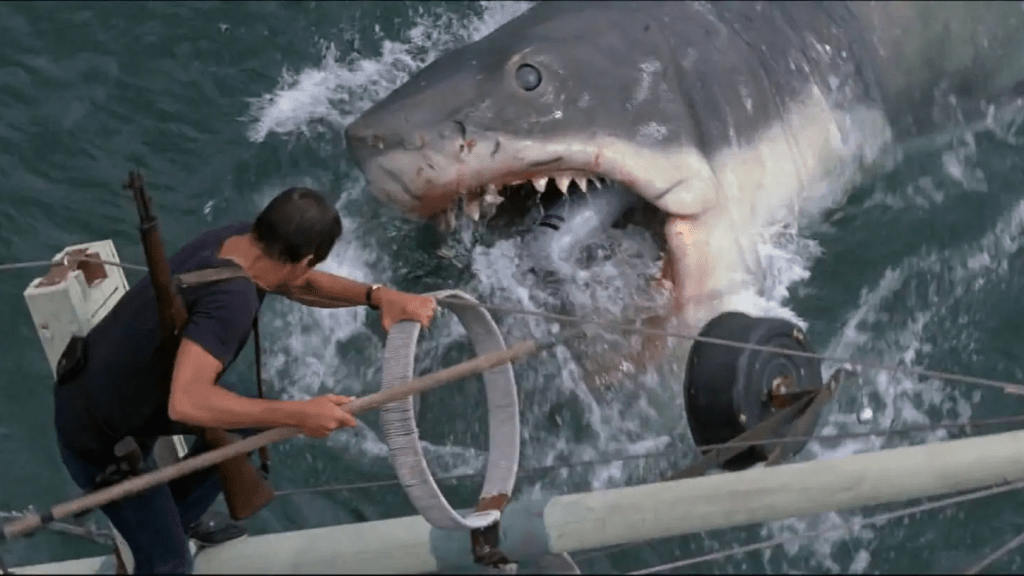
Before Luke Skywalker learnt to use the Force and before Superman taught us that a man can fly, Jaws (1975) used the toothy imagery of a great white shark to usher in the birth of the blockbuster. It was the mid-1970s, and Hollywood’s major studios no longer sat at the top of the food chain. Instead, investment in lower-budget and often subversive productions like Bonnie and Clyde (1967), The Graduate (1967), and Easy Rider (1969) were proving a smoother passage to financial reward than throwing untold millions into spiralling behemoths such as Cleopatra (1963), Mutiny on the Bounty (1962), and Doctor Doolittle (1967). With the release of Jaws, however, up-and-coming filmmaker Steven Spielberg reminded the industry of the indisputable power of adrenaline-fuelled spectacle. Existential dramas about the American psyche were out; B-movie aesthetics, awe-inspiring monsters, and special effects were in!
As Linda Ruth Williams and Michael Hammond would summarise, Jaws was “the must see ‘event-movie’ cut to the measure of the big screen, a sure-fire draw that would take families away from their television sets” (2006: 117). In the years since, there have been few movies so frequently discussed, with its tales of behind-the-scenes pandemonium firmly established within the annals of Hollywood legend. The film’s recent 50th anniversary revived interest in the chaotic nature of its production, while Ian Shaw and Joseph Nixon’s stage show, The Shark is Broken (2019), has been met with universal praise for comedically dramatising the intense rivalry between its stars.

Peter Benchley, the author of the original 1974 novel, had been inspired by his experiences fishing off the waters of Nantucket, as well as a news article from 1964 about “a fisherman who caught a 4,550lb great white off the beaches of Long Island” (Benchley qtd. Dowling 2004). As literary critics of the time noted, Jaws was no Moby Dick (1851), but the frightening prospect of a shark terrorising a seaside community was potent enough to fuel over half a century of oceanic suspense.
Although Spielberg made use of a few shots of actual sharks during the production of his film, those predominantly seen on screen are animatronic. Three fake great whites were constructed, powered by hydraulic motion so that their immense steel armatures, covered in rubber latex, could thrash around dramatically, while colossal jaws, lined with polyurethane teeth, could chomp together threateningly. Collectively named Bruce after Spielberg’s lawyer, the near constant malfunctioning of these sharks turned a fraught production into one that frequently skirted disaster. A special ‘shark sled’ had to be constructed underwater, allowing the mechanical creatures to be mounted on an adjustable arm and moved along the water’s surface. Battered by seawater and perpetually breaking down, Spielberg would describe them collectively as “the Great White Turd,” as they took enormous bites out of a budget and schedule that were steadily trebling in size (qtd. Fordy, 2025).
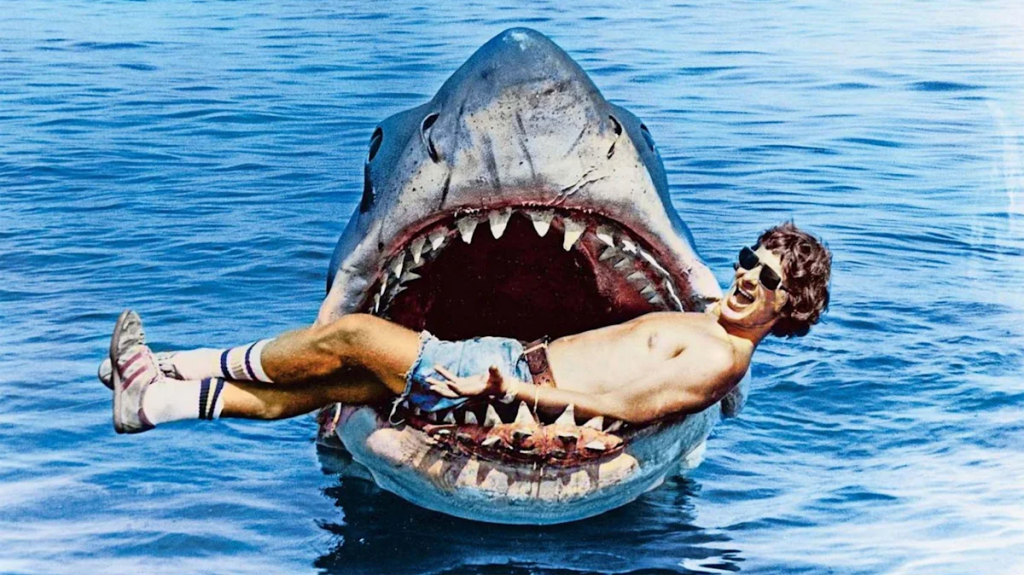
Despite Jaws’ turbulent production, no one could dispute its eventual success. At the box office, it would overtake The Godfather (1972) as the highest-grossing film of all time, subsequently dismounted from its position by the arrival of Star Wars (1977) two years later. The frothing waters of Amity Island seemed to wash away the post-Watergate era of popular American cynicism, with Brody’s heroism providing the nation a victory over a primordial evil that transcended ideological affiliations. The great white’s ravenous appetite for human flesh seemed to have no preference for political allegiance. This was a threat that all could be united against.
The central myth of Jaws, that of man against nature, was perfectly encapsulated in the marketing materials for the film, which famously reworked the eye-popping painting by Roger Kastel that adorned the cover of Bantam Books’ own publication of the mass-market paperback. Positioning a human victim on the verge of being devoured to ensure that no one could mistake the beast’s scale, the evocation that “here be monsters” acts as one of the most memorable designs in both film and literature’s visual history.
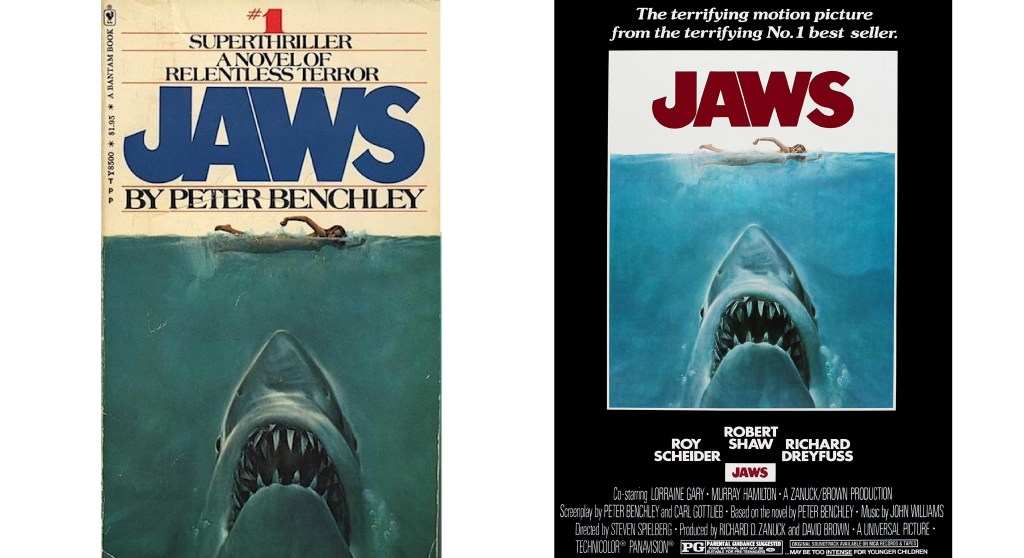
The mythos surrounding the great white shark featured in Jaws was, of course, a constructed fantasy. From an uncharacteristic temperament, vindictively targeting humans, to the supernatural power and endurance required to chomp and smash through the heroes’ vessel, the Orca, the shark in Jaws holds little in common with its real-world equivalents. Even Kastel’s infamous painting used a stuffed mako from the American Museum of Natural History as a point of reference, rather than a great white (Chen 2025).
Jaws’ conceptual power draws upon centuries of human fascination with these predators. Interestingly, most of the cultures that have shared closest proximity to sharks have placed them in positions of veneration. The Māori’s mythical Parata controls the tides with each immense breath it takes beneath the ocean’s surface, while the Fijian Dakuwaqa is known as a protector of fishermen. A reverence for sharks extends to widespread beliefs, found in Hawaii and the Solomon Islands, that the people’s ancestors could take the form of the fishes, allowing them to act as spiritual guides. The fact that sharks are adept at signalling prosperous fishing waters, and have been known to swim alongside vessels such as canoes, evidences the strong foundations upon which these traditions are rooted (Flannery & Flannery 2023).

Europeans attempting to expand their power in the age of sail had a different attitude. Frightening encounters with sharks on long voyages led the English mariners of the sixteenth century to refer to the creatures as ‘sea dogs,’ before adopting the word ‘shark’ that had previously been used to refer to otherwise human scoundrels, villains, and swindlers. Herman Melville himself would sum up such anthropomorphism in his own descriptions of the animals, describing the “rude, savage swagger” of the tiger shark as “a round, portly gourmand; with distended mouth and collapsed conscience, swimming about seeking whom he might devour.” “No wonder, then,” he would add, “that sailors denounce them” (1849: 60).
Whether valorised or vilified, sharks have, famously, outlived us all. The earliest evidence we have of these cartilaginous creatures dates them back at least 450 million years, surviving five mass extinction events that each variously devastated and wiped-out comparative species (Davis 2018). Is it really possible that a single monster movie from the 1970s could have an indelible impact on their wellbeing? ‘The Jaws Effect,’ as it has become known, attempts to track the extent that the film reshaped audiences’ relationships to sharks and quantify the increased levels of hostility and measurable violence that the animals have been subjected to.
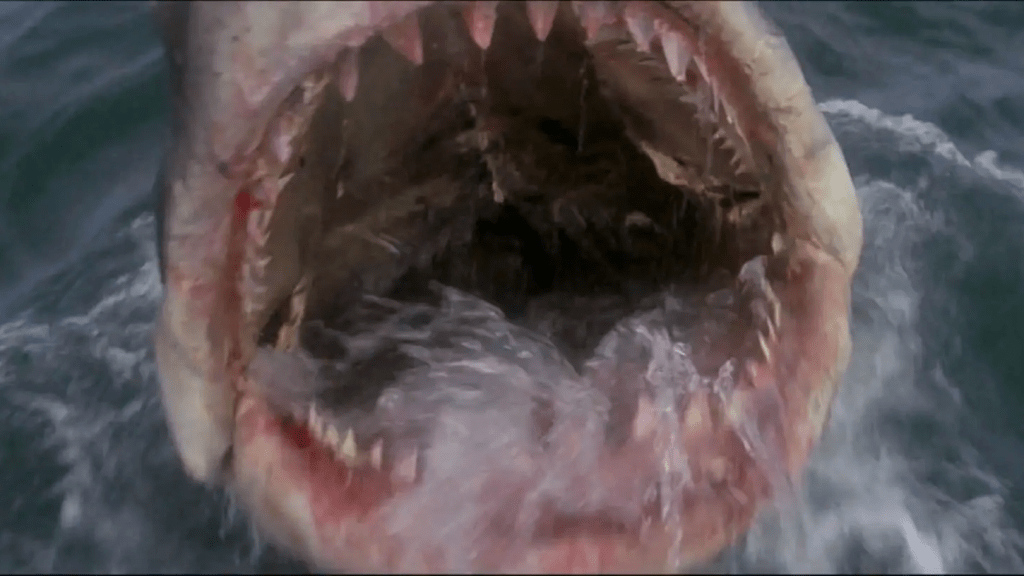
As with much of cinema’s history, the furore surrounding Jaws’ release was emboldened by media hype and hysteria. Notably, the film’s PG certificate came at a time preceding the creation of the PG-13 in 1984, and the public were astonished by the film’s gratuity. Charles Champlin would write for The Los Angeles Times that “Jaws is nightmare time for the young. Even the mature are apt to be jolted harder by Jaws than by earlier jeopardy films. Violence done to the helpless, always the hardest to watch, is here compounded because the victims are in the water, an alien environment, demanding and potentially dangerous at best. The inability to flee or fight back, as in a nightmare of paralysis, is real and only too easy to identify with” (qtd. Woerner 2015).
Universal would licence towels with the slogan ‘if you’re brave… take it to the beach!’ while a tidal wave of media panic accompanied ‘shark scare’ stories to capitalise upon the public’s mounting fears. A Gallup poll conducted at the time of Jaws’ release reported that 23% of men and 47% of women admitted that the film “increased their fear of swimming in the ocean” (Saad 2025), while many have continued to claim that it contributed to a “marked drop in beach attendance” after audiences saw it in cinemas (Fisher 2010).
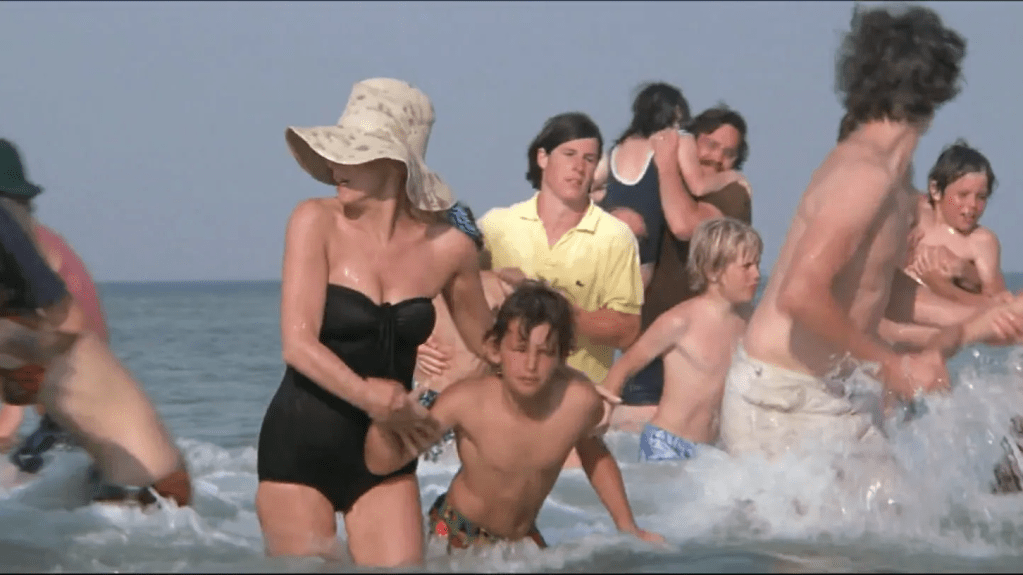
Despite evidence that you are seventy-five times more likely to be killed by a bolt of lightning, already something of a statistically freak occurrence, than suffer the same fate to the jaws of a shark (Naylor 2023), many studies have observed the film’s contribution to a growing hostility towards the fishes. Social scientist Christopher Neff would argue, for example, that the Australian government drew directly on Jaws’ mythos to promote legislation that “allowed for pre-emptively killing individual sharks” that strayed near waters used by humans (2015: 123). His research highlighted what he described as “a worrying style of policymaking where widely known fiction can be used to navigate the attribution of blame and to prescribe policy responses” (ibid: 125).
Similarly, as Monster Shark Tournaments grew in popularity across the East Coast of the U.S. throughout the 1980s, such competitions would often promote themselves by vilifying the animals’ apparent hostility and position their own activities as responsive acts of social responsibility. In 2016, The Guardian would release a list of major corporations that provided lucrative sponsorship deals to such ‘catch and kill’ events, many of which targeted endangered species. These included organisations such as Coca-Cola, Lexus, Caterpillar, Budweiser, Ford, and Captain Morgan, as well as numerous others (Milman & Mathiesen 2016). Entry fees, cash prizes, and sizeable side bets made such events fiercely competitive and subject to numerous scandals surrounding cheating and prohibited fishing. The wanton slaughter of sharks was not only culturally condoned; it was a practice that could be highly profitable.
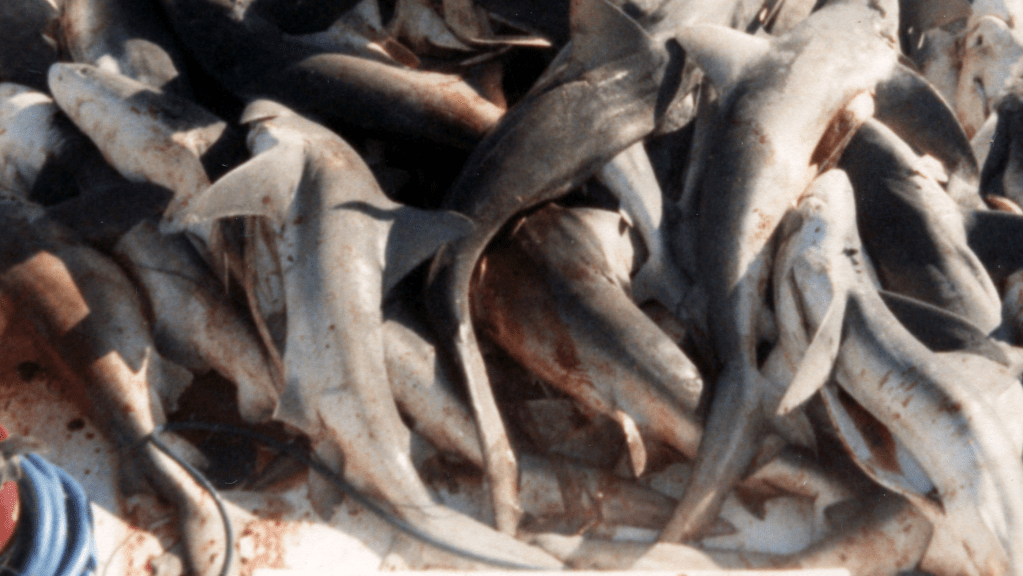
As Ashley D. Keefer summarises of such recreational bloodshed, “sharks, as apex predators, are vital to maintaining the balance of marine ecosystems. That ecological balance markedly impacts the tourism-driven economy of local communities. Despite our awareness of the critical importance of maintaining that balance, an estimated seventy-three million sharks are killed by humans each year. Those sharks would probably have a different take on who warrants fear” (2016: 291-292). Keefer goes on to describe how the fishes’ long-lived lifespans, delayed sexual maturity, and low birth rates make them “especially susceptible to human threats” (ibid: 295).
On screen, Jaws’ mythic representation of predatory terror was strong enough to fuel three direct sequels and popularise an entire sub-genre of ‘sharksploitation’ movies that hit critical mass with the release of The Asylum’s Sharknado (2013). Steven Spielberg himself would recently state that he “really and truly regret[s]” the contribution that his film played in stigmatising sharks in the world’s popular consciousness (‘Steven Spielberg,’ 2022), while Peter Benchley would dedicate much of his professional life to repudiating the claims his novel helped propagate. “What I now know, which wasn’t known when I wrote Jaws, is that there is no such thing as a rogue shark which develops a taste for human flesh,’’ the author would argue, “no one appreciates how vulnerable they are to destruction” (qtd. Delves Broughton 2000). As Benchley observed, despite changing attitudes, many of the species remain in severe danger if humans do not actively reassess their maligned reputation immediately.
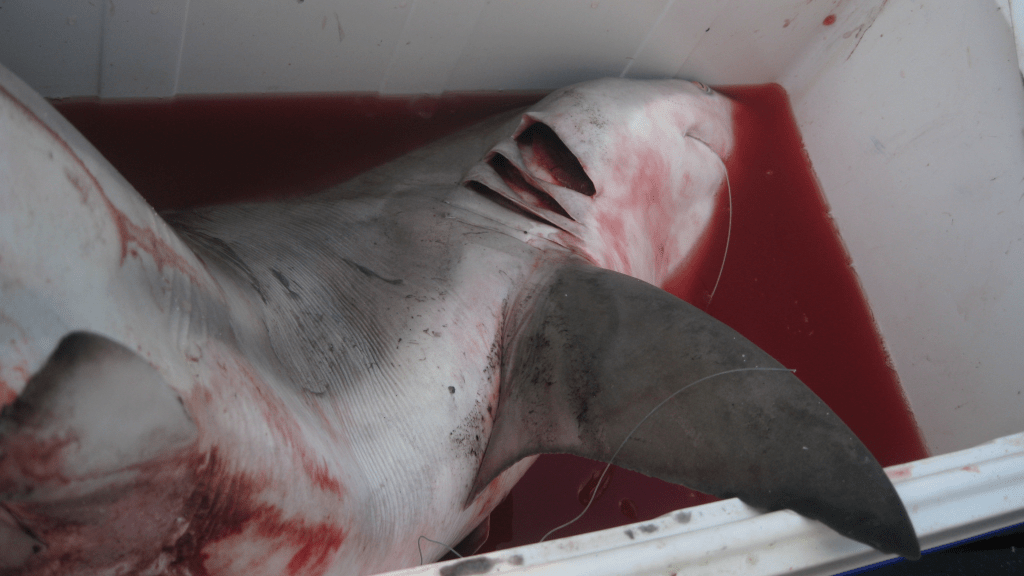
Changing perspectives and public advocacy have helped to shut down numerous monster shark tournaments over the last decade. However, troublingly, there is increased interest led by various fishing organisations and notable spokespeople within such competitions in effecting their return, despite the ecological consequences of doing so (Williams 2024). Similarly, important questions remain concerning the questionable survival rates of sharks caught in competitions that have since converted to seemingly ethical ‘catch and release’ practices. Many marine biologists are hard at work attempting to convince the public that animals caught in such a manner will still frequently die from the stress of fighting for their lives on the line and struggling outside the water (Geib 2023).
Distressingly, new research suggests that the great whites of the Mediterranean are on the cusp of total extinction. Overfishing, as well as the illegal fishing of protected species, has resulted in dwindling populations that are fast becoming unsalvageable (Gill, Stephens, Hughes & Nour 2025). Regulation of industrialised fishing, robust protections for endangered species, and further support to education and training programmes that enable communities to benefit from and utilise sustainable practices will undoubtedly help recover much of our damaged marine ecosystems. Time, however, is running short. Jaws provided audiences with one of the most archetypal figures of inept leadership and obstinate foolishness in Amity’s own Mayor Vaughn. This is the man who, famously, refused to close his island’s beaches despite expert advice and, importantly, witnessing measurable bloodshed. It is ironic, perhaps, that a film that so heavily maligns sharks also signals their only remaining course of salvation. Our own leadership needs to be equivalently pressured, if it is to listen to reason.
Head Image: Jaws, Universal Pictures, 1975.
Bonnie and Clyde. 1967. D. Arthur Penn, Film. US: Warner Bros. Pictures.
Chen, Min. 2025. ‘The Painting That Helped Jaws Make a Killing,’ Artnet, September 15: https://news.artnet.com/art-world/jaws-roger-kastel-academy-museum-2688384.
Cleopatra. 1963. D. Joseph L. Mankiewicz, Film. US: 20th Century Fox.
Davis, Josh. 2018. ‘Shark Evolution: a 450 Million Year Timeline,’ Natural History Museum, December 13: https://www.nhm.ac.uk/discover/shark-evolution-a-450-million-year-timeline.html.
Delves Broughton, Peter. 2000. ‘Jaws author now regrets his “attack” on sharks, The Salt Lake Tribune, April 4: http://www.igorilla.com/gorilla/animal/2000/sharks_peter_benchley.html.
Doctor Doolittle. 1967. D. Richard Fleischer, Film. US: 20th Century Fox.
Dowling, Stephen. 2004. ‘The book that spawned a monster,’ BBC News, February 1: http://news.bbc.co.uk/1/hi/entertainment/3400291.stm.
Easy Rider. 1969. D. Dennis Hopper, Film. US: Columbia Pictures.
Fisher, Luchina. 2010. ‘Jaws Launched Summer Blockbuster 35 Years Ago,’ ABC News, June 18: https://abcnews.com/Entertainment/jaws-launched-summer-blockbuster-35-years-ago/story?id=10855868.
Flannery, Tim & Flannery, Emma. 2023. From Gods to Monsters: How Did We Come to Fear the Shark?” The Guardian, July 29: https://www.theguardian.com/books/2023/jul/30/from-gods-to-monsters-how-did-we-come-to-fear-the-shark?.
Fordy, Tom. 2025. ‘Why Steven Spielberg hated the “star” of Jaws,’ The Telegraph, June 20: https://www.telegraph.co.uk/films/2025/06/20/why-steven-spielberg-hated-the-star-of-jaws/.
Geib, Claudia. 2023. ‘At Sharkathon, Shark Fishers Are a Keen Audience for Conservation Advice,’ Hakai Magazine, December 21: https://hakaimagazine.com/news/at-sharkathon-shark-fishers-are-a-keen-audience-for-conservation-advice/.
Gill, Victoria, Stephens, Kate, Hughes, Gwyndaf, & Nour, Ahmed. 2025. Great white sharks face extinction in Mediterranean, say researchers,’ BBC News, December 30: https://www.bbc.co.uk/news/articles/c9qe9wvq534o.
The Godfather. 1972. D. Francis Ford Coppola, Film. US: Paramount Pictures.
The Graduate. 1967. D. Mike Nichols, Film. US: United Artists.
Jaws. 1975. D. Steven Spielberg, Film. US: Universal Pictures.
Keefer, Ashley. 2016. ‘We’re Gonna Need a Bigger Boat”: How Federal Regulations of Shark Fishing Tournaments Could Shift the Tides of Conservation Initiatives,’ Jeffrey S. Moorad Sports Law Journal 23. 1, pp. 291-336.
Melville, Heman. 1849. Mardi: and a Voyage Thither, London: Richard Bentley.
Melville, Herman. 1851. Moby-Dick; or, The Whale. New York: Harper & Brothers.
Milman, Oliver & Mathiesen, Karl. 2016. ‘Monster shark fishing tournaments face growing pressure to reform,’ The Guardian, July 19: https://www.theguardian.com/environment/2016/jul/19/atlantic-shark-hunting-tournaments-endangered-species.
Mutiny on the Bounty. 1962. D. Lewis Milestone, Film. US: Metro-Goldwyn-Mayer.
Naylor, Gavin. 2023. ‘The International Shark Attack File,’ Florida Museum, May 31: https://www.floridamuseum.ufl.edu/shark-attacks/.
Neff, Christopher. 2015. ‘The Jaws Effect: How movie narratives are used to influence policy responses to shark bites in Western Australia,’ Australian Journal of Political Science 50. 1, pp. 114-127.
Saad, Lydia. 2025. ‘Gallup Vault: Jaws Made Waves in 1975,’ Gallup, June 20: https://news.gallup.com/vault/691907/gallup-vault-jaws-made-waves-1975.aspx.
The Shark is Broken. 2019-2025. W. Ian Shaw & Joseph Nixon, Play. London: Samuel French.
Sharknado. 2013. D. Thunder Levin, Film. US: The Asylum.
Star Wars. 1977. D. George Lucas, Film. US: 20th Century-Fox.
‘Steven Spielberg.’ 2022. Desert Island Discs, BBC Radio 4, December 18.
Williams, Linda Ruth & Hammond, Michael. 2006. Contemporary American Cinema. Maidenhead: McGraw-Hill.
Williams, Ted. 2024. ‘It’s time for America to outgrow shark tournaments,’ Hatch, July 27: https://www.hatchmag.com/articles/its-time-america-outgrow-shark-tournaments/7715957.
Woerner, Meredith. 2015. ‘L.A. Times’ original 1975 review of Jaws unearthed: We hated it,’ The Los Angeles Times, June 20: https://www.latimes.com/entertainment/herocomplex/la-et-hc-jaws-original-review-20150619-story.html.

