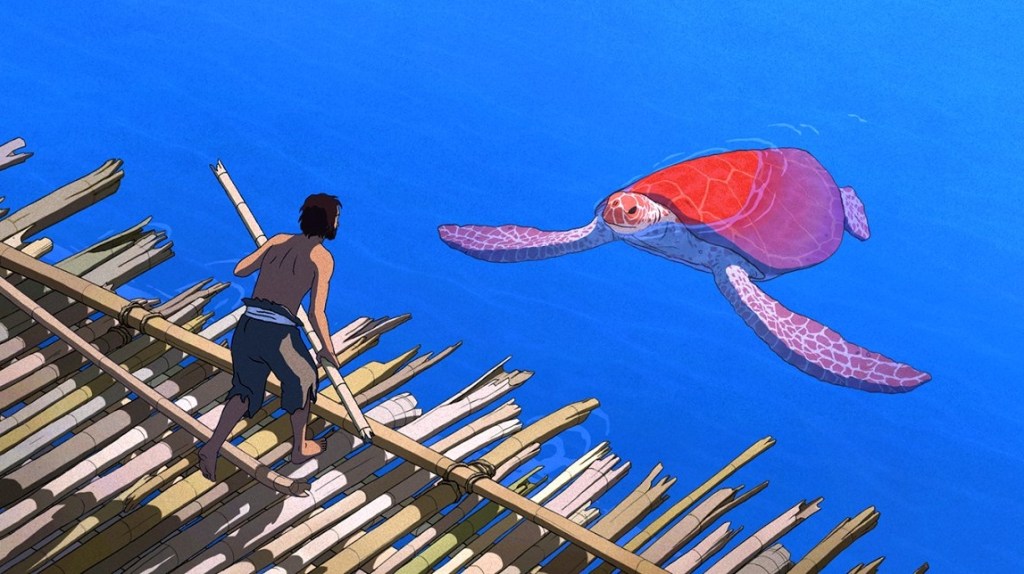
Those who know me best probably assume that, of all the films released to general audiences in 2017, Guillermo del Toro’s Academy Award-winning The Shape of Water surely secures the top spot in my heart. Not so. It was pipped at the post, remarkably, by another film about a human protagonist forming a romantic relationship with an aquatic creature. Once is happenstance; twice, as in this case, feels faintly conspiratorial. Whatever the case, I’ve championed The Red Turtle at almost every opportunity. Revisiting it now, ten years after its premiere in the Un Certain Regard section of Cannes, it remains an utterly beguiling animation that inspires reflection on the delicate ecosystems of our planet’s oceans.
Produced through an alliance of the Parisian arm of the European animation studio Wild Bunch and Tokyo’s own Studio Ghibli, The Red Turtle boasts a transcultural identity that is as adrift as its castaway protagonist. Impressed by the animated short films of Michaël Dudok de Wit, the producers at Ghibli wrote to the London-based Dutch filmmaker in the hope of collaborating on a feature. Watching Dudok de Wit’s prior shorts, it’s clear to see how his silent and painterly expressions of animals and objects, imbued with magical significance, would have charmed the talent at Ghibli.
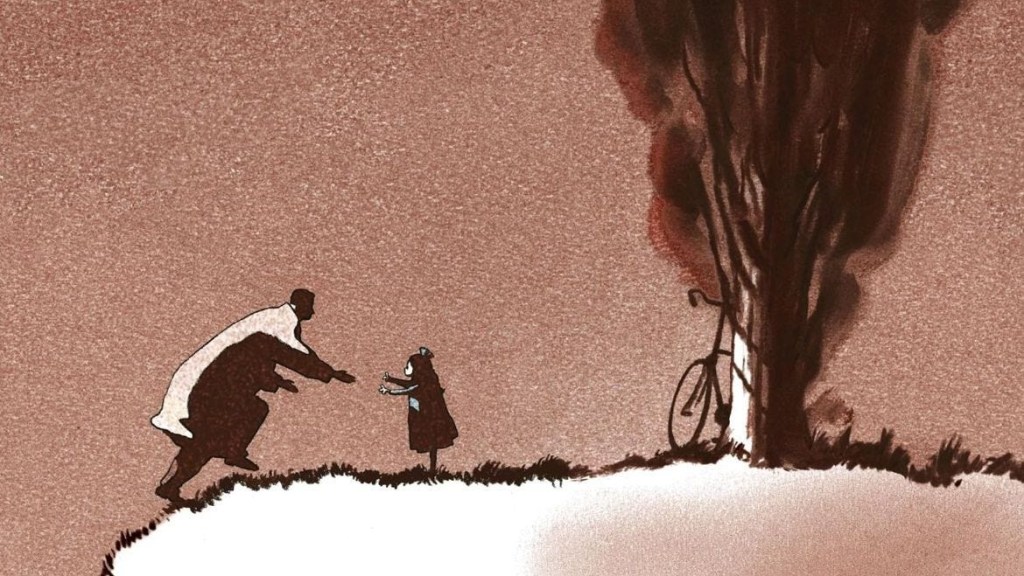
For the animation enthusiasts among you, I highly recommend watching The Monk and the Fish (1994), Father and Daughter (2000), and The Aroma of Tea (2006), all currently available online, collectively demonstrating Dudok de Wit’s gifts as a storyteller, crafting deeply moving and meditative experiences through illustrations in motion. ‘I aim for audio silence and also visual silence. I call it “timelessness”,’ the animator explains, ‘I find it hard to pinpoint but it’s a very still moment, not because nothing happens, but because whatever happened before and whatever will happen next doesn’t matter. We’re just there, now’ (Williams 2016).
Toshio Suzuki and Isao Takahata, filmmakers who had worked, respectively, as director and producer on features of such towering brilliance as Grave of the Fireflies (1988), were clearly impressed by Dudok de Wit’s animations and signed on as producers, alongside Vincent Maraval, Wild Bunch’s own representative in France. It’s tempting to dive head-first into deep waters with The Red Turtle, to discuss how Dudok de Wit’s first feature acts as an important landmark in the animation industry as its traditions navigate from East to West and back again. If these are debates that interest you, pick up a copy of Andrijana Ružić’s recent book on the filmmaker, as she offers comprehensive analysis of the cultural exchanges that lie at the centre of his work, arguing that ‘his unadorned drawings reflect themselves vaguely in Hergé’s clear line, whilst his watercolour settings, inspired by compositions from Rembrandt’s etchings and Hakuin’s artwork, evoke transcendence and spirituality’ (2021: xxi). Hefty praise! We, however, are here to talk about turtles and, more specifically, the ways that Dudok de Wit’s film can be placed amidst debates that concern our oceans’ ecologies.
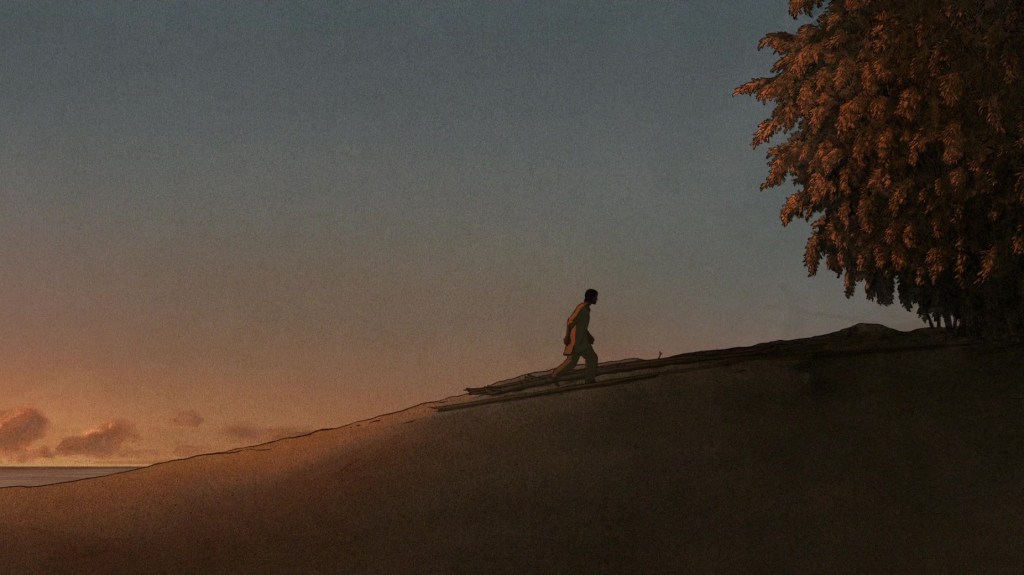
Like Dudok de Wit’s other features, The Red Turtle eschews dialogue in favour of articulating its story through movement and environment. Inspired by the many adaptations that rework Daniel Defoe’s archetypal tale of shipwrecked adventure, Robinson Crusoe (1719), we watch its nameless protagonist wash ashore a tropical island and construct a new life for himself, far from the reach of his home civilisation. As such, The Red Turtle contributes to a long line of so-called ‘Robinsonades’ that explore the identities of their heroes by relocating them outside of their communities and isolating them in the natural world. Defoe’s novel explores these issues through the lens of Empire-building and colonialism, with Crusoe shipwrecked while on an expedition to procure slaves for his plantation. He is also quick to convert his Native American companion, whom he names Friday, to Christianity, all the while imposing his enlightenment-era sense of moral and rational Englishness upon both the wilderness that surrounds him and the heathen cannibals who threaten his existence.
For Stefan Č. Čizmar, our fascination with such tales ‘embodies and epitomises the general worldview of the time, especially in the British context’ of ‘ever-growing colonial expansionism, which in turn strengthened the ideas of British racial superiority and the belief in Britain’s need to expand its colonial dominion’ (Čizmar, 2021: 215). How, then, does Dudok de Wit’s transcultural feature re-approach such well-established representations of men lost at sea? The answer comes fairly quickly in the form of its castaway’s interactions with the eponymous turtle herself.
Upon awakening on the beach, The Red Turtle’s protagonist, somewhat understandably, is determined to return to his homeland and constructs a raft from the forest of bamboo stalks covering the island. He is horrified when he is approached each time by this huge sea turtle, which, looming from within the waves, rams and batters his raft, destroying his sole means of escape. Enraged, the man eventually seeks revenge, attacking it when it comes ashore with a stick of bamboo and flipping it onto its back, leaving it beached and immobile.
Watching as the hulking creature slowly perishes, the castaway soon begins to feel remorse for his action and attempts to flip the creature upright, failing due to its colossal weight. After running desperately to and fro to fetch water in the hopes of keeping the animal hydrated, he returns to find it dead and collapses in exhaustion next to its lifeless body. As the film’s name suggests, it is the appearance of this mysterious turtle that distinguishes Dudok de Wit’s animation from so many comparable Robinsonades. This is not, despite its nameless hero’s initial intentions, the story of environmental escape or conquest. His own humanistic confidence, desperation, and certainty, invested in his rickety raft, were, after all, disastrously misplaced. The turtle’s actions have saved him from certain death in the roaring ocean surrounding him, and his act of revenge is quickly revealed as one of impotent rage. What follows is, instead, a story of ecological revival and return, where the hero is offered a second option: accept the turtle’s suggested guidance and make peace with the wilderness in which he finds himself.
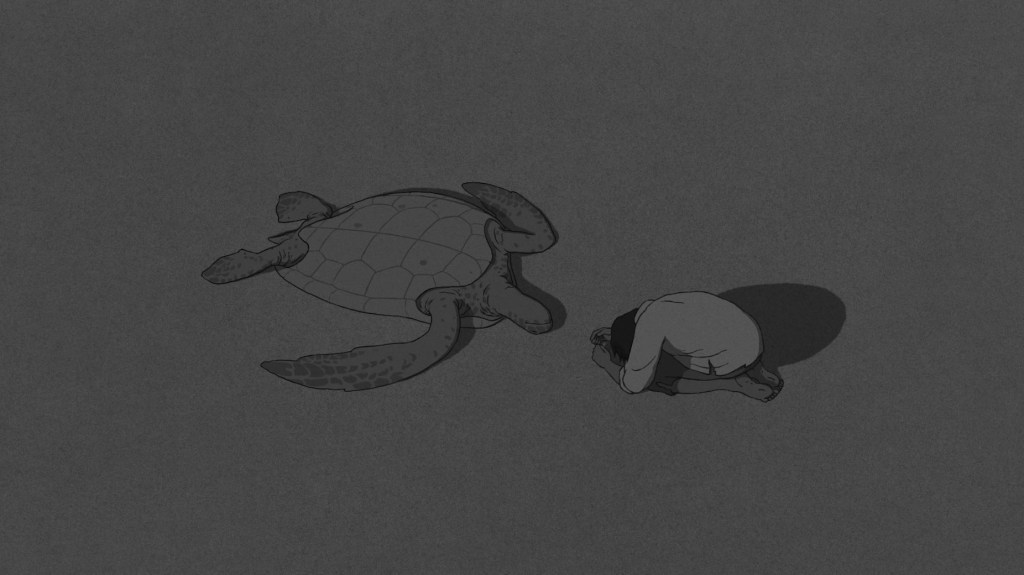
Although the turtle’s actions have denied the protagonist his seeming preference for a watery demise over his condemnation to the isolation of the island, its actions have nevertheless provided him with the opportunity to carve out a new existence that he would have otherwise been denied. Change may be traumatic and unwanted but, rather than embrace death, he is now free to recontextualise his identity among the natural world he once sought to escape. Adithian K. describes the film’s titular turtle as representing a ‘renewal of nature,’ writing that ‘humanity has posited itself as an alienated being that is separate from the natural entity, and we have almost forgotten the truth that the destruction of nature will eventually lead to self-destruction, for in essence, we are inseparable parts of a larger unity’ (2025: 33).
The film’s central hook, driving the entirety of its remaining narrative, is revealed when the unnamed hero awakens to discover that the turtle’s shell has split open and, from within, a red-headed woman has emerged. We watch as the two decide to accept their changed identities, as castaway and newly formed human, overcome their resentments, and build a life with one another. For its remaining running time, Dudok de Wit silently renders their time together on the island in series of hauntingly beautiful vignettes that, frame by frame, maintain a minimalistic palette detailed with elegant, yet rich, texture. We see the two fall in love and raise a son, educate him on his mixed heritage, and collectively fight for their survival when a storm sweeps through the bamboo forests of their home, leaving it a desolate wasteland.
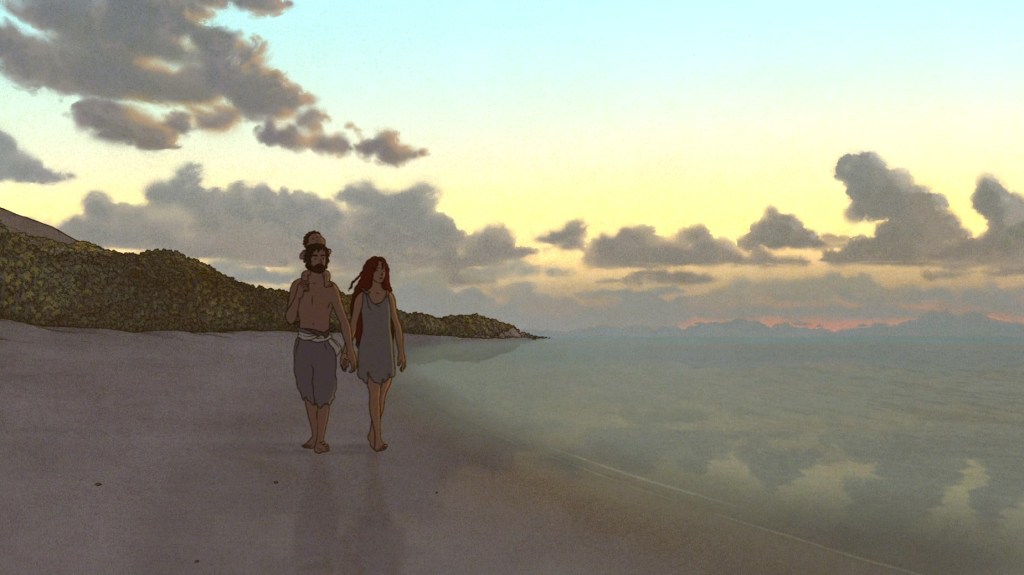
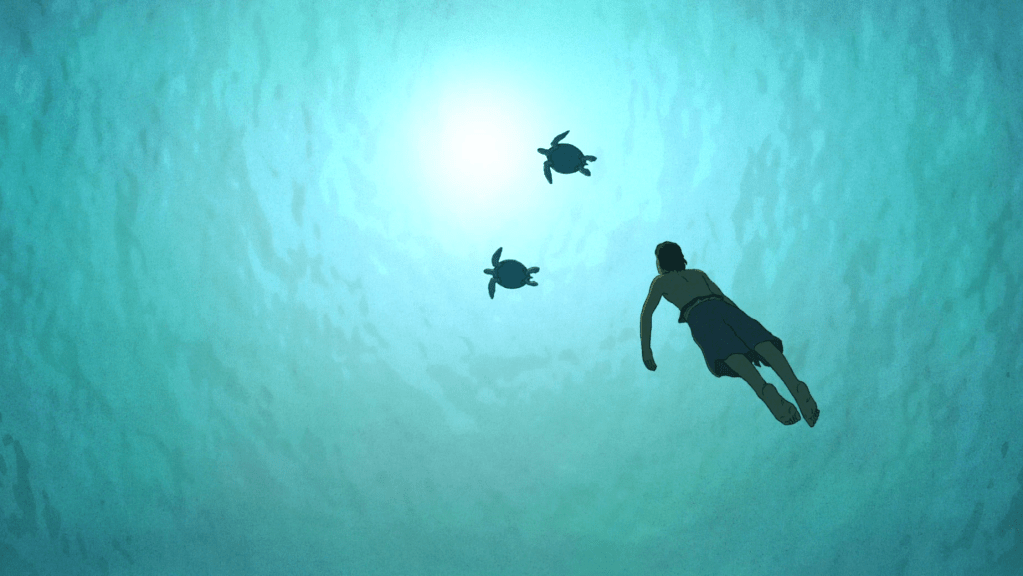
Eventually, the boy ages and, with an emotional send-off from his parents, swims away with another group of sea turtles that he has befriended, leaving the island that has, since his birth, been his home. The parents age and the man eventually passes away peacefully in his sleep as they lie together on the beach. The woman wakes, gently holds his hand and then, after a beat, returns yet again into the form of a sea turtle before slipping quietly into the ocean. Summarily, Dudok de Wit uses his film to explore the triumphs and tragedies of life, from youth to old age, dramatised through three figures building a home together out of unlikely circumstances.
Importantly, the familial dynamic of The Red Turtle does not bear any resemblance to the sorts of escapades evident in similar narratives such as The Swiss Family Robinson (1812). Theirs is not a story of salvaging supplies and using their ingenious know-how to attempt to replicate the comforts of civilisation. Just as Dudok de Wit’s style of animation is sparse and minimalistic, so too is he uninterested in depicting the mechanics of their everyday lives. His heroes are perfectly content to get on without language, complex tools, or contraptions. Rather than being defined by the trappings of modernity, the essential merits of their existence are measured by the love and devotion they share, the fundamental roots of human behaviour that life on the island can reveal. The natural world and, in effect, life itself, is depicted as traumatic, tragic and unrelentingly shaped by the forces of change and destruction. Yet it is, in Dudok de Wit’s animation, the same force that provides his protagonists with everything upon which they depend. It is notable that the only man-made object featured in the film is a single bottle that survived the initial shipwreck. This item then inspires the child’s curiosity and allows him to understand that there is a world beyond the island than he is unaware of.
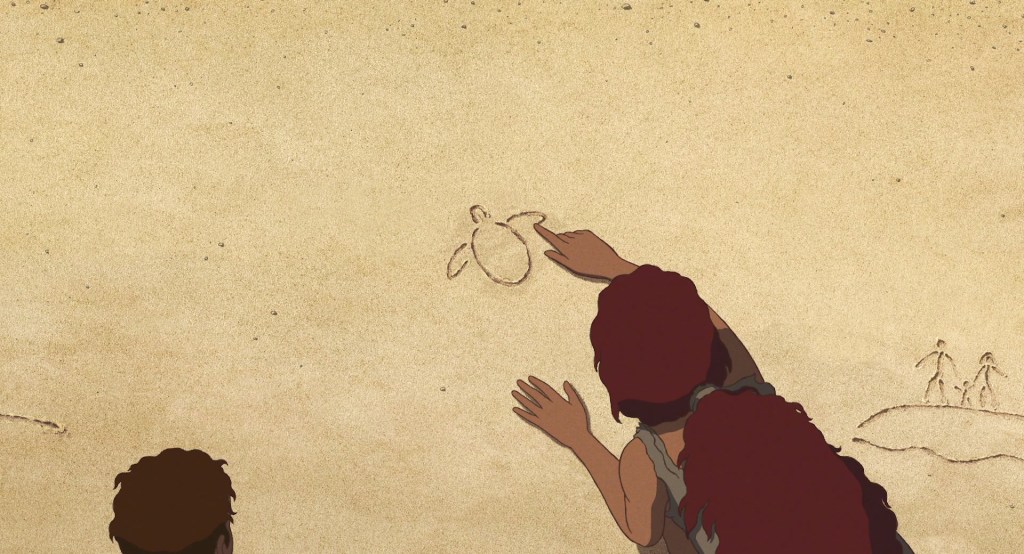
From Thomas More’s Utopia (1551), William Shakespeare’s The Tempest (1623), Jules Verne’s The Mysterious Island (1875), and William Golding’s Lord of the Flies (1954), we possess a centuries-old tradition of utilising imagined islands to map out landscapes through which dystopian and utopian ideals can be encountered. Patrick Gill argues that The Red Turtle’s ecocritical, anticolonial representation of its family is its most remarkable quality: ‘no longer identified with ideas of civilisation, cultivation and domination,’ he writes, ‘humanity in Dudok de Wit’s film can forgo attempts at physical and verbal empire building and instead be at one with nature’ (2019: 153).
Reading the animator’s description of his childhood, it’s easy to see where this mindset developed, and how it became such an important component of his works’ shared aesthetic: ‘We lived near heather moors and I would cycle across the moors to school,’ Dudok de Wit would remember, ‘they were part of a vast nature reserve, gorgeous in all weather conditions: snow, rain or mist. They would be covered once a year with lavender coloured flowers. The attraction of the flat polder landscape too lies in its vastness, in its infinity. When you cycle there, you are very aware of the sky and the horizon. Faraway in the distance, you spot a tiny profile of a poplar tree or a church bell tower. All this space was exhilarating’ (Ružić, 2021: 4).
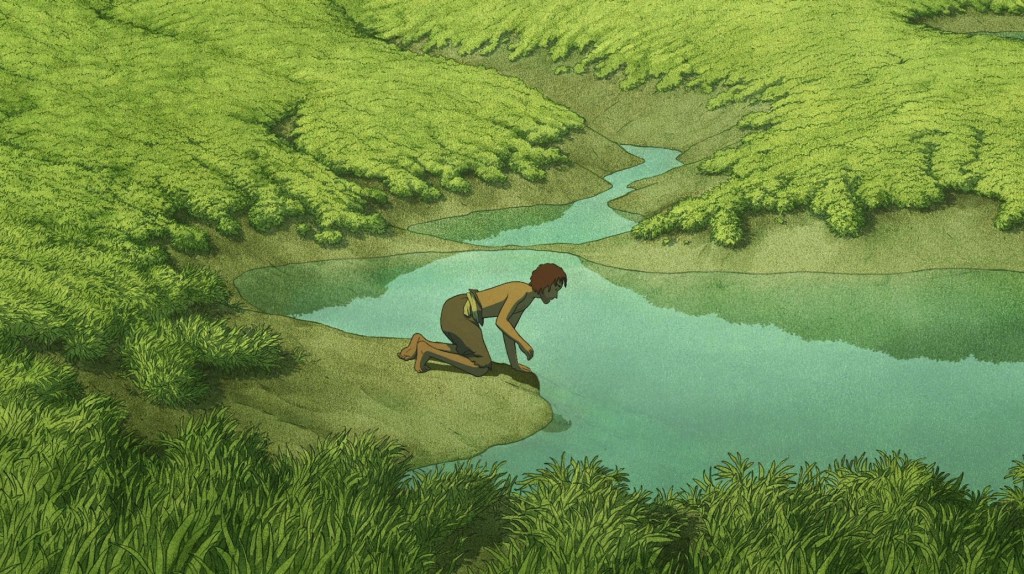
The romantic coupling of The Red Turtle’s human protagonist and his animal companion might be thought of as a contemporary reworking of Odysseus’ subjugation by Calypso, or the countless selkies, sirens, mermaids, rusalki, and nereids that our cultures have variously imagined seducing men to the lakes, rivers, and oceans within which they reside. However, rather than motivated by fear of entrapment, trickery, and domestication, Dudok de Wit positions his character’s metamorphosis as an opportunity for renewal. As with its reframing of Robinsonade adventure, the threat of the wilderness and its creatures, so often indicative of monstrosity, pales in comparison to the human willingness to dominate and destroy.
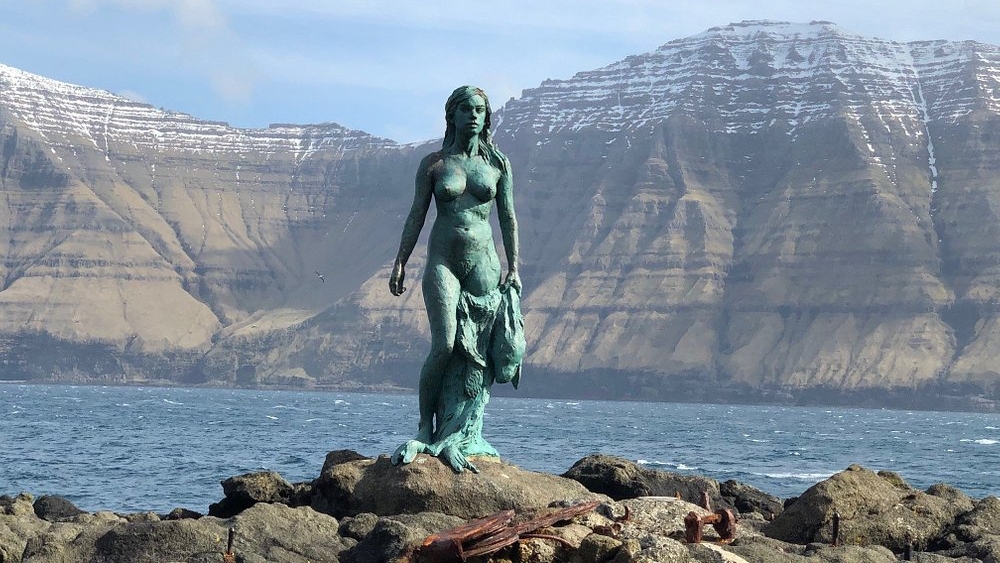
Similarly, while the fantastical transformation of a giant sea turtle into a woman might seem conspicuously bewildering, it participates in a tradition of animal-bride narratives that are as old as civilisation itself. Anthrozoologist Boria Sax, who has written a fascinating book on the subject titled The Serpent and the Swan (1998), argues that such narratives are fundamental components of humanity’s attempts to reconcile its relationship to the natural world. ‘The process we call “civilisation” is, in general, characterised by increasing distance from the natural world,’ he writes, ‘in older tales the world is less likely to be sharply divided into different realms, appropriate to animals, human beings, and divinities’ (1998: 30). The image below is an excellent example of these folk tales immortalised in recent years, showcasing a statue of Kópakonan, or the selkie, the seal woman, shedding her skin upon the shores of Mikladalur in the Faroe Islands.
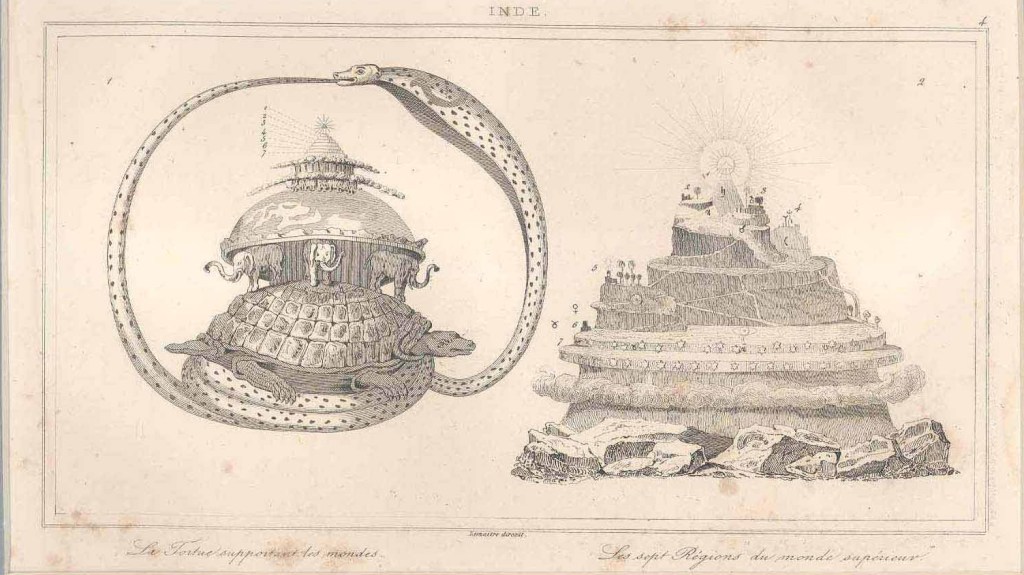
Turtles are, like the seals that inspired the selkie, fundamentally liminal beings. They are able to exist on both land and in water, and have, therefore, often been used within folklore to represent distinctions between diametrically opposed states of being. In the Japanese legend Urashima Tarō, a turtle carries a fisherman who had saved its life to the fantastical palace of Ryūgū-jō beneath the sea. The Vietnamese golden turtle god Kim Quy is seen to be a keeper of great secrets and wisdom, capable of acting as an intermediary between humans and the land of spirits. The Chinese, indigenous Lenape peoples of North America, and Hindus all boast their own variations of a ‘world turtle,’ a beast so large that it supports entire islands, continents, and even worlds on its immense back.
In contemporary popular culture, there are multiple authors who appropriate and rework such folklore: a world turtle named Great A’Tuin carries aloft Terry Pratchett’s entire setting of Discworld as it slowly swims through space, while Stephen King sees Maturin the Turtle as the overarching protagonist of his own creative multiverse. The popular adage ‘turtles all the way down,’ in reference to such cosmologies, speaks to a sense of existential continuity and infinite regress that positions humanity’s existence as a mere speck within the grand workings of our universe.
Turtles are employed for similar effect in Dudok de Wit’s film, symbols of a world that is unquestionably beyond the boundaries of our understanding. Just as we are given no information about our nameless protagonist’s prior identity, or the nature of his shipwreck, so too are we left in the dark as to the reasoning behind the red turtle’s own transformation and eventual departure. I have offered my own readings of the film here, but devoid of verbal narration or expository dialogue, Dudok de Wit leaves this completely up to personal interpretation. The film’s inscrutable identity, explicitly refusing to explain its meanings, will either bewitch or frustrate those who seek to engage with it.
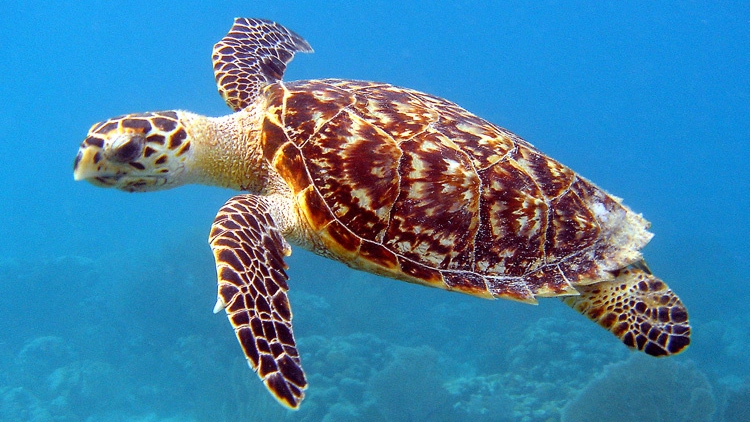
It is notable, however, that the creature featured in the film is based upon the hawksbill sea turtle, a critically endangered species that possesses nesting sites that span throughout the world’s tropics. The practice of eating the hawskbills and their eggs, has led to them being a target for human hunters for centuries, but it is the harvesting of their shells that has had the greatest impact on their numbers. In 2008, a report by the Marine Turtle Specialist Group (MTSG) noted that ‘Japanese statistics document the import of shell equivalent to more than 1.3 million large Hawksbills from around the world between 1950-1992 and more than 575,000 stuffed juveniles from Asia between 1970-1986,’ instigating a population decline that has been measured at approximately 80% (Mortimer & Donnelly). It is apt that The Red Turtle, a film defined by the shifting waters of international cooperation, would orient itself through the iconography of an animal that has been used as a trophy through thousands of years of international trade and conquest, latter European colonialism, and contemporary industrialised exploitation.
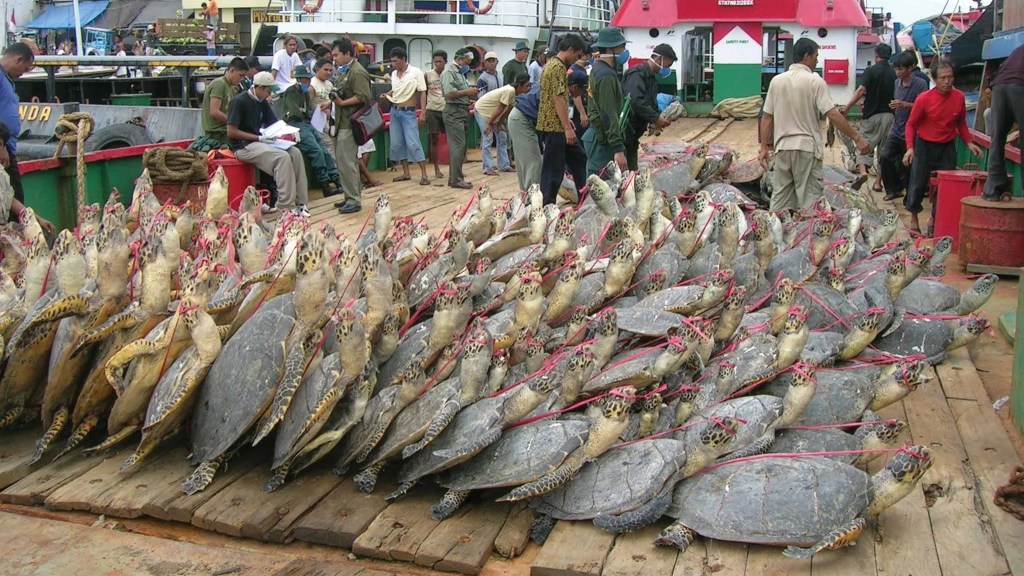
Now listed in the Convention on International Trade in Endangered Species (CITES), commercial dealing of the creatures has been prohibited, with numerous programs designed to assist conservation efforts. Just this month, The State of the World’s Sea Turtles organisation (SWOT) highlighted promising developments in attempts to bolster existing laws and consolidate information and regulation that is spread across habitats that span across numerous national boundaries. Unsurprisingly, however, they also point towards major issues in ‘the scarcity of funding and technical expertise,’ as well as the immense damage produced by sea turtle bycatch in ‘illegal, unreported, and unregulated (IUU) fishing’ (Hawksbill SSAP Steering Group & CMS IOSEA Secretariat, 2026: 31).
Beyond the issues of bycatch and trafficking, hawksbills are dependent on a range of different habitats such as coral reefs, seagrass meadows, and undisturbed beaches that are variously threatened by the impact of manmade degradation, climate change and pollution. In April of 2025, President Donald Trump reversed decades‑old protections by signing a proclamation that opened the Pacific Islands Heritage Marine National Monument to commercial fishing by the nation’s vessels. “This is one of the most pristine tropical marine environments in the world that already faces dire threats from climate change and ocean acidification,” David Henkin, an attorney for the nonprofit Earthjustice would state, ‘we will do everything in our power to protect the monument’ (Fox, 2025). That same month, the U.S. Fish and Wildlife Service and National Marine Fisheries Service would similarly publish a Notice of Proposed Rulemaking titled ‘Rescinding the Definition of Harm under the Endangered Species Act’ (Hays Barho, 2025). Environmental campaigners have argued that changing the definition of ‘harm’ in such a way would profoundly weaken the Act’s existing protections of animals, downplay the significance of their habitat loss, and open up new opportunities for their exploitation (Steinzor 2025).
Dudok de Wit was firm in his belief that ‘I don’t see this as a film with an ecological message,’ arguing instead that his animation ‘is just a film that expresses my deep love and respect for nature’ (Pape, 2017). He purposefully designed The Red Turtle so that it did not possess an easily digestible ‘moralistic’ point; ‘the film doesn’t present an answer,’ he would assert, when questioned on the matter (ibid). Visualised through stunning sun-drenched landscapes upon shore and positively luminescent undersea sequences, the animator succeeds admirably in capturing what he describes in another interview as an ‘emotional and intuitive relationship to nature’: ‘I like the word “awe,”’ he would say, ‘it’s about the temperature we feel on our skin, the breeze in our hair. It’s about the sunlight and the shadows it casts, It’s about the changing of lights outside. It’s about nature in all shapes, in all senses’ (Jacobs, 2017).
Michaël Dudok de Wit may not be supplying any answers, but it is impossible, when swept up within the majestic imagery of his debut feature, to prevent that feeling of awe from manifesting into questions about the world’s changing ecologies. Our marine life has long been mythologised as representatives of the interconnected nature between our species and the oceans that surround us. Reframing its shipwrecked narrative upon a creature that is at home on both land and in water, and developed through the international collaboration of its globe-spanning production companies, The Red Turtle is a reminder of common interests that defy national borders and our impulse towards self-segregation. There may well come a time when, castaway and lost at sea, survival may depend on our willingness to unlearn our instinct to dominate.
Head Image: The Red Turtle, StudioCanal, 2016.
The Aroma of Tea. 2006. D. Michaël Dudok de Wit, Film, Netherlands: CinéTé Filmproductie.
Čizmar, Stefan Č. 2021. ‘Colonialism and Capitalist Ideology in Robinson Crusoe,’ Philologia Mediana 13. 13, pp. 215-228.
Earthjustice. 2025. ‘Earthjustice Statement on Trump Administration Executive Order to Open Pacific Marine Monument to Commercial Fishing,’ Earthjustice, April 17: https://earthjustice.org/press/2025/earthjustice-statement-on-trump-administration-executive-order-to-open-pacific-marine-monument-to-commercial-fishing.
Father and Daughter. 2000. D. Michaël Dudok de Wit, Film, Netherlands & UK: CinéTé Filmproductie.
Gill, Patrick. 2019. ‘Dystopian and Utopian Omission of Discourse in Three Modern Robinsonades: Lord of the Flies, Concrete Island, The Red Turtle,’ Porównania 2. 25, pp. 145-156.
Golding, William. 1954. Lord of the Flies. London: Faber & Faber.
Hawksbill SSAP Steering Group & CMS IOSEA Secretariat. 2026. ‘Strengthening Collaboration for Hawksbill Protection,’ The State of the World’s Sea Turtles Report, XXI: pp. 30-31.
Hays Barho, Rebecca. 2025. ‘Agencies Move to Rescind “Harm” Definition under Endangered Species Act,’ Endangered Species Law and Policy, April 17: https://www.endangeredspecieslawandpolicy.com/agencies-move-to-rescind-harm-definition-under-endangered-species-act.
Jacobs, Derek. 2017. ‘Interview: Michaël Dudok de Wit talks The Red Turtle,’ Cinema Axis, January 23: https://cinemaaxis.com/2017/01/23/interview-michael-dudok-de-wit-talks-the-red-turtle/.
K, Adithian. 2025. ‘The Minimalist Poetics of Ecology: A Study of The Red Turtle,’ Creative Saplings 4. 4: pp. 27-37.
The Monk and the Fish. 1994. D. Michaël Dudok de Wit, Film, France: Folimage.
More, Thomas. 1551. Utopia. Translated by Ralph Robinson. London: Abraham Veale.
Mortimer, J.A & Donnelly, M. 2008. Eretmochelys imbricata. The IUCN Red List of Threatened Species: https://www.iucnredlist.org/species/8005/12881238.
Pape, Stefan. 2017. ‘“I couldn’t believe it” – Michael Dudok de Wit on collaborating with Studio Ghibli on The Red Turtle,’ HeyUGuys, May 24: https://www.heyuguys.com/michael-dudok-de-wit-interview-the-red-turtle/.
The Red Turtle. 2016. D. Michaël Dudok de Wit, Film, Japan & France: Wild Bunch.
Ružić, Andrijana. 2021. Michael Dudok de Wit: A Life in Animation, Boca Raton: CRC Press.
Sax, Boria. 1998. The Serpent and the Swan: The Animal Bride in Folklore and Literature. Virginia: McDonald & Woodward.
Shakespeare, William. 1623 ‘The Tempest,’ Mr. William Shakespeares Comedies, Histories, & Tragedies. London: Isaac Jaggard and Edward Blount.
Steinzor, Nadia. 2025. ‘Wildlife need habitat! Speak out to stop federal agencies from changing the definition of “harm” in the Endangered Species Act,’ Rewilding Institute, April 30: https://rewilding.org/wildlife-need-habitat-speak-out-to-stop-federal-agencies-from-changing-the-definition-of-harm-in-the-endangered-species-act/.
Verne, Jules. 1875. The Mysterious Island. Translated by W. H. G. Kingston. London: Sampson Low, Marston, Low, & Searle.
Williams, Fiona. 2016. ‘Michael Dudok de Wit talks ‘Red Turtle’, and being backed by Studio Ghibli,’ Special Broadcasting Service, September 20: https://www.sbs.com.au/whats-on/article/michael-dudok-de-wit-talks-red-turtle-and-being-backed-by-studio-ghibli/5xoyoko5w.
Wyss, Johann David. 1812. Der Schweizerische Robinson [The Swiss Family Robinson]. Zurich: Orell, Füssli und Compagnie.
 Creature Features: Animal Welfare on Screen