Tag: movies

  • “Are We Ready to Go in the Water Again?” the Legacy of the Jaws Effect

    “Are We Ready to Go in the Water Again?” the Legacy of the Jaws Effect

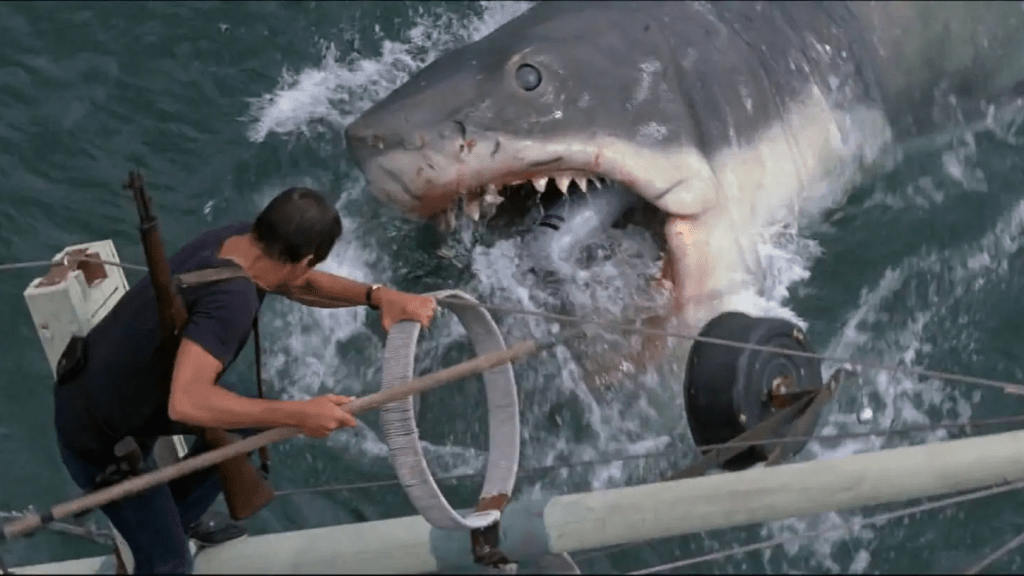
    Before Luke Skywalker learnt to use the Force and before Superman taught us that a man can fly, Jaws (1975) used the toothy imagery of a great white shark to usher in the birth of the blockbuster. It was the mid-1970s, and Hollywood’s major studios no longer sat at the top of the food chain. Instead, investment in lower-budget and often subversive productions like Bonnie and Clyde (1967), The Graduate (1967), and Easy Rider (1969) were proving a smoother passage to financial reward than throwing untold millions into spiralling behemoths such as Cleopatra (1963), Mutiny on the Bounty (1962), and Doctor Doolittle (1967). With the release of Jaws, however, up-and-coming filmmaker Steven Spielberg reminded the industry of the indisputable power of adrenaline-fuelled spectacle. Existential dramas about the American psyche were out; B-movie aesthetics, awe-inspiring monsters, and special effects were in!

    As Linda Ruth Williams and Michael Hammond would summarise, Jaws was “the must see ‘event-movie’ cut to the measure of the big screen, a sure-fire draw that would take families away from their television sets” (2006: 117). In the years since, there have been few movies so frequently discussed, with its tales of behind-the-scenes pandemonium firmly established within the annals of Hollywood legend. The film’s recent 50th anniversary revived interest in the chaotic nature of its production, while Ian Shaw and Joseph Nixon’s stage show, The Shark is Broken (2019), has been met with universal praise for comedically dramatising the intense rivalry between its stars.

    Image: The Shark is Broken, Sonia Friedman Productions, 2025.

    Peter Benchley, the author of the original 1974 novel, had been inspired by his experiences fishing off the waters of Nantucket, as well as a news article from 1964 about “a fisherman who caught a 4,550lb great white off the beaches of Long Island” (Benchley qtd. Dowling 2004). As literary critics of the time noted, Jaws was no Moby Dick (1851), but the frightening prospect of a shark terrorising a seaside community was potent enough to fuel over half a century of oceanic suspense.

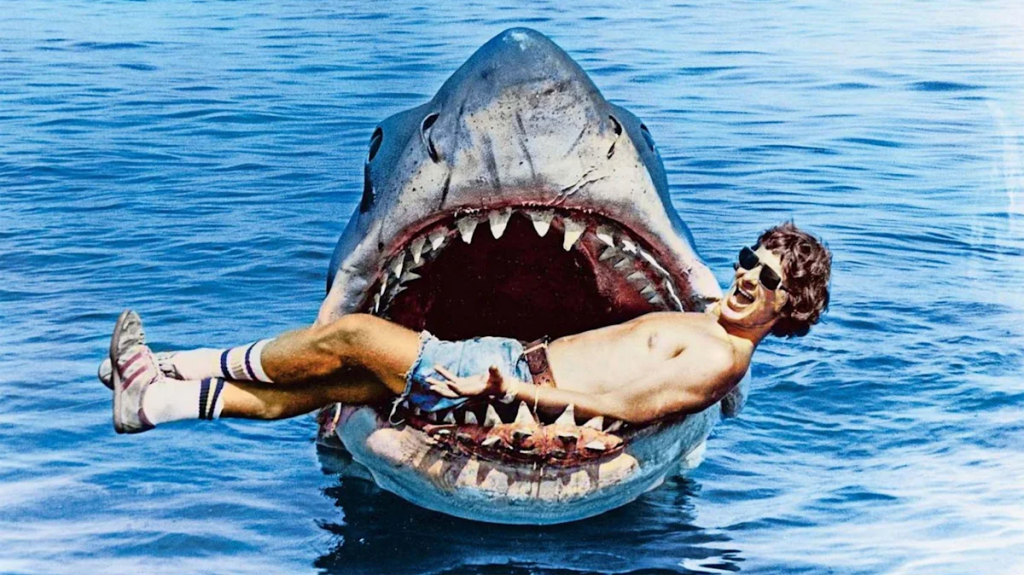
    Although Spielberg made use of a few shots of actual sharks during the production of his film, those predominantly seen on screen are animatronic. Three fake great whites were constructed, powered by hydraulic motion so that their immense steel armatures, covered in rubber latex, could thrash around dramatically, while colossal jaws, lined with polyurethane teeth, could chomp together threateningly. Collectively named Bruce after Spielberg’s lawyer, the near constant malfunctioning of these sharks turned a fraught production into one that frequently skirted disaster. A special ‘shark sled’ had to be constructed underwater, allowing the mechanical creatures to be mounted on an adjustable arm and moved along the water’s surface. Battered by seawater and perpetually breaking down, Spielberg would describe them collectively as “the Great White Turd,” as they took enormous bites out of a budget and schedule that were steadily trebling in size (qtd. Fordy, 2025).

    Image: Steven Spielberg and ‘Bruce,’ Universal Pictures, 1975.

    Despite Jaws’ turbulent production, no one could dispute its eventual success. At the box office, it would overtake The Godfather (1972) as the highest-grossing film of all time, subsequently dismounted from its position by the arrival of Star Wars (1977) two years later. The frothing waters of Amity Island seemed to wash away the post-Watergate era of popular American cynicism, with Brody’s heroism providing the nation a victory over a primordial evil that transcended ideological affiliations. The great white’s ravenous appetite for human flesh seemed to have no preference for political allegiance. This was a threat that all could be united against.

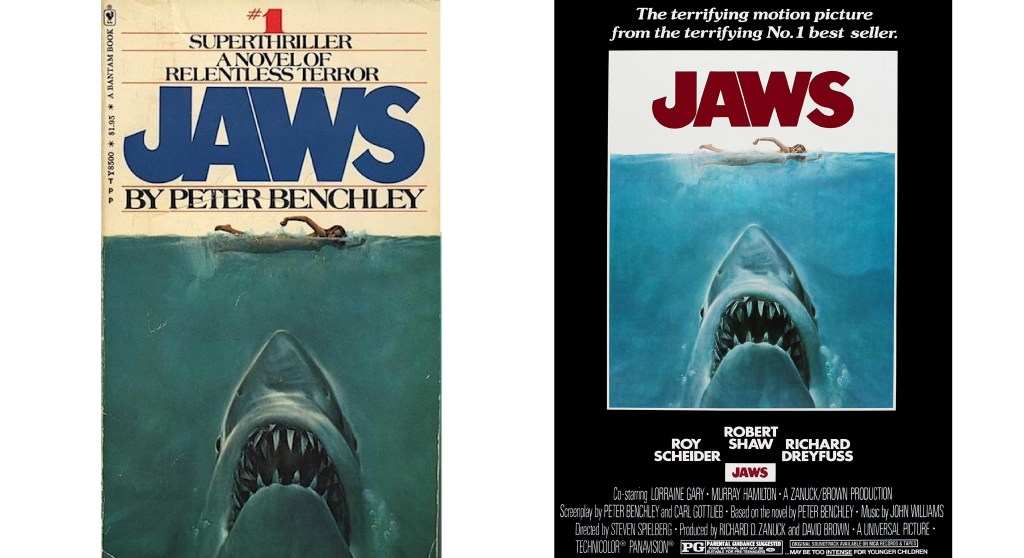
    The central myth of Jaws, that of man against nature, was perfectly encapsulated in the marketing materials for the film, which famously reworked the eye-popping painting by Roger Kastel that adorned the cover of Bantam Books’ own publication of the mass-market paperback. Positioning a human victim on the verge of being devoured to ensure that no one could mistake the beast’s scale, the evocation that “here be monsters” acts as one of the most memorable designs in both film and literature’s visual history.

    Image: Jaws, Bantam Books, 1975 & Jaws, Universal, 1975.

    The mythos surrounding the great white shark featured in Jaws was, of course, a constructed fantasy. From an uncharacteristic temperament, vindictively targeting humans, to the supernatural power and endurance required to chomp and smash through the heroes’ vessel, the Orca, the shark in Jaws holds little in common with its real-world equivalents. Even Kastel’s infamous painting used a stuffed mako from the American Museum of Natural History as a point of reference, rather than a great white (Chen 2025).

    Jaws’ conceptual power draws upon centuries of human fascination with these predators. Interestingly, most of the cultures that have shared closest proximity to sharks have placed them in positions of veneration. The Māori’s mythical Parata controls the tides with each immense breath it takes beneath the ocean’s surface, while the Fijian Dakuwaqa is known as a protector of fishermen. A reverence for sharks extends to widespread beliefs, found in Hawaii and the Solomon Islands, that the people’s ancestors could take the form of the fishes, allowing them to act as spiritual guides. The fact that sharks are adept at signalling prosperous fishing waters, and have been known to swim alongside vessels such as canoes, evidences the strong foundations upon which these traditions are rooted (Flannery & Flannery 2023).

    Image: Shark God Dakuwaqa, Photo by Rama, 2017.

    Europeans attempting to expand their power in the age of sail had a different attitude. Frightening encounters with sharks on long voyages led the English mariners of the sixteenth century to refer to the creatures as ‘sea dogs,’ before adopting the word ‘shark’ that had previously been used to refer to otherwise human scoundrels, villains, and swindlers.  Herman Melville himself would sum up such anthropomorphism in his own descriptions of the animals, describing the “rude, savage swagger” of the tiger shark as “a round, portly gourmand; with distended mouth and collapsed conscience, swimming about seeking whom he might devour.” “No wonder, then,” he would add, “that sailors denounce them” (1849: 60).

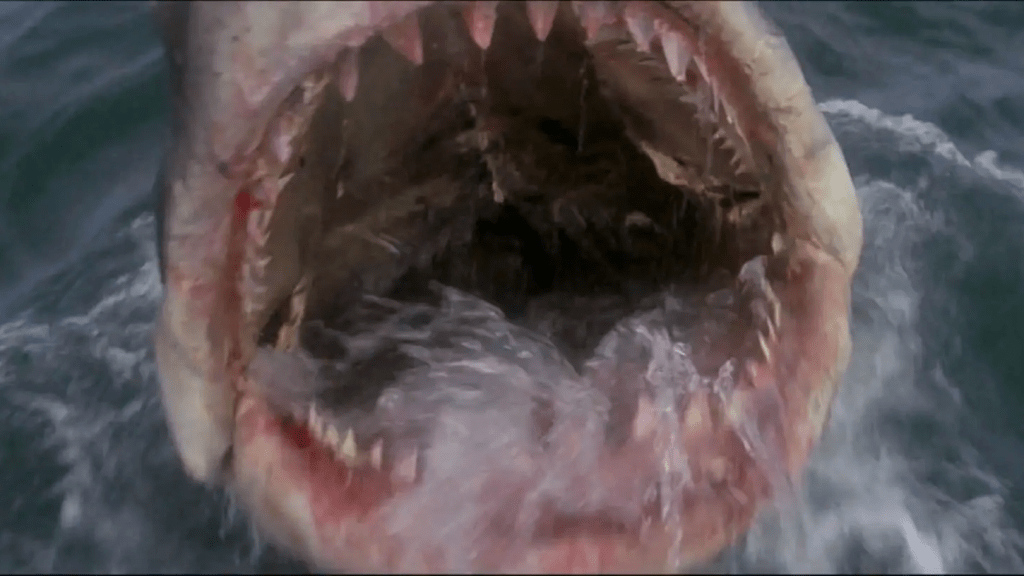
    Whether valorised or vilified, sharks have, famously, outlived us all. The earliest evidence we have of these cartilaginous creatures dates them back at least 450 million years, surviving five mass extinction events that each variously devastated and wiped-out comparative species (Davis 2018). Is it really possible that a single monster movie from the 1970s could have an indelible impact on their wellbeing? ‘The Jaws Effect,’ as it has become known, attempts to track the extent that the film reshaped audiences’ relationships to sharks and quantify the increased levels of hostility and measurable violence that the animals have been subjected to.

    Image: Jaws, Universal Pictures, 1975.

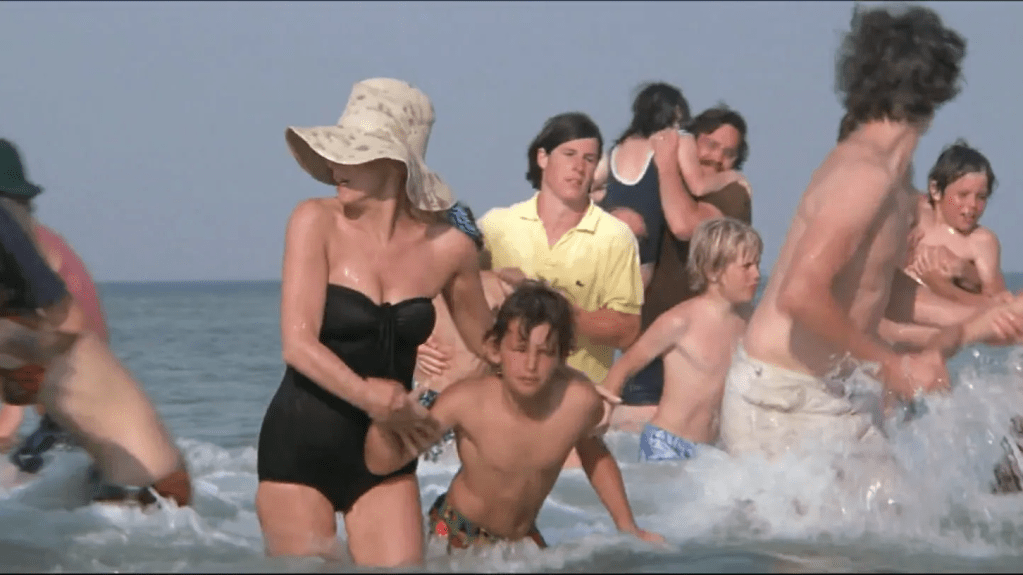
    As with much of cinema’s history, the furore surrounding Jaws’ release was emboldened by media hype and hysteria. Notably, the film’s PG certificate came at a time preceding the creation of the PG-13 in 1984, and the public were astonished by the film’s gratuity. Charles Champlin would write for The Los Angeles Times that “Jaws is nightmare time for the young. Even the mature are apt to be jolted harder by Jaws than by earlier jeopardy films. Violence done to the helpless, always the hardest to watch, is here compounded because the victims are in the water, an alien environment, demanding and potentially dangerous at best. The inability to flee or fight back, as in a nightmare of paralysis, is real and only too easy to identify with” (qtd. Woerner 2015).

    Universal would licence towels with the slogan ‘if you’re brave… take it to the beach!’ while a tidal wave of media panic accompanied ‘shark scare’ stories to capitalise upon the public’s mounting fears. A Gallup poll conducted at the time of Jaws’ release reported that 23% of men and 47% of women admitted that the film “increased their fear of swimming in the ocean” (Saad 2025), while many have continued to claim that it contributed to a “marked drop in beach attendance” after audiences saw it in cinemas (Fisher 2010).

    Image: Jaws, Universal Pictures, 1975.

    Despite evidence that you are seventy-five times more likely to be killed by a bolt of lightning, already something of a statistically freak occurrence, than suffer the same fate to the jaws of a shark (Naylor 2023), many studies have observed the film’s contribution to a growing hostility towards the fishes. Social scientist Christopher Neff would argue, for example, that the Australian government drew directly on Jaws’ mythos to promote legislation that “allowed for pre-emptively killing individual sharks” that strayed near waters used by humans (2015: 123). His research highlighted what he described as “a worrying style of policymaking where widely known fiction can be used to navigate the attribution of blame and to prescribe policy responses” (ibid: 125).

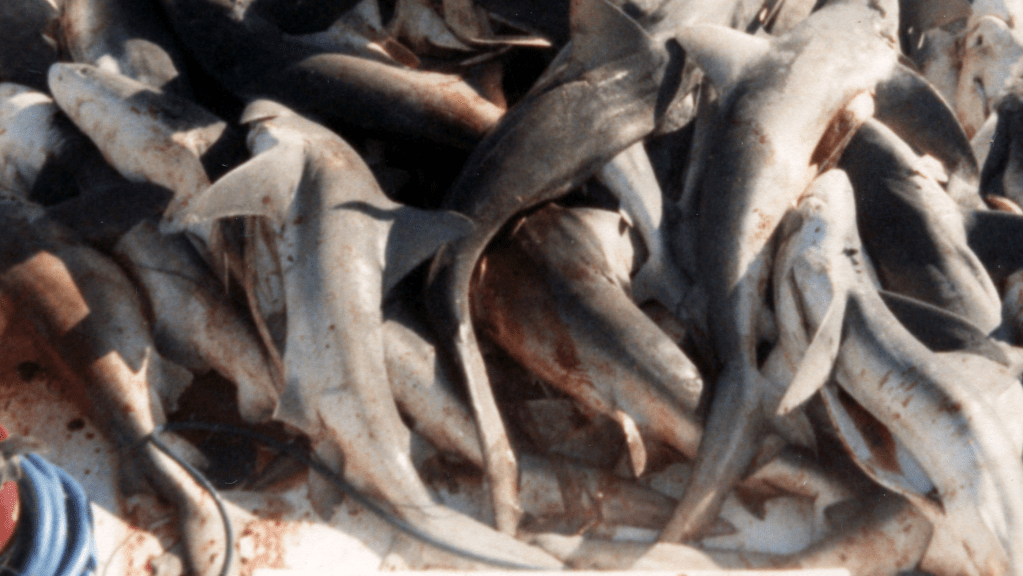
    Similarly, as Monster Shark Tournaments grew in popularity across the East Coast of the U.S. throughout the 1980s, such competitions would often promote themselves by vilifying the animals’ apparent hostility and position their own activities as responsive acts of social responsibility. In 2016, The Guardian would release a list of major corporations that provided lucrative sponsorship deals to such ‘catch and kill’ events, many of which targeted endangered species. These included organisations such as Coca-Cola, Lexus, Caterpillar, Budweiser, Ford, and Captain Morgan, as well as numerous others (Milman & Mathiesen 2016). Entry fees, cash prizes, and sizeable side bets made such events fiercely competitive and subject to numerous scandals surrounding cheating and prohibited fishing. The wanton slaughter of sharks was not only culturally condoned; it was a practice that could be highly profitable.

    Image: Collection of Don DeMaria, Flickr, 1987.

    As Ashley D. Keefer summarises of such recreational bloodshed, “sharks, as apex predators, are vital to maintaining the balance of marine ecosystems. That ecological balance markedly impacts the tourism-driven economy of local communities. Despite our awareness of the critical importance of maintaining that balance, an estimated seventy-three million sharks are killed by humans each year. Those sharks would probably have a different take on who warrants fear” (2016: 291-292). Keefer goes on to describe how the fishes’ long-lived lifespans, delayed sexual maturity, and low birth rates make them “especially susceptible to human threats” (ibid: 295).

    On screen, Jaws’ mythic representation of predatory terror was strong enough to fuel three direct sequels and popularise an entire sub-genre of ‘sharksploitation’ movies that hit critical mass with the release of The Asylum’s Sharknado (2013). Steven Spielberg himself would recently state that he “really and truly regret[s]” the contribution that his film played in stigmatising sharks in the world’s popular consciousness (‘Steven Spielberg,’ 2022), while Peter Benchley would dedicate much of his professional life to repudiating the claims his novel helped propagate. “What I now know, which wasn’t known when I wrote Jaws, is that there is no such thing as a rogue shark which develops a taste for human flesh,’’ the author would argue, “no one appreciates how vulnerable they are to destruction” (qtd. Delves Broughton 2000). As Benchley observed, despite changing attitudes, many of the species remain in severe danger if humans do not actively reassess their maligned reputation immediately.

    Image: Shawn Rossi, Flickr, 2008.

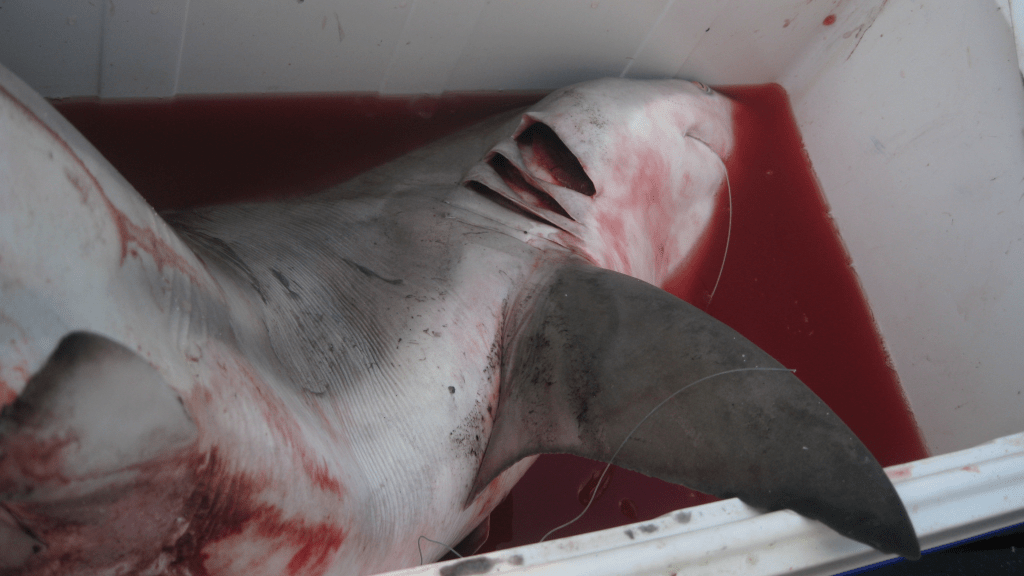
    Changing perspectives and public advocacy have helped to shut down numerous monster shark tournaments over the last decade. However, troublingly, there is increased interest led by various fishing organisations and notable spokespeople within such competitions in effecting their return, despite the ecological consequences of doing so (Williams 2024). Similarly, important questions remain concerning the questionable survival rates of sharks caught in competitions that have since converted to seemingly ethical ‘catch and release’ practices. Many marine biologists are hard at work attempting to convince the public that animals caught in such a manner will still frequently die from the stress of fighting for their lives on the line and struggling outside the water (Geib 2023).

    Distressingly, new research suggests that the great whites of the Mediterranean are on the cusp of total extinction. Overfishing, as well as the illegal fishing of protected species, has resulted in dwindling populations that are fast becoming unsalvageable (Gill, Stephens, Hughes & Nour 2025). Regulation of industrialised fishing, robust protections for endangered species, and further support to education and training programmes that enable communities to benefit from and utilise sustainable practices will undoubtedly help recover much of our damaged marine ecosystems. Time, however, is running short. Jaws provided audiences with one of the most archetypal figures of inept leadership and obstinate foolishness in Amity’s own Mayor Vaughn. This is the man who, famously, refused to close his island’s beaches despite expert advice and, importantly, witnessing measurable bloodshed. It is ironic, perhaps, that a film that so heavily maligns sharks also signals their only remaining course of salvation. Our own leadership needs to be equivalently pressured, if it is to listen to reason.

    Head Image: Jaws, Universal Pictures, 1975.

    Bonnie and Clyde. 1967. D. Arthur Penn, Film. US: Warner Bros. Pictures.

    Chen, Min. 2025. ‘The Painting That Helped Jaws Make a Killing,’ Artnet, September 15: https://news.artnet.com/art-world/jaws-roger-kastel-academy-museum-2688384.

    Cleopatra. 1963. D. Joseph L. Mankiewicz, Film. US: 20th Century Fox.

    Davis, Josh. 2018. ‘Shark Evolution: a 450 Million Year Timeline,’ Natural History Museum, December 13: https://www.nhm.ac.uk/discover/shark-evolution-a-450-million-year-timeline.html.

    Delves Broughton, Peter. 2000. ‘Jaws author now regrets his “attack” on sharks, The Salt Lake Tribune, April 4: http://www.igorilla.com/gorilla/animal/2000/sharks_peter_benchley.html.

    Doctor Doolittle. 1967. D. Richard Fleischer, Film. US: 20th Century Fox.

    Dowling, Stephen. 2004. ‘The book that spawned a monster,’ BBC News, February 1: http://news.bbc.co.uk/1/hi/entertainment/3400291.stm.

    Easy Rider. 1969. D. Dennis Hopper, Film. US: Columbia Pictures.

    Fisher, Luchina. 2010. ‘Jaws Launched Summer Blockbuster 35 Years Ago,’ ABC News, June 18: https://abcnews.com/Entertainment/jaws-launched-summer-blockbuster-35-years-ago/story?id=10855868.

    Flannery, Tim & Flannery, Emma. 2023.  From Gods to Monsters: How Did We Come to Fear the Shark?” The Guardian, July 29: https://www.theguardian.com/books/2023/jul/30/from-gods-to-monsters-how-did-we-come-to-fear-the-shark?.

    Fordy, Tom. 2025. ‘Why Steven Spielberg hated the “star” of Jaws,’ The Telegraph, June 20: https://www.telegraph.co.uk/films/2025/06/20/why-steven-spielberg-hated-the-star-of-jaws/.
    Geib, Claudia. 2023. ‘At Sharkathon, Shark Fishers Are a Keen Audience for Conservation Advice,’ Hakai Magazine, December 21: https://hakaimagazine.com/news/at-sharkathon-shark-fishers-are-a-keen-audience-for-conservation-advice/.
    Gill, Victoria, Stephens, Kate, Hughes, Gwyndaf, & Nour, Ahmed. 2025. Great white sharks face extinction in Mediterranean, say researchers,’ BBC News, December 30: https://www.bbc.co.uk/news/articles/c9qe9wvq534o.

    The Godfather. 1972. D. Francis Ford Coppola, Film. US: Paramount Pictures.

    The Graduate. 1967. D. Mike Nichols, Film. US: United Artists.

    Jaws. 1975. D. Steven Spielberg, Film. US: Universal Pictures.

    Keefer, Ashley. 2016. ‘We’re Gonna Need a Bigger Boat”: How Federal Regulations of Shark Fishing Tournaments Could Shift the Tides of Conservation Initiatives,’ Jeffrey S. Moorad Sports Law Journal 23. 1, pp. 291-336.

    Melville, Heman. 1849. Mardi: and a Voyage Thither, London: Richard Bentley.

    Melville, Herman. 1851. Moby-Dick; or, The Whale. New York: Harper & Brothers.

    Milman, Oliver & Mathiesen, Karl. 2016. ‘Monster shark fishing tournaments face growing pressure to reform,’ The Guardian, July 19: https://www.theguardian.com/environment/2016/jul/19/atlantic-shark-hunting-tournaments-endangered-species.

    Mutiny on the Bounty. 1962. D. Lewis Milestone, Film. US: Metro-Goldwyn-Mayer.

    Naylor, Gavin. 2023. ‘The International Shark Attack File,’ Florida Museum, May 31: https://www.floridamuseum.ufl.edu/shark-attacks/.

    Neff, Christopher. 2015. ‘The Jaws Effect: How movie narratives are used to influence policy responses to shark bites in Western Australia,’ Australian Journal of Political Science 50. 1, pp. 114-127.

    Saad, Lydia. 2025. ‘Gallup Vault: Jaws Made Waves in 1975,’ Gallup, June 20:  https://news.gallup.com/vault/691907/gallup-vault-jaws-made-waves-1975.aspx.

    The Shark is Broken. 2019-2025. W. Ian Shaw & Joseph Nixon, Play. London: Samuel French.

    Sharknado. 2013. D. Thunder Levin, Film. US: The Asylum.

    Star Wars. 1977. D. George Lucas, Film. US: 20th Century-Fox.

    ‘Steven Spielberg.’ 2022. Desert Island Discs, BBC Radio 4, December 18.

    Williams, Linda Ruth & Hammond, Michael. 2006. Contemporary American Cinema. Maidenhead: McGraw-Hill.

    Williams, Ted. 2024. ‘It’s time for America to outgrow shark tournaments,’ Hatch, July 27: https://www.hatchmag.com/articles/its-time-america-outgrow-shark-tournaments/7715957.

    Woerner, Meredith. 2015. ‘L.A. Times’ original 1975 review of Jaws unearthed: We hated it,’ The Los Angeles Times, June 20: https://www.latimes.com/entertainment/herocomplex/la-et-hc-jaws-original-review-20150619-story.html.

  • Renouncing the Hunt in Predator: Badlands (2025)

    Renouncing the Hunt in Predator: Badlands (2025)

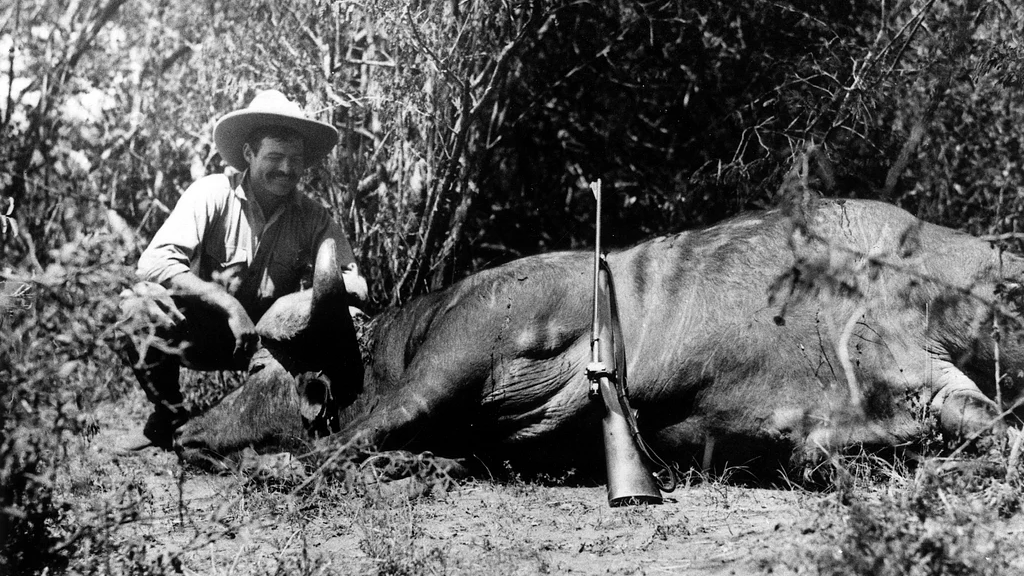
    The business of trophy hunting is booming. The wildlife hunting tourism market is projected to be on the cusp of crossing over one billion dollars in value across the next few years (Coherent Market Insights 2025). This growth has been largely attributed to a rising interest in the display of wild animal body parts to signal status, personal achievement, and mastery over nature. Many of us will have the same picture in mind when we imagine the blood sport in practice. Khaki-covered figures in a ‘grip-and-grin’ posture, rifle in hand while sat on the carcass of big game. The trophies themselves, hides, tusks, horns, and antlers, are, for their owners, reflective of the practical skills required to attain them, but they are also monuments of the cultural and financial privileges through which the sector operates.

    These are not the acts of subsistence hunting or indigenous ritualism that are practiced by countless communities around the world. This is a global business that exists to commodify the lives of rare and exotic animals. There is little dignity, in my opinion, to be found in a banker from Montana jetting off to Tanzania to shoot big game. Many women, of course, are self-identified trophy hunters, but it is not a coincidence that the industry is couched in grotesque machismo and predominantly propped up by men. What better method of reaffirming masculinity than to demonstrate the stoicism required to kill without sentiment? Ernest Hemingway, for example, whose life and work were variously elevated and diminished by a startling level of brutal clarity, expressed no compunction at the prospect of taking such lives when done with seemingly sufficient skill. When wounding a bull and condemning it to a long death while hunting in Africa, he would write that “I felt a son of a bitch to have hit him and not killed him. I did not mind killing anything, any animal, if I killed it cleanly, they all had to die and my interference with the nightly and the seasonal killing that went on all the time was very minute and I had no guilty feeling at all” (1936: 185).

    Image: Ernest Hemingway on Safari in Africa, U.S. National Archives and Records Administration, 1933.

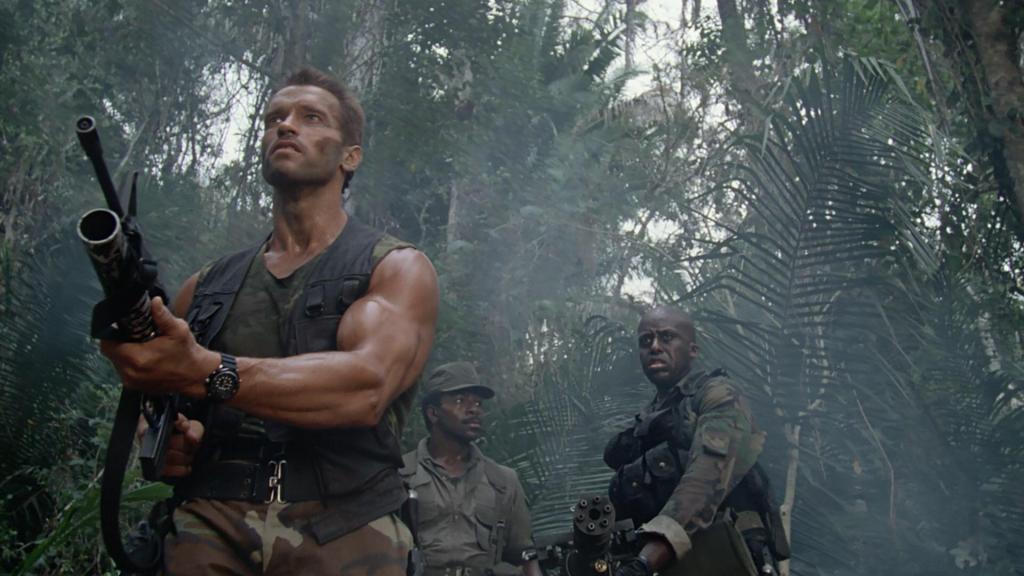
    Since its first instalment in 1987, the Predator franchise has made an indelible mark on the sci-fi and action genres by mythologising trophy hunting as a testosterone-fuelled thrill-ride driven by such acts of lethal prowess. When a ferocious alien arrives on Earth to test the mettle of humanity, Arnold Schwarzenegger is a suitably muscle-bound ambassador for us to deploy in kind. The film acts, alongside many features in the action star’s decades-long oeuvre, as a textbook example of vainglorious action at its most bombastically appealing. The film’s cacophonic barrage of machine guns, flexing biceps, and hyperinflated machismo is delivered in such a straight-faced manner that it’s difficult not to get swept up in its absurd spectacle. This is the film, after all, that features Jesse Ventura offering his buddies chewing tobacco with the cavalier statement that “this stuff will make you a god damned sexual Tyrannosaurus, just like me.” Less lovingly remembered, but no less notable, is the shockingly normalised homophobic expletive that Ventura utters beforehand. In both instances, audiences are in no doubt of the red-blooded virility and violence through which all-American manhood might be derived.

    Collecting the skulls of its victims for display within its spacecraft, the predator acts as an appropriate means for the sci-fi genre to speculate upon the skills and temperament required to be a trophy-hunting glory hound. Directed by John McTiernan, who would follow up on its success with Die Hard (1988), Predator’s high-octane adrenaline was potent enough to sustain thirty-five years of diminishing returns. For all their bravado, Predator 2 (1990), Predators (2010), and The Predator (2018) unfortunately proved themselves to be relatively toothless productions. The less said about Alien vs. Predator (2004) and Aliens vs. Predator: Requiem (2007), the better.

    Image: Predator, 20th Century Fox, 1987.

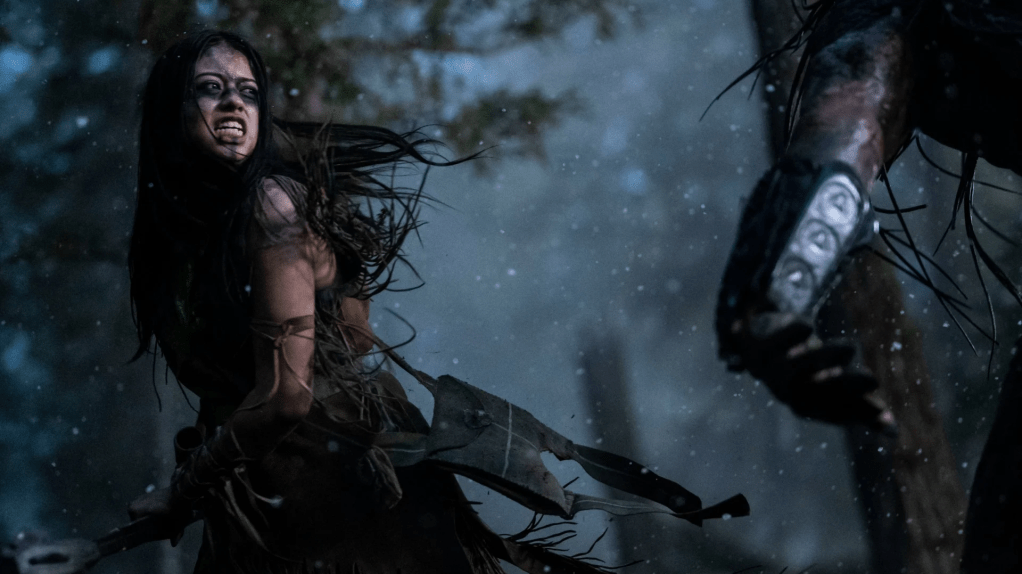
    Thankfully, the franchise is currently experiencing something of a resurgence due to several projects that have been collectively helmed by Dan Trachtenberg, of 10 Cloverfield Lane (2016) fame. Prey (2022) acted as a noteworthy addition to the series by reframing it’s archetypal ‘wild hunt’ from the perspective of a young Comanche woman, Naru, in the Northern Great Plains of 1719. Played by Amber Midthunder, Naru’s battle against the eponymous alien allows her to demonstrate her strength, resilience, and ability to protect her tribe from the dangers of the wilderness. The animated follow-up, Predator: Killer of Killers (2025), offers similar variance to the franchise, structured through a series of historical vignettes that draws its protagonists from Viking, samurai, and US naval history.

    In defiance of Hollywood’s consistent reluctance to release their intellectual properties from the vice-like grip of nostalgic repetition, the Predator franchise acts as an apt reminder that it is only with the inclusion of new blood and fresh perspectives that popular culture remains timely and resonant. Prey may not be a radical departure from studio convention, but it nevertheless holds the honour of being the first feature film to possess a full dub in the Comanche language. The Predator franchise’s science-fictional explorations of bravery and endurance, violence and reward, demonstrate the richness of hunting mythologies that can be traced throughout all human history. As Brian Boyd argues in On the Origins of Stories (2009), our species’ impulse to shape our social structures through the creation of narratives and myths is evolutionarily tied to the cognitive and biological standards that hundreds of millennia spent as hunter-gatherers instilled within us (167).

    Image: Prey, 20th Century Studios, 2022.

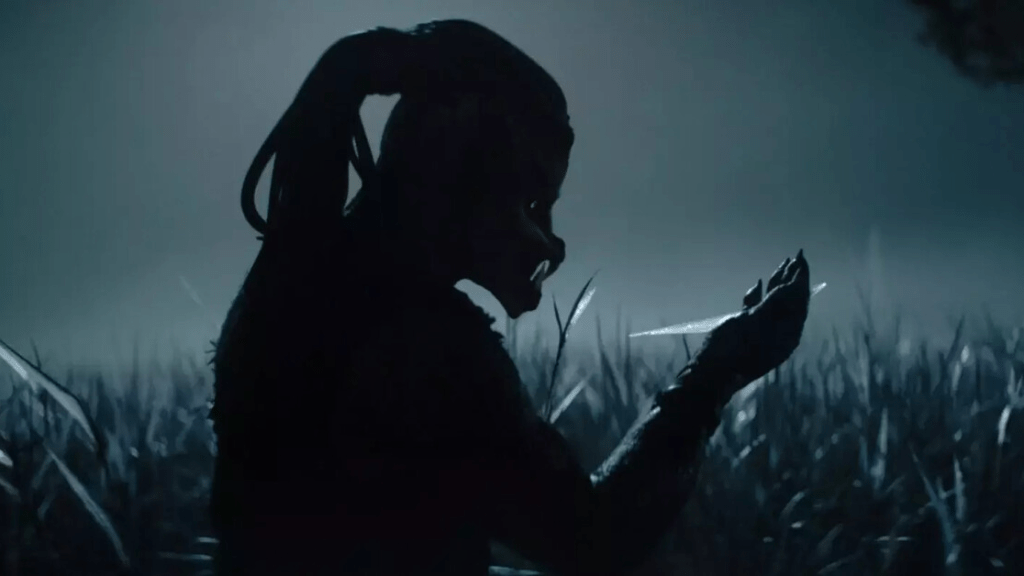
    As the third of Trachtenberg’s entries in the series, Predator: Badlands (2025) had its work cut out to avoid the same sense of inertia that had restricted so many of the series’ previous efforts. Its primary contribution is, therefore, a comparatively sizeable one. The film reframes its action-oriented mythos of trophy hunting through the perspective of Dek, Dimitrius Schuster-Koloamatangi, a member of the alien race that has long acted as the franchise’s antagonists. Borrowing the name of the species, Yautja, from the series’ expanded universe, Badlands ensures all the creatures’ characteristic features are present and accounted for. Schuster-Koloamatangi’s performance, impressively tracked and transformed by mo-cap, renders Dek as a being of cold-blooded lethality, determined to hunt the most dangerous beasts the universe has to offer.

    Anatomically, Dek’s monstrous appearance is similarly familiar to fans of the franchise. His unblinking yellow eyes betray no sense of sentiment, his battle-cries are hollered out through a yawning mouth of sharp teeth and mandibles, and even his blood appears toxic in nature, spattering upon the wilderness in streaks of luminescent green. Due to his towering presence on-screen, Schuster-Koloamatangi found himself repeatedly addressing rumours that he was 7’3”: “I’ve had this question a lot,” he would state through laughter, “everyone is always severely disappointed when they see me because I’m only six foot two” (qtd. in LRM 2025). Dek might not inhabit the role of villain usually adopted by his species, but he nevertheless fulfils the Predator series’ expectations of alien power-fantasy admirably.

    Image: Predator: Badlands, 20th Century Studios, 2025.

    Despite his formidable appearance, Dek is portrayed as an ignoble runt within his species. While he appears sufficiently intimidating to his human audience, compared to his kin, his diminutive size and comparable weakness place him in danger of being culled for the good of the clan’s honour. The film opens with Dek’s father, Njohrr, killing the Yautja’s more physically imposing brother, Kwei, for refusing to do the job himself. For the patriarch, his children’s loyalty to one another is a sign of their emotional frailty, and must be met with fatal recompense. Driven by a desperate need to overcome his perceived inadequacies, Dek embarks on a quest to hunt the Kalisk, a legendary apex predator feared even by Njohrr. “Father calls me the weakest,” Dek says determinedly, “so I must kill the strongest.”

    The film’s first half follows Dek as he tracks the fearsome Kalisk and learns to survive the dangers of its native planet, Genna. Carnivorous vines, poisonous barbs, and fields of razor-like grass, as well as alien variations of bison, vultures, grubs, and snakes all act as hostile antagonists. At first, the Kalisk’s habitat seems to align very closely with the Yautja’s designation of a so-called ‘death planet.’ This is a landscape where every element of its flora and fauna have evolved to compete in a deadly struggle for survival, the perfect arena to test Dek’s cunning and combative abilities, while evidencing his clan’s mantra that ‘Yautja are prey to none. Friend to none. Predator to all.’

    Image: Predator: Badlands, 20th Century Studios, 2025.

    Badlands’ most significant turning point occurs in the middle of its second act, when, finally in combat with the Kalisk, Dek is captured by a Weyland-Yutani expedition who are similarly hunting the creature while exploiting the planet’s natural resources. Weyland-Yutani is, of course, the interstellar conglomerate first introduced in Alien (1979), subsequently crossed-over frequently with the Predator series by their joint-owners, 20th Century Fox, now owned and rebranded by Disney. With speculative stories of corporate hegemony and aggressive resource extraction, life appears to imitates art.

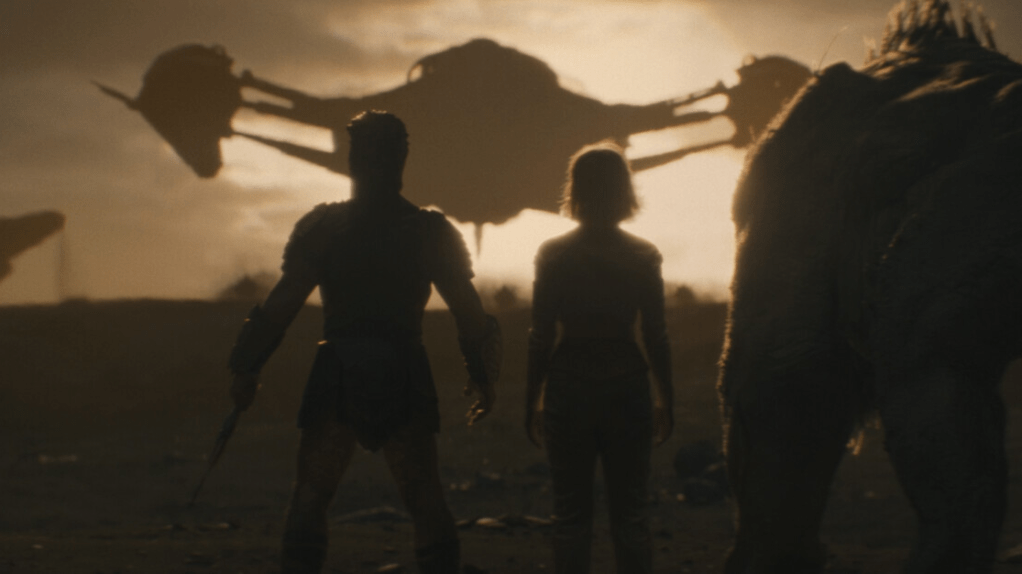
    Exposed to the pillaging practices of Weyland-Yutani, Dek’s story becomes a quest of ecological redemption. Revisiting Kwei’s ship and ruminating on the sacrifice that his brother paid to spare his life, the Yautja realises that strength and bravery are not measured by unthinking brutality, but by a resilience of character that is uncowed by an overwhelming adversary. Mounting an attack on the company’s compound, Dek employs the knowledge of Genna’s ecology that he had previously utilised to conquer it. Various local animals are recruited as allies, while the planet’s dangerous vegetation is crafted into an assortment of darts and explosives. Badlands reframes the carnage and excitement of its hunt through the spectacle of anti-corporate vigilantism and eco-activism. Rather than killing the Kalisk, Dek’s sense of self-worth is pivoted by his desire to liberate the creature and reunite it with its young.

    Image: Predator: Badlands, 20th Century Studios, 2025.

    The film’s coda sees Dek return to his father, who is disgusted when he discovers that the trophy his son has claimed is the head of a Weyland-Yutani android, rather than that of the Kalisk. “I’ve completed my hunt,” says the younger Yautja defiantly, casting the burned-out metal skull at his feet. Njohrr’s contempt sparks one final trial by combat, this time between parent and offspring. Dek’s righteous fury and skill carries him to victory, proving that he is not as weak as his father suspected. The boon that he had once desperately craved, Njohrr’s acceptance of him, is met by Dek’s indifferent rejection that “I have my own clan,” as he watches the Kalisk’s child casually behead him. Violence and spectacle might remain Badlands’ operating principle, but it is notable for exultating in its protagonist’s refusal to slay his questing beast.

    Dek’s rejection of his patriarch’s trophy-hunting demands aligns him with a time-honoured history of myths, legends, and folktales that extol the virtue of similar protagonists who transgress dominant expectations of the treatment of animals. Whether it is Siddhartha saving a hunted swan, Androcles caring for a wounded lion, Francis of Assisi taming the Wolf of Gubbio, or King Śibi offering sanctuary to a dove, centuries of fables collectively attempt to reassess humanity’s dismissal of other species’ rights to ethical consideration. As Imelda Martin Junquera and Francisco Molina Moreno summarise in ‘Mythology and Ecocriticism: A Natural Encounter’ (2018), ‘just as certain myths have legitimised the subjugation and exploitation of nature by humankind, others reflect a will to attain a harmonious relationship with the natural environment (6).

    Image: Predator: Badlands, 20th Century Studios, 2025.

    Badlands’repositioning of its audience’s perspective into that of its seemingly antagonistic aliens is its most important facet. It’s a shift that places the film firmly within science fiction’s tradition of posthuman concerns, challenging a host of anthropocentric biases. Helen Kopnina (2020) is one of many anthropologists to argue that such questions are of the utmost importance to contemporary culture, claiming that they have the potential to expose what she calls ‘the central tenets that define humanism,’ by ‘condemning speciesism, human chauvinism, and human supremacy’ (2).

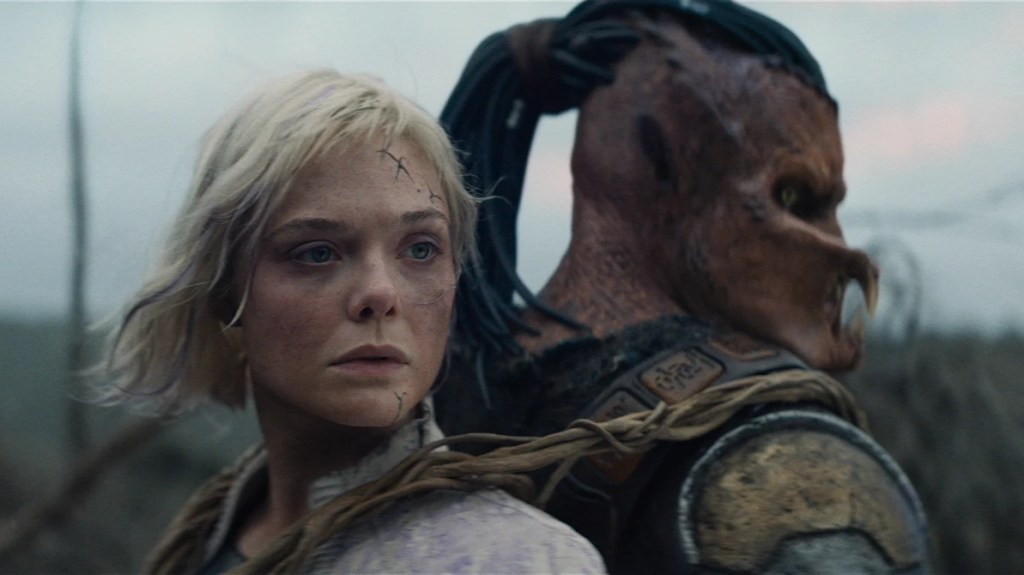
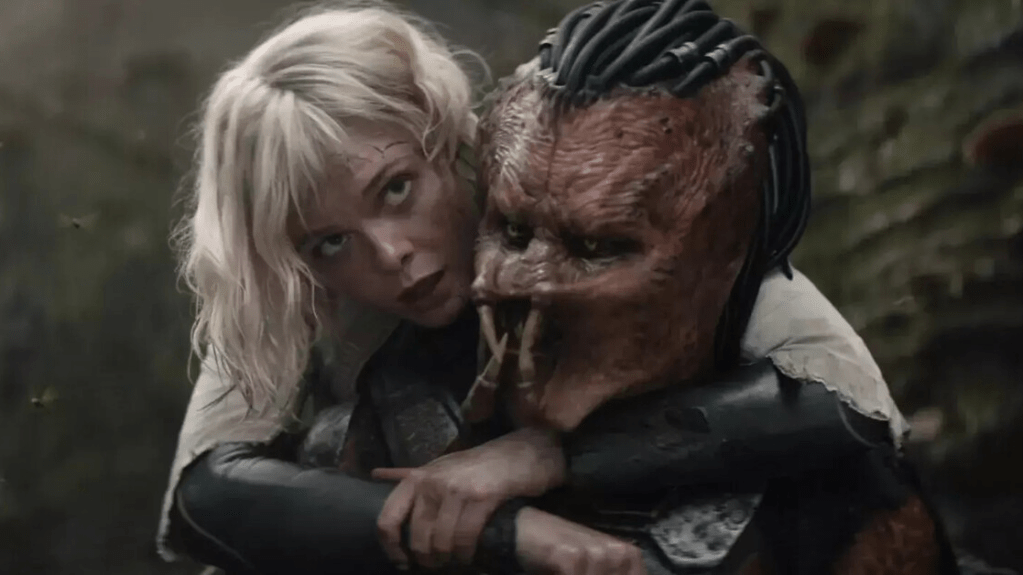
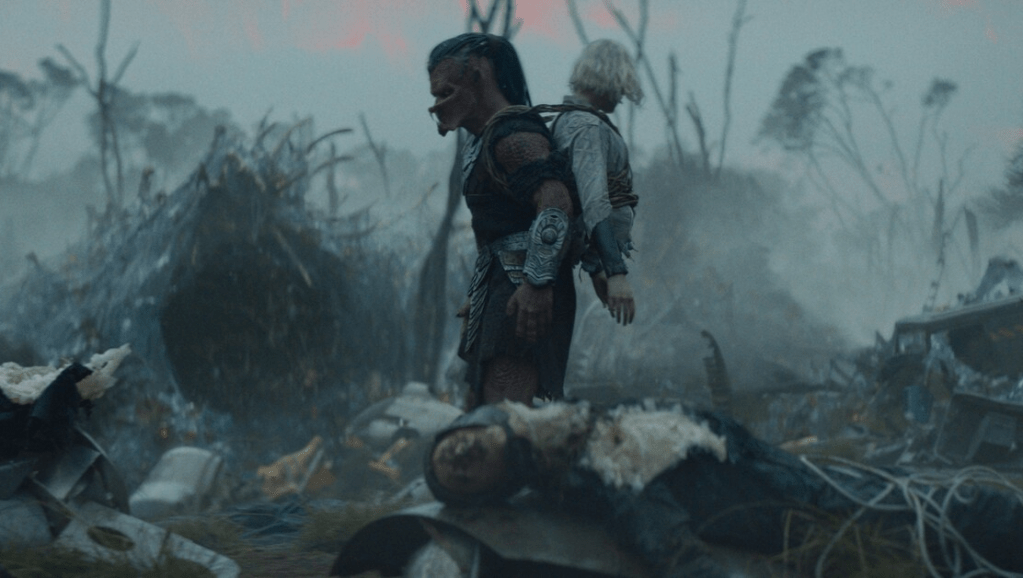
    Beyond upending its myth of the hunt, Badlands’ does this most directly by featuring absolutely no human characters whatsoever throughout the entirety of its running time. Alongside Dek and his clan of Yautja, the Weyland-Yutani expedition is entirely made up of the synthetic lifeforms that have played a prominent role in the Alien franchise. Receiving top-billing is Elle Fanning as Thia, an android who serves as Dek’s companion throughout his adventure. The Yautja’s respect for her is, following their initial meeting, comparable to the meagre courtesy he extends to the other lifeforms he encounters on Genna. He ignores her name and refers to her instead as “tool” when learning that she is synthetic, carrying her severed torso around like a backpack so that she may aid him on his hunt. Thia’s attempts to unite with her surviving twin ‘sister,’ Tessa, has a similarly tragic trajectory to Dek’s own ambitions for familial acceptance. Both characters are born from oppressive systems of power, corporate and tribal, that deny them the communal belonging that they crave.

    Image: Predator: Badlands, 20th Century Studios, 2025.

    It is Thia who first challenges Dek’s inherited belief that strength within a hunting community is best cultivated through individualism and self-reliance, informing him that “the alpha isn’t the wolf who kills the most, the alpha is actually the one who best protects the pack.” Dek’s dismissal of Thia’s call for communal cooperation, “I will be the alpha that kills the most,” is weathered away by Badlands’ conclusion. It is his relationship to the synthetic and the other creatures of Genna that eventually allows him to free the Kalisk, reject his father, and develop a new understanding of his social value.

    Interestingly, Dek’s shift in perspective reflects the recognition of several endemic flaws that Craig Stanford associates with hunting practices that can be traced back to our species’ pre-history. In The Hunting Apes: Meat Eating and the Origins of Human Behaviour (1999) Stanford argues that much of humanity’s inability to maintain social solidarity and empathy has been modelled and worsened by practices of ‘meat acquisition rather than meat sharing’ that have physiologically and culturally been engrained within us (11). Dek’s own character arc similarly teaches us that survival of the fittest relies as much on social cooperation as it does the prioritising of self-sufficiency.

    Image: Predator: Badlands, 20th Century Studios, 2025.

    Similarly, Badlands’ reliance on an entirely posthuman cast signals several ethical concerns regarding disparate approaches to hunting practices. Humanity remains notable through its lack of physical presence upon the surface of Genna. Weyland-Yutani has no desire to risk human lives during its resource extraction if synthetic lifeforms can be reproduced and disposed of remorselessly. In contrast, the Yautja’s own hunting ideologies, as brutal as they might seem, possess a modicum of honour based on the stakes and consequences risked if their efforts meet with failure. Their bravery and skills are tested within a variety of dangerous environments that they have neither industrialised or dominated. The ritualistic nature of Dek’s hunt demands he triumph over an opponent that is provided with advantage. Anyone with familiarity of the Predator franchise will know that the Yautja will not needlessly kill a creature that does not pose an immediate threat.

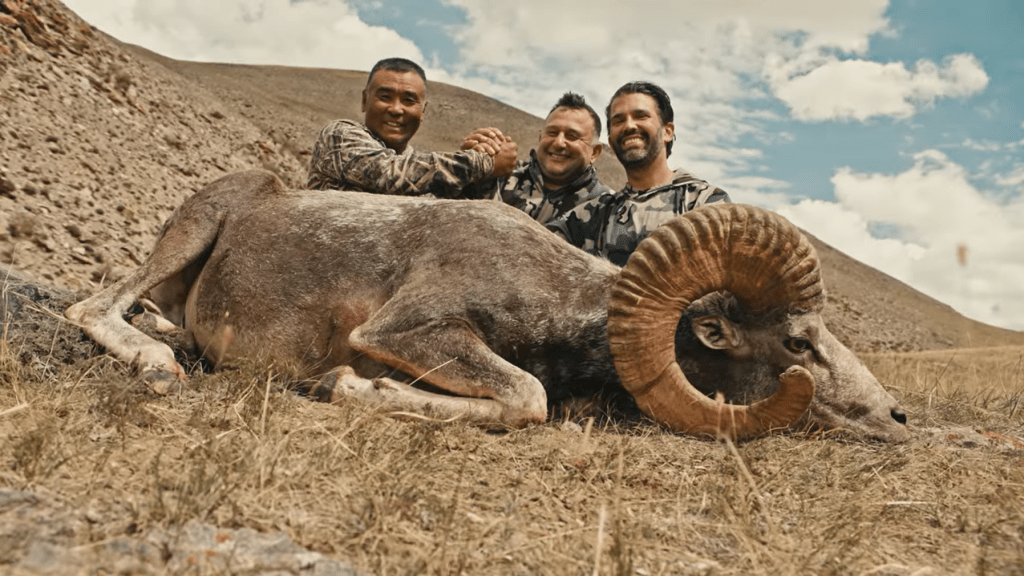
    It is difficult, therefore, to relate the Yautja’s hard-fought successes to the trophy hunting industries of our contemporary cultures. Little personal merit accompanies, for example, the act of Donald Trump Jr. spending over $17,000 of American tax-payers’ money to hunt argali and ibex sheep in Mongolia (White and Honl-Stuenkel 2020). It is nigh on impossible to find nobility in his taking of such lives when one considers the fact that he did not possess a licence to do so, and was only provided one retroactively (ibid.). This sense of entitlement and privilege exists in dichotomy to the hunting practices of communities that, for centuries, have accounted for far greater care and deference for our natural world. As Calvin Martin observed in Keepers of the Game (1978), the hunting practices of the Ojibwa people stand in stark contrast “to the exalted position” that humanity places itself within much of “Judeo-Christian tradition” (74).

    Image: Donald Trump Jr and companions in Mongolia, Field Ethos, 2022.

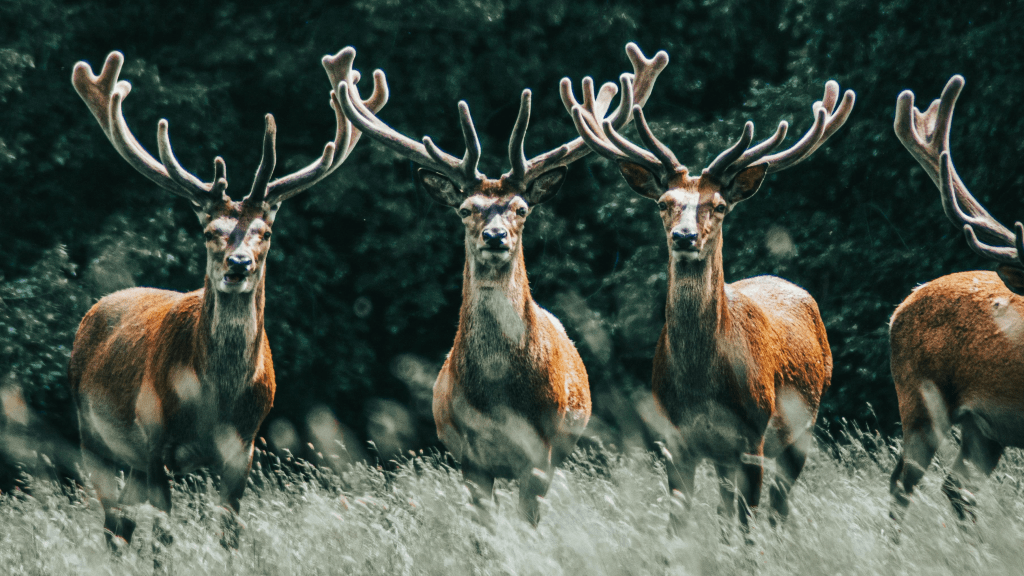
    Trump Jr. has repeated all of the usual arguments that are trotted out when questioned on his recreational interest in killing living creatures. When British gun manufacturer John Rigby & Company interviewed him during a deer-stalking trip in Oxfordshire, he obliged by rolling through them one by one. Rather than being a practice embedded in everyday rural existence, it is, for him, a holiday: “a great escape from some of the nonsense of the world” (qtd. in Brodie 2025). He is keen to describe shooting a roebuck with a broken leg as “the right thing to do,” a seeming act of mercy that helps the herd’s well-being (ibid.).

    His hunting partner, Rigby’s managing director Marc Newton, adds that heritage and a sense of historical connectiveness is also of apparent importance. “I can imagine our ancestors doing much the same thing,” Newton says, reaffirming the masculine power-dynamics of the culture by describing his own expedition with Trump Jr. as “three blokes out there spending time with one another” (ibid.). The most frequent defence of trophy hunting seeks to position the blood sport as an act of conservation and wilderness management. As Trump Jr. himself states, “we’ve hunted in the most pristine landscape today and it’s key that we conserve that for the future” (ibid.). His statement that “I’ve not been an angel but hunting has kept me out of a lot more trouble I’d have found myself in without it” speaks volumes to his beliefs concerning the psychological merits of firearm use and a recreational outlet for violence (ibid.).

    Image: A Herd of Deer, Lewis Ashton, Pexels, 2021.

    Even if one wishes to overcome the sizable ethical concern presented when justifying the pleasure and enjoyment found in the killing of a living creature, an over-whelming number of environmental scientists and organisations argue that corporatising conservation efforts and tying ecological management to tourism revenue and financially-motivated practices is entirely counter-productive. The repeated refrain that such trophy hunters are “killing them to save them,” is, in the minds of environmental law scholars such as Myanna Dellinger, entirely fallacious. “Doubt about the true conservation value, if any, of trophy hunting is still raised as a reason to continue the practice,” she writes, “this is turning the situation and applicable law on its head: when in doubt, we must – under the precautionary principle of law and for reasons of common sense – err on the side of saving the species” (2019: 59).

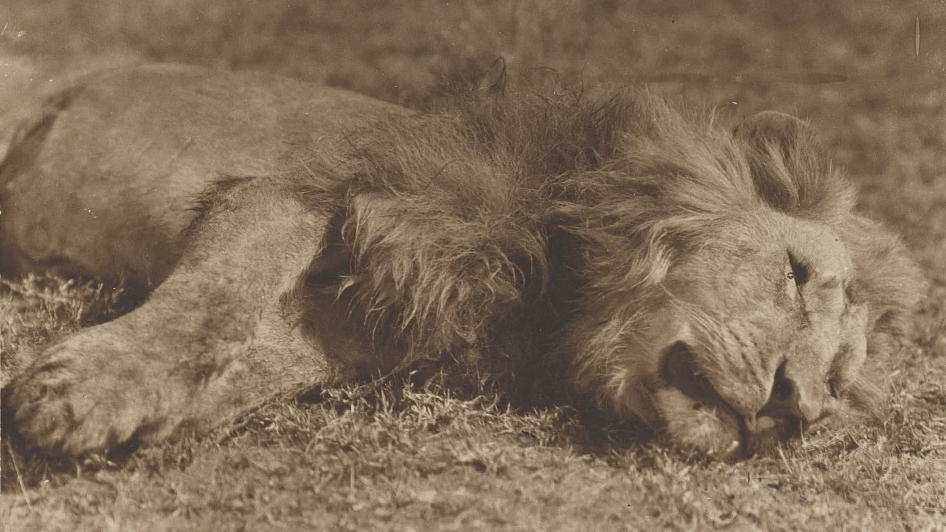
    Scandals continue to abound of the population decline of rare, high-value game, corruption in hunting governance, regulatory loopholes, and rampant illegal poaching due to a spiralling global marketplace for their remains. A report on trophy hunting from last year tallied that “in 2023 alone hunters took home over 25,000 bodies and body parts from 100 threatened species and an estimated 100,000 trophies were taken from all wild species” (Warner 2025). The killing of Cecil the lion in 2015, where the creature was illegally lured from a nature reserve, shot with a compound bow, and left critically injured for over ten hours before being killed, beheaded, and skinned, caused justified international outrage against the Minnesotan dentist who had reportedly paid $50,000 for the privilege (Kassam & Glenza 2015). Even so, in the decade that has followed, at least 10,000 more lions have been killed by similar acts of trophy hunting (Warner 2025).

    Image: Lion Shot by Kermit Roosevelt, Picryl: 1919.

    Here in the UK, the Animals (Low Welfare Activities Abroad) Act 2023 has been introduced to regulate the use of captive animals for entertainment tourism, but it is notable that the more expansive Animals Abroad Bill was blocked by prominent Conservative members Jacob Rees-Mogg and Mark Spencer (Dalton 2022). This Bill, which would have introduced measures to outlaw the import of hunting trophies, furs, and foie gras had been promised in the party’s 2019 manifesto, and was curtailed by the ministers for being, in their words, ‘un-Conservative’ (ibid.).

    The current Labour government has promised to introduce such legislation, but recent news reports that the U.S. Secretary of the Interior Doug Burgum has reached out to the UK’s Environment Secretary, Emma Reynolds, suggest direct attempts to hamper such efforts. Burgum reportedly expressed “concern about any bill that would crack down on trophy imports, arguing that trophy hunting benefits wildlife conservation and communities around the world” (Block 2026). It remains to be seen whether pressure from the US administration will restrict the UK’s animal welfare reform in the same manner that its wider policy has taken a sledgehammer to broader acts of international cooperation and global stability.

    Image: Jacob Rees-Mogg and Mark Spencer, Justin Tallis via Getty Images: 2022.

    Summarising increasing frustration with several European nations’ resistance to the ban of such imports, former president of Botswana, Ian Khama would state “with the decline of wildlife worldwide, and many species approaching extinction, all caused by man, how can there be justification in trophy hunting? How can any government say they are fighting poaching whilst allowing trophy hunting at the same time?” (qtd. in Millar 2024: 52). Kharma’s call for clarity and action is all the more remarkable considering the fact that 86% of the UK’s population reportedly supports the ban, rising to 92% of Conservative party voters, despite their ministerial attempts to block it (Millar 2024: 39).

    It might seem strange to attach such politically-charged and contentious debates to a film that derives its pleasures so obviously from pulse-pounding action. As Cary Wolfe notes of animal studies more generally in What is Posthumanism? (2010), “just because we direct our attention to the study of nonhuman animals, and even if we do so with the aim of exposing how they have been misunderstood and exploited, that does not mean that we are not continuing to be humanist – and therefore, by definition, anthropocentric” (2010: 99). The ideologically circumscribed Walt Disney Company is certainly ill-equipped in its capacity to disrupt such perspectives of the world.

    Image: Predator: Badlands, 20th Century Studios, 2025.

    Still, I would contend that Predator: Badlands is a welcome, if minor, distraction from the cultural and political drive towards self-interest and individual populism. It’s posthuman cast face problems similar to our own. Deliberately subjugated, Dek has been forced by his paternalistic clan to direct his anger against those in similar positions of subordination. Like him, our struggle requires us to reject the overwhelming number of voices that encourage us to embrace callous and fatalistic worldviews. Badlands’ representation of a world where action might be utilised to overthrow such perspectives provides much-needed catharsis.

    Head Image: Predator: Badlands, 20th Century Studios, 2025.

    Alien. 1979. D. Ridley Scott, Film, US: 20th Century Fox.

    Alien vs. Predator. 2004. D. Paul W. S. Anderson, Film, US: 20th Century Fox.

    Aliens vs. Predator: Requiem. 2007. D. The Brothers Strause, Film, US: 20th Century Fox.

    Block, Kitty. 2026. ‘Trophy Hunting Does Not Benefit Animals, No Matter What US Interior Secretary Claims,’ Humane World, February 3: https://www.humaneworld.org/en/blog/uk-trophy-hunting-trade-bill.

    Boyd, Brian. 2009. On the Origin of Stories: Evolution, Cognition, and Fiction. Cambridge: The Belknap Press of Harvard University Press.

    Brodie, Liz. 2025. ‘Donald Trump Jr. Tracks the Traditions of the Hunt,’ John Rigby & Co, July 31: https://www.johnrigbyandco.com/donald-trump-jr-tracks-the-traditions-of-the-hunt/.

    Coherent Market Insights. 2025. ‘Wildlife Tourism Market,’ in Market Research Report, March 25: https://www.coherentmarketinsights.com/market-insight/wildlife-hunting-tourism-market-4922.

    Dalton, Jane. 2022. ‘Jacob Rees-Mogg Refuses to Debate Why He ‘Blocked’ Bill That Would Have Spared Elephants from Torture,’ The Independent, June 10: https://www.independent.co.uk/news/uk/home-news/rees-mogg-bill-mark-spencer-elephants-ban-b2098382.html.

    Dellinger, Myanna. 2019. ‘Trophy Hunting – A Relic of the Past,’ Journal of Environmental Law & Litigation 34: 25-60.

    Die Hard. 1988. D. John McTiernan. Film, US: 20th Century Fox.

    Hemingway, Ernest. 1936 [2004]. Green Hills of Africa. London: Vintage.

    Kassam, Ashifa & Glenza, Jessica. 2015. ‘Killer of Cecil the Lion Was Dentist from Minnesota, Claim Zimbabwe Officials,’ The Guardian, July 28: https://www.theguardian.com/environment/2015/jul/28/killer-of-cecil-the-lion-was-american-zimbabwe-officials-claim.

    Kopnina, Helen. 2020. ‘Anthropocentrism and Post-humanism,’ The International Encyclopedia of Anthropology, ed. Hilary Callan. Chicester: John Wiley & Sons: 1-9.

    LRM. 2025. ‘Dimitrius Schuster-Koloamatangi is Not 7’3″ To Play Predator in Predator: Badlands,’ YouTube, November 9: https://www.youtube.com/shorts/AJL3_D1xaKY.

    Martin, Calvin. 1978. Keepers of the Game: Indian-Animal Relationships and the Fur Trade. Berkeley: University of California Press.

    Martin-Junquera, Imelda & Molina Moreno, Francisco. 2018. ‘Mythology and Ecocriticism: A Natural Encounter Introduction,’ Ecozon@, 9. 2: 1–7.

    Millar, Lydia. 2024. ‘In Memory of Cecil the Lion: An Analysis of Trophy Hunting, CITES and the Way Forward,’ UK Journal of Law 8.1: 38-52.

    Predator. 1987. D. John McTiernan. Film, US: 20th Century Fox.

    Predator 2. 1990. D. Stephen Hopkins. Film, US: 20th Century Fox.

    Predator: Badlands. 2025. D. Dan Trachtenberg, Film, US: 20th Century Studios.

    Predator: Killer of Killers. 2025. D. Dan Trachtenberg, Film, US: 20th Century Animation.

    Predators. 2010. D. Nimród Antal. Film, US: 20th Century Fox.

    Prey. 2022. D. Dan Trachtenberg, Film, US: 20th Century Studios.

    Stanford, Craig B. 1999. The Hunting Apes: Meat Eating and the Origins of Human Behaviour. Princeton: Princeton University Press.

    The Predator. 2018. D. Shane Black. Film, US: 20th Century Fox.

    Warner, Caitlin. 2025. “Biggest Ever Global Exposé of Trophy Hunting Industry,” Global Media Centre, June 30: https://www.globalmediacentre.com/news/biggest-ever-global-expose-trophy-hunting-industry.

    Wolfe, Cary. 2010. What is Posthumanism? Minneapolis: University of Minnesota Press.